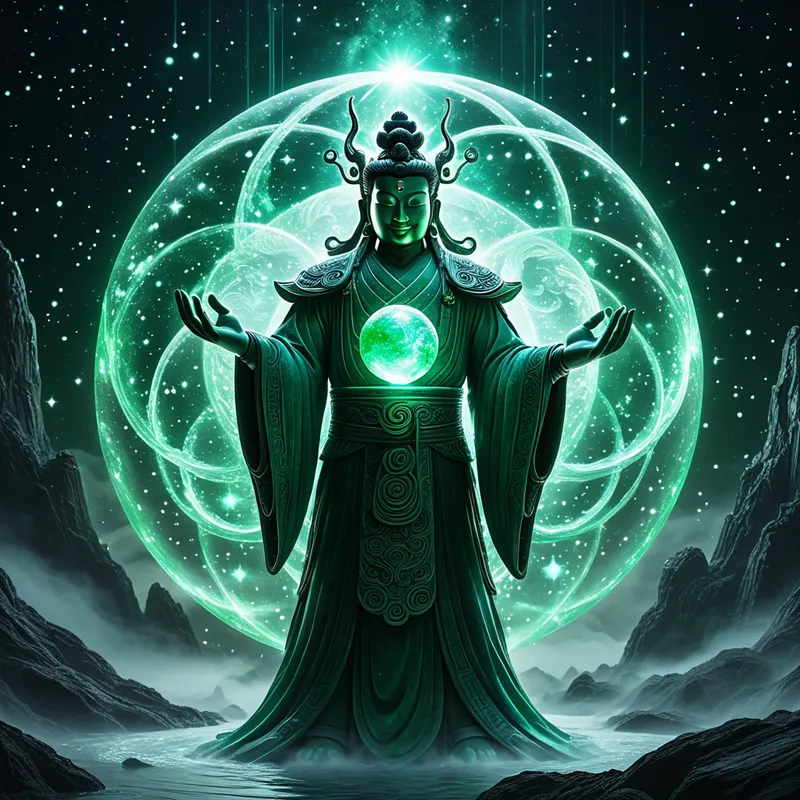
The Transformation of Chi Myth Meaning & Symbolism
A mythic tale of primordial energy's journey through chaos and form, revealing the alchemical process of refining raw potential into spiritual gold.
The Tale of The Transformation of Chi
In the time before time, there was only the Hundun. No sky pressed down, no earth held firm. No name existed to cleave one thing from another. There was only a breath, a pulse, a vast and pregnant silence. And within that silence, slept Chi.
Chi was not a god with a face, but the very possibility of face. It was the hum before the note, the warmth before the fire, the longing before the thought. It was pure, unbounded potential, dreaming of form. Yet its dream was a turbulent one, a swirling nebula of conflicting impulses—to rise and to sink, to scatter and to gather, to be and to not-be. This was the Great Agitation, a storm within the womb of silence.
From this inner tumult, a yearning crystallized. Chi dreamed of knowing itself, not as a chaotic whole, but through relationship, through the dance of distinct things. With a sigh that would become the first wind, it began to divide. The lighter, clearer, more active parts of itself strained upward, yearning for the heights. They became Yang—the spirit of mountain peaks, of eagle’s flight, of the sun’s piercing gaze. The heavier, denser, more receptive parts sank downward, embracing the depths. They became Yin—the essence of river valleys, of rooted stone, of the moon’s reflective grace.
But this was not a clean divorce. It was a birth, bloody and magnificent. Yang, in its fierce joy, shot upward too fast, threatening to tear itself apart into a million scattered sparks. Yin, in its profound gravitas, condensed too heavily, threatening to collapse into a single, inert point of nothingness. The dream of relationship teetered on the edge of becoming two separate nightmares: absolute dissipation and absolute stagnation.
Then, from the very tension between them, a third presence emerged. It was not a new division, but the child of their interaction—the Wanwu, the Ten Thousand Things. The first mountain rose because Yang pushed upward against the yielding resistance of Yin. The first river flowed because Yin carved a path through the firm guidance of Yang. Star, leaf, tiger, and tide—each was a unique melody played on the single instrument of their dynamic tension.
Chi had transformed. It was no longer the undifferentiated dreamer, but the breath within the dream. It was the vital force in the tiger’s pounce, the sap in the bamboo, the current in the stream, and the silence between thoughts. It had sacrificed its uniform, solitary nature to become the connective tissue of a living, breathing cosmos. The storm had found its rhythm in the eternal, swirling dance of the Taiji.

Cultural Origins & Context
This foundational narrative is not a single, codified myth from a sacred text, but the deep, underlying substrate of Taoist thought, woven into texts like the Daodejing and the Zhuangzi. It was passed down not merely by priests, but by poets, painters, and practitioners of Neidan. Its tellers were the sages who observed the natural world and saw in the turning seasons, the flow of water, and the cycle of day and night, the grand opera of Chi’s transformation.
Its societal function was profoundly pedagogical. It served as a cosmological map, explaining the origin and nature of a universe seen as an organic, interconnected whole. More importantly, it provided a model for human life. If the cosmos itself was born from the refinement and balancing of primordial energy, then the path to harmony—for a person, a community, or a kingdom—lay in understanding and aligning with this same transformative process. It grounded philosophy in the palpable reality of breath, movement, and the silent observation of nature’s way.
Symbolic Architecture
The myth presents a symbolic blueprint for the emergence of consciousness from the unconscious. The primordial Chi represents the undifferentiated totality of the psyche—the Self in its pure, potential state. The Great Agitation is the innate tension within that wholeness that compels it to know itself, which necessitates a movement into duality.
The birth of consciousness is a fall into distinction, a necessary fragmentation of the whole to create the mirrors in which it can behold itself.
Yang and Yin are the fundamental archetypal polarities: conscious and unconscious, logos and eros, assertion and receptivity, spirit and matter. Their peril—scattering versus collapse—symbolizes the psychological dangers of one-sided development: the inflated ego unmoored from instinct, or the inert psyche drowned in unconscious material.
The true alchemy, however, lies not in either pole, but in the sacred space between them. The Wanwu, the Ten Thousand Things, symbolize the rich, multifaceted personality that can only emerge from the conscious engagement and integration of these opposites. Every thought, emotion, talent, and relationship becomes a unique manifestation of this inner marriage.
The Dreamer’s Resonance
When this mythic pattern stirs in the modern dreamer, it often signals a profound somatic and psychological process of reorganization. One may dream of chaotic, overwhelming energies—turbulent waters, electrical storms, or dense, impenetrable fog. This is the dream-ego encountering the “Great Agitation” of its own unprocessed Chi, the raw material of a impending transformation.
Alternatively, dreams may present stark polarities: being torn between a soaring bird and a deep cave, or trying to unite hot and cold, light and dark substances. These are the psyche staging the drama of Yang and Yin. The somatic resonance can be felt as acute tension—a tightness in the chest, a knotted stomach, or a restless energy seeking outlet. The psychological process is one of holding the tension of opposites without prematurely identifying with one side or forcing a false resolution. The dreamer is in the crucible, and the psyche is working to find its new, more complex equilibrium.
Alchemical Translation
For the modern individual, the myth models the core of the individuation process: the transmutation of raw, often chaotic, life energy (Chi) into a refined, purposeful, and harmonious expression of the Self. Our unexamined impulses, inherited complexes, and buried potentials are the contemporary Hundun. The first, often painful, step is to allow this material to differentiate—to let the conflicting parts of ourselves be seen and named (the birth of inner polarity).
The work is not to eliminate tension, but to learn its dance; to become the space where opposing forces generate life, not conflict.
The alchemical practice is the daily, mindful engagement with these opposites. It is giving voice to the assertive drive (Yang) while also honoring the need for rest and reflection (Yin). It is applying conscious thought to intuitive hunches, and grounding spiritual insights in practical action. This conscious negotiation is the inner Neidan.
The triumph is not a final, static state of perfection, but the ongoing capacity to generate the “Ten Thousand Things”—the creative acts, the deep relationships, the unique contributions that are the offspring of our integrated being. We become, like the transformed Chi, no longer identified with the storm of our potential, but as the vital, connecting force that breathes through the artistry of our own lived experience, forever participating in the eternal transformation.
Associated Symbols
Explore related symbols from the CaleaDream lexicon: