The Tower of Babel (Genesis 11 Myth Meaning & Symbolism
A unified humanity builds a tower to reach heaven, provoking God to scatter them by confounding their single language into a multitude of tongues.
The Tale of The Tower of Babel (Genesis 11)
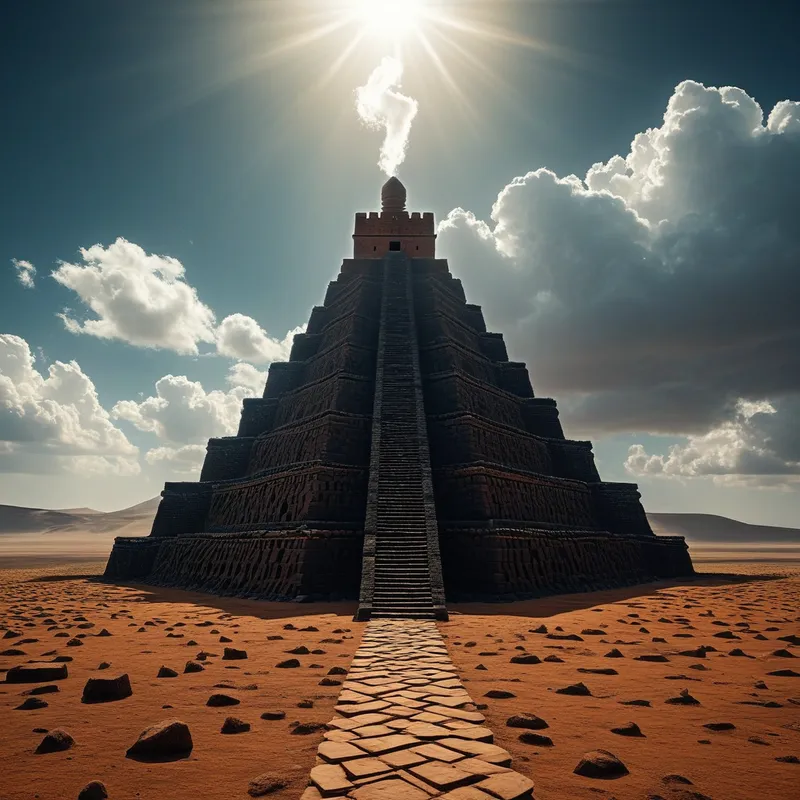
In the beginning, after the great waters had receded, the whole earth was of one language and one speech. And as people journeyed from the east, they found a plain in the land of Shinar, and they settled there. The soil was rich, [the sky](/myths/the-sky “Myth from Persian culture.”/) vast, and a single thought grew in their hearts, a thought spoken with one voice: “Let us make bricks, and burn them thoroughly.” And they had brick for stone, and slime for mortar.
Then [the word](/myths/the-word “Myth from Biblical culture.”/) passed among them, a whisper that became a roar, a shared dream that hardened into a command: “Come, let us build us a city and a tower, whose top may reach unto heaven; and let us make us a name, lest we be scattered abroad upon the face of the whole earth.”
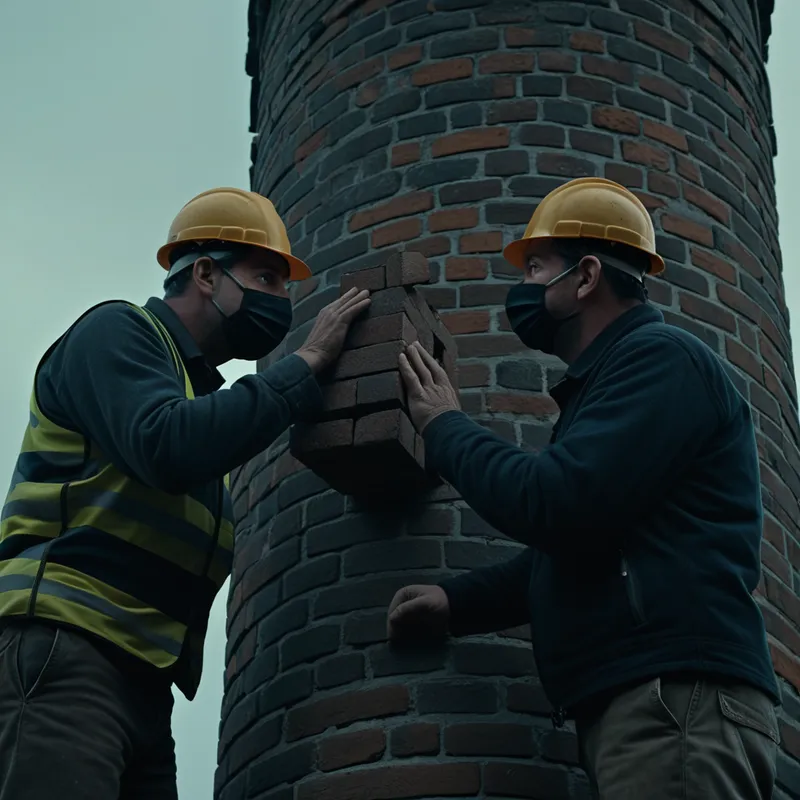
And so they toiled. A great hive of humanity, moving as one body. The kilns smoked day and night, baking the clay of the plain. The bitumen pits bubbled, offering their black glue. Stone upon stone, course upon course, the structure rose—a monstrous [ziggurat](/myths/ziggurat “Myth from Mesopotamian culture.”/), a stairway not for gods to descend, but for mortals to ascend. Its shadow grew long across the land, a testament to their unity, their strength, their defiance of the very horizon. The sound was a single, pounding rhythm: the slap of mud, the scrape of brick, the unified chant of a thousand throats. They would pierce the vault of the firmament. They would sit among the stars. They would be as gods.
But Yahweh came down to see the city and [the tower](/myths/the-tower “Myth from Tarot culture.”/) which the children of men had built. And the Creator did not see a marvel of cooperation, but a seed of ultimate tyranny. The Lord said, “Behold, the people are one, and they have all one language; and this they begin to do: and now nothing will be restrained from them, which they have imagined to do.”
And in that moment, a wind not of [the earth](/myths/the-earth “Myth from Hindu culture.”/) swept across the plain of Shinar. It was a wind of divine breath, a confounding spirit. Yahweh said, “Let us go down, and there confound their language, that they may not understand one another’s speech.”
The change was not violent, but it was absolute. A builder called for mortar, and the word that left his lips was a guttural, alien bark to the man beside him. An architect pointed to a flaw in the design, and his urgent explanation was a stream of melodic, meaningless syllables. The great, unified rhythm shattered into a cacophony of panic. Gestures became frantic, faces contorted in the effort to be understood, but the bridge of shared meaning had collapsed. The word “brick” was now a hundred different sounds. The plan was lost. The common purpose dissolved into a Babel of confusion.
So Yahweh scattered them abroad from thence upon the face of all the earth: and they left off to build the city. Therefore is the name of it called Babel; because the Lord did there confound the language of all the earth. The tower stood unfinished, a silent, crumbling monument to a shattered unity, as humanity streamed away in disparate tribes, carrying their new, lonely tongues to the corners of [the world](/myths/the-world “Myth from Tarot culture.”/).
Cultural Origins & Context
This myth is embedded in the Book of Genesis, a foundational text of the Abrahamic traditions. Its setting, the land of Shinar, is a direct [reference](/myths/reference “Myth from Global/Universal culture.”/) to ancient Mesopotamia, the cradle of urbanization and the very real, massive ziggurats—temple towers like the Etemenanki of Babylon—that sought to bridge earth and heaven. The story functions as an etiological narrative, explaining the profound human reality of linguistic and cultural diversity. For a nomadic or early tribal society defining itself against the grand, imperial city-states of Mesopotamia, the tale served as a powerful critique of centralized urban hubris and imperial ambition. It was passed down orally and later codified by priestly scribes, not merely as history, but as theology: a reminder that human ambition, when untethered from divine order, contains the seeds of its own dissolution. It places the origin of fragmentation not in a natural drift, but in a divine act—a purposeful introduction of creative chaos to prevent a monolithic, and thus potentially tyrannical, human totality.
Symbolic Architecture
The [Tower](/symbols/tower “Symbol: The tower symbolizes protection, aspirations, and isolation, representing both stability and the longing for higher achievement.”/) is the central [symbol](/symbols/symbol “Symbol: A symbol can represent an idea, concept, or belief, serving as a powerful tool for communication and understanding.”/), and it is not merely a building. It is the embodied will to power of the undifferentiated collective. It represents [the ego](/myths/the-ego “Myth from Jungian culture.”/)’s [inflation](/symbols/inflation “Symbol: A dream symbol representing feelings of diminishing value, loss of control, or expansion beyond sustainable limits in one’s life or psyche.”/), the attempt to storm [heaven](/symbols/heaven “Symbol: A symbolic journey toward ultimate fulfillment, spiritual transcendence, or connection with the divine, often representing life’s highest aspirations.”/) by sheer force of will and technical prowess, to “make a name” for oneself in perpetuity, rendering God—or the unconscious Self—obsolete.
The Tower is the ultimate symbol of the ego’s fortress, built from the bricks of logic and the mortar of collective agreement, seeking to replace the mystery of the heavens with the certainty of its own summit.
The “one [language](/symbols/language “Symbol: Language symbolizes communication, understanding, and the complexities of expressing thoughts and emotions.”/)” is equally symbolic. It is not just linguistic unity, but a state of psychic uniformity, where critical thought, dissent, and individuality are subsumed by a totalizing consensus. It is the language of the [mass](/symbols/mass “Symbol: Mass often symbolizes a gathering or collective experience, representing shared beliefs, burdens, or the weight of emotions within a community.”/), the ideology, the unquestioned dogma. The divine “confounding” is, therefore, not a [punishment](/symbols/punishment “Symbol: A dream symbol representing consequences for actions, often tied to guilt, societal rules, or internal moral conflicts.”/) in the simplistic sense, but a necessary deus ex machina of the [psyche](/myths/psyche “Myth from Greek culture.”/). It is the [eruption](/symbols/eruption “Symbol: A sudden, violent release of pent-up energy or emotion from beneath the surface, often representing transformation or crisis.”/) of the unconscious (the “God” within) to shatter a dangerous, sterile perfection. The resulting multiplicity of tongues symbolizes the [birth](/symbols/birth “Symbol: Birth symbolizes new beginnings, transformation, and the potential for growth and development.”/) of individual [consciousness](/symbols/consciousness “Symbol: Consciousness represents the state of awareness and perception, encompassing thoughts, feelings, and experiences.”/), [differentiation](/symbols/differentiation “Symbol: The process of distinguishing or separating parts of the self, emotions, or identity from a whole, often marking a developmental or psychological milestone.”/), and the often-frustrating but vital necessity of [translation](/symbols/translation “Symbol: The process of converting meaning from one form or language to another, representing communication, adaptation, and the bridging of differences.”/)—between people, within oneself, between the ego and the deeper layers of the [soul](/symbols/soul “Symbol: The soul represents the essence of a person, encompassing their spirit, identity, and connection to the universe.”/).
The Dreamer’s Resonance
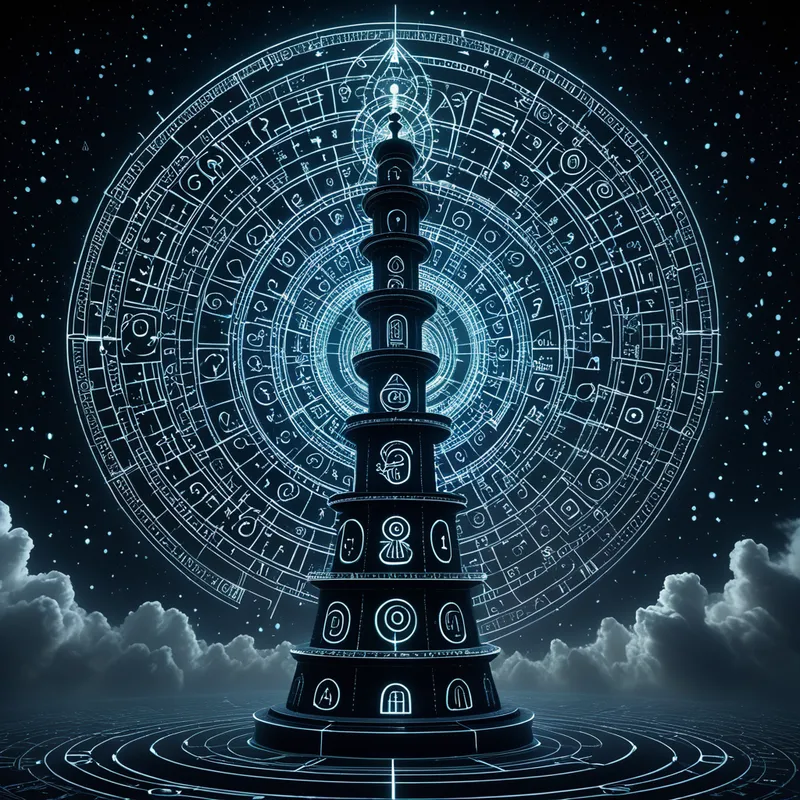
To dream of [the Tower of Babel](/myths/the-tower-of-babel “Myth from Global/Universal culture.”/) is to experience the somatic shock of failed communication and collapsing unity. The dreamer may find themselves in a vast, impersonal project—a corporate office, a endless construction site—where suddenly, no one understands their instructions or their cries for help. The dream language may literally become gibberish, or familiar faces may speak in alien tongues.
This is the psyche signaling a critical juncture. The dreamer is likely invested in a “Tower” in their waking life: a rigid career path, a monolithic relationship dynamic, a grandiose self-image, or a ideological system that promises total explanation. The Babel event in the dream marks the point where this structure is becoming psychically unsustainable. The confusion and scattering felt in the dream body—the anxiety, the isolation—are the birth pangs of a necessary fragmentation. The old, unified but illusory self-conception is breaking down so that a more complex, differentiated, and authentic identity can eventually emerge. It is a terrifying but ultimately creative disintegration.

Alchemical Translation
The alchemical journey mirrored in Babel is the [Nigredo](/myths/nigredo “Myth from Alchemical culture.”/), the essential first step of putrefaction and separation. The conscious project of the ego (the Tower) must be dissolved by the unconscious (the divine intervention) for true individuation to begin.
The process starts with the [prima materia](/myths/prima-materia “Myth from Alchemical culture.”/) of undifferentiated unity—the “one language” of conformity, of living solely through collective expectations. The building of the Tower is the ego’s attempt to coagulate this material into a permanent, glorious form. The alchemical fire, however, is not in the kilns baking bricks, but in the divine breath that confounds. This fire brings the [Solutio](/myths/solutio “Myth from Alchemical culture.”/), the flooding that dissolves the rigid structure.
The fall of Babel is not a defeat, but the necessary shattering of the vessel so that the gold of individual consciousness can be separated from the dross of collective inflation.
The “scattering abroad” represents the stage of [separatio](/myths/separatio “Myth from Alchemical culture.”/). The formerly unified elements—the different aspects of [the self](/myths/the-self “Myth from Jungian culture.”/), the conflicting desires, the unique voice—are now distinct and must be acknowledged. The long, often lonely journey to the “ends of the earth” is the beginning of true self-discovery. One must learn the unique language of their own soul, which feels foreign at first. The ultimate goal is not to rebuild the Tower, nor to return to the ignorant unity of the plain, but to achieve a complex unity—a Unio Mentalis—where the many internal “tongues” (the thinker, the feeler, the intuitor, the sensor) can communicate and cooperate, not through enforced sameness, but through hard-won understanding and integration. We are forever post-Babel, tasked with the eternal alchemy of translation, both within and without.
Associated Symbols
Explore related symbols from the CaleaDream lexicon: