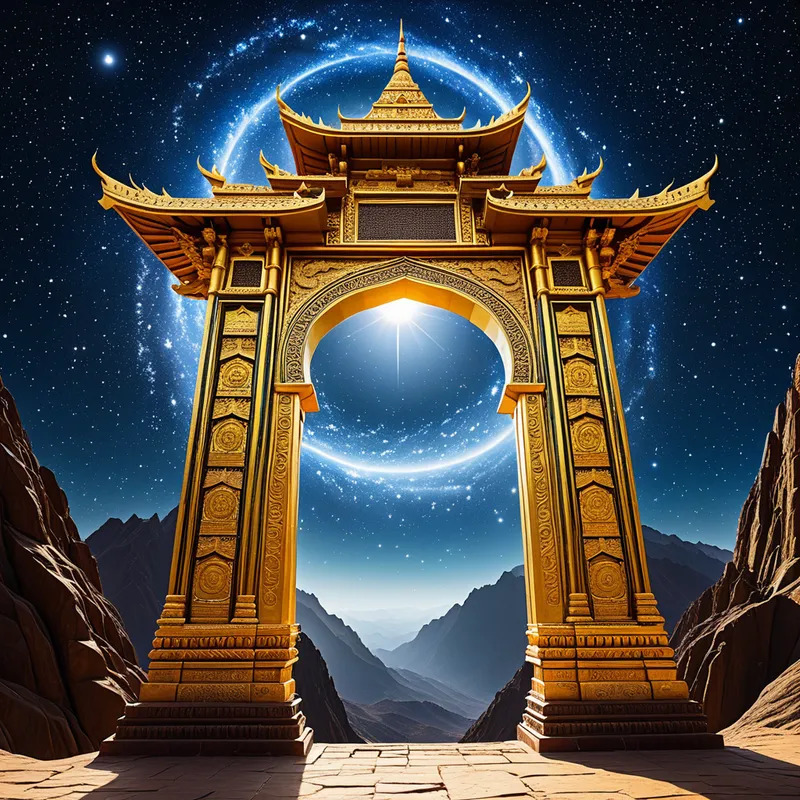
The Torana Myth Meaning & Symbolism
A myth of a celestial gateway forged from divine conflict, serving as the ultimate threshold between the human world and the realm of the gods.
The Tale of The Torana
Listen, and hear of the forging of the boundary between worlds.
The cosmos was young, its layers still whispering to one another. The realm of the gods, Svarga, shone with an unbearable light, a symphony of perfection that echoed through the void. The earthly realm, Bhuloka, lay below—a tapestry of mud and miracle, of fragrant earth and suffering hearts. Between them was only a trembling veil of atmosphere, a permeable membrane through which aspirations rose like incense and divine grace occasionally seeped like rain.
This permeability became a crisis. For the Asuras, beings of formidable power and ambition, learned to scale the ladder of their own tapas—the inner fire of austerity—to storm the gates of heaven itself. They would arrive, not as petitioners, but as conquerors, their chaos threatening the very order of Dharma. The Devas would marshal their armies, and the skies would crack with the sound of divine weapons, the earth trembling from the fallout of celestial war. The peace of both worlds was shattered again and again.
The great preserver, Vishnu, whose eyes see the turning of all ages, perceived the flaw in the design. A world without a true threshold is a house without a door—it offers neither sanctuary nor true entry. He summoned the divine architect, Vishvakarma, master of all form and substance.
“Father of Making,” spoke Vishnu, his voice the sound of deep space. “We must craft a limit that is not a barrier, but a definition. A gateway that does not deny, but clarifies. It must be so sublime that only the essence of righteousness, the weight of true merit, can pass its arch. It must be forged from the very substance of consequence.”
Vishvakarma bowed. He journeyed to the core of cosmic causality, to the place where the first law of creation still resonated. There, he gathered the laughter of the stars, the patience of mountains, the memory of the first dawn, and the unyielding truth of mathematical perfection. Upon the anvil of eternity, with hammers that struck the frequency of being itself, he began his work.
The forging was not a act of violence, but of supreme concentration. Each curve of the arch was a sentence in the grammar of reality. Each carving on its pillars—lotuses, elephants, Apsaras, Yalis—was a story of the universe’s potential. The lintel was inscribed with the silent mantra of transition. When it was complete, the Torana did not merely stand; it manifested, erupting into existence at the summit of Mount Meru, the axis of all realms.
It was not a door to be opened or closed. It was a condition to be met. The next time the Asuras, swollen with power and pride, stormed the heavens, they did not find an army. They found a silent, glorious arch. They charged through it—and found themselves instantly, gently, returned to the foot of the mountain, their aggressive intent nullified, their path erased. A being of pure devotion, however, a sage whose heart was a single flame of love, could approach and find the gateway offering no resistance, the realms on either side becoming one in their perception.
The Torana stood. It did not fight. It simply was. And in its eternal presence, the worlds learned their places, not as prisons, but as chambers in the great palace of existence, each with its own dignity, each with its proper door.

Cultural Origins & Context
The concept of the Torana is deeply embedded in the architectural and spiritual DNA of the Indian subcontinent. While not the subject of a single, canonical Puranic epic like the Ramayana, its mythic idea is woven into the fabric of Dharma and temple cosmology. Its story is told in fragments—in the architectural treatises like the Vastu Shastras, in the symbolic explanations given by temple priests, and in the oral traditions surrounding the construction of great stupas and temple gateways.
Historically, the tangible Torana evolved from ceremonial wooden archways used in festivals and processions, eventually becoming the monumental stone and brick gateways (Toranas) of Buddhist stupas (like Sanchi) and the towering Gopurams of South Indian Hindu temples. These were not merely entrances; they were symbolic reifications of the mythic threshold. Their societal function was profound: to mark the transition from the profane, worldly space (Samsara) to the sacred, ordered space of the temple (Mandira). Passing under the Torana was an act of leaving one state of consciousness and preparing for another—a physical ritual echoing the metaphysical myth.
Symbolic Architecture
The Torana is the archetype of the limen, the sacred threshold. It is the ultimate symbol of the principle that transformation requires a defined passage, not a vague blending.
The gateway does not exist to keep worlds apart, but to make crossing meaningful. It is the form given to the moment of decision, the architecture of initiation.
Psychologically, it represents the structure of the ego-Self axis. The earthly realm (Bhuloka) is the domain of the conscious ego with its desires, fears, and identities. The celestial realm (Svarga) symbolizes the Self—the total, integrated psyche, the seat of wholeness and divine connection. The permeable chaos before the Torana’s construction mirrors the neurotic state where unconscious contents (the Asuras of our shadow) can erupt uncontrollably into consciousness, and where ego-inflation can lead to a misguided “storming of heaven.” The Torana represents the development of a conscious relationship between these realms—a structured channel, like the disciplined practice of meditation, analysis, or ritual, through which communication and integration can safely occur.
Its forged nature, the work of Vishvakarma, tells us this threshold is not found, but built. It is constructed from the “substance of consequence”—our lived experiences, our insights, our earned wisdom. The carvings upon it are the complexes, archetypal images, and personal myths that decorate our psyche’s structure.
The Dreamer’s Resonance
When a Torana appears in a modern dream, it signals a profound somatic and psychological process: the dreamer is at a critical existential threshold. The body may feel it as a tension at the solar plexus, a tightening in the chest, or a feeling of vertigo—the somatic signature of standing at a precipice of change.
The condition of the Torana is diagnostic. A crumbling, overgrown Torana suggests a neglected inner process; the pathway to the Self is obscured, and the dreamer may feel stuck, unable to progress in their individuation. A shining, resplendent Torana that feels inviting indicates the ego is aligned, prepared for a conscious engagement with deeper layers of the psyche. A Torana that is barred, guarded, or leads into darkness reflects the dreamer’s fear of what lies beyond their current identity—the shadowlands they must consent to enter.
The crucial action in the dream is not always passing through. Sometimes, the entire work is in approaching it, studying its carvings (the symbols of one’s own psyche), or cleaning its stones. The dream Torana asks: “What are you carrying? What intention, what quality of being, are you bringing to this transition?” If the dreamer attempts to bull through with willpower (the Asura method), they will find themselves back at the beginning. The passage demands integration, not force.

Alchemical Translation
The alchemical process mirrored in the Torana myth is that of coagulatio—the giving of fixed, enduring form to the spiritual. It is the stage where the insights from the solutio (the dissolution of old ego structures) must be shaped into a new, stable vessel for consciousness.
Individuation is not an endless, formless merging. It is the successive construction of more capacious and refined forms—psychic Toranas—that can contain greater voltages of reality.
The modern individual’s “celestial conflict” is the internal civil war between aspects of the self: ambition versus contentment, intellect versus intuition, persona versus shadow. The “permeable membrane” is a life without boundaries, where work spills into home, trauma spills into relationships, and the unconscious spills into neurosis. The crisis demands a Vishvakarma moment—the conscious, creative act of the ego in service of the Self.
We must become our own divine architects. We forge our Torana from the “substance of consequence”: the hard-won lessons from our failures (the metal), the beauty of our creative acts (the carvings), and the unwavering commitment to our own truth (the architectural plan). We erect it at the boundary of our old self and our emerging self. This psychic structure—which could be a sustained meditation practice, a commitment to therapy, an artistic discipline, or a moral code—allows for sacred passage. It filters out the “Asuric” impulses of raw, unintegrated power and grandiosity, while allowing the “sage” within, the essence of our authentic being, to pass freely toward wholeness.
Thus, the myth teaches that freedom is not the absence of gates, but the wisdom to build them rightly. Our ultimate sanctuary and our greatest potential are found not by demolishing all thresholds, but by crafting the one true gate through which only our most essential self may pass.
Associated Symbols
Explore related symbols from the CaleaDream lexicon: