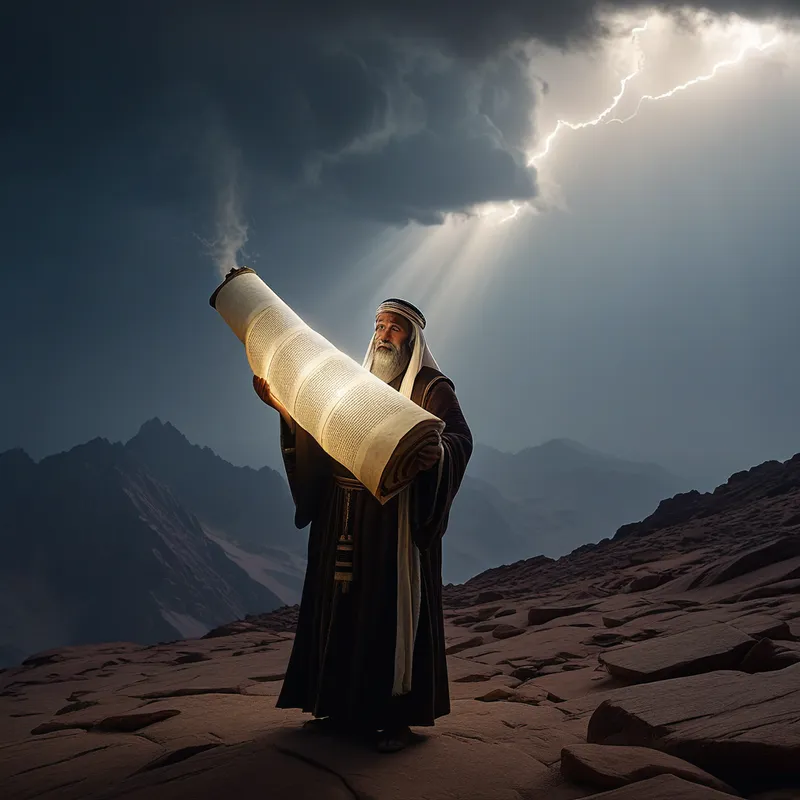
The Torah Scroll Myth Meaning & Symbolism
The myth of a sacred scroll containing divine law, given to a prophet on a mountain, forging an eternal covenant between a people and their God.
The Tale of The Torah Scroll
Listen. There is a mountain that scrapes the belly of heaven, a place where the air is thin with holiness and the rocks remember fire. Its name is Sinai. For forty days and forty nights, a veil of thundercloud has wrapped its peak, and within that tempest, a conversation is happening. It is not a conversation of words as we know them, but of lightning shaping law, of silence birthing commandment.
Below, a people wait. They are a multitude forged in the kiln of bondage, newly freed but still carrying the dust of pyramids in their souls. They are a body without a spine, a story without a central thread. They look up at the shrouded mountain and tremble, for the sound that rolls down its slopes is the voice of the YHWH, a sound that unmakes and remakes the listener.
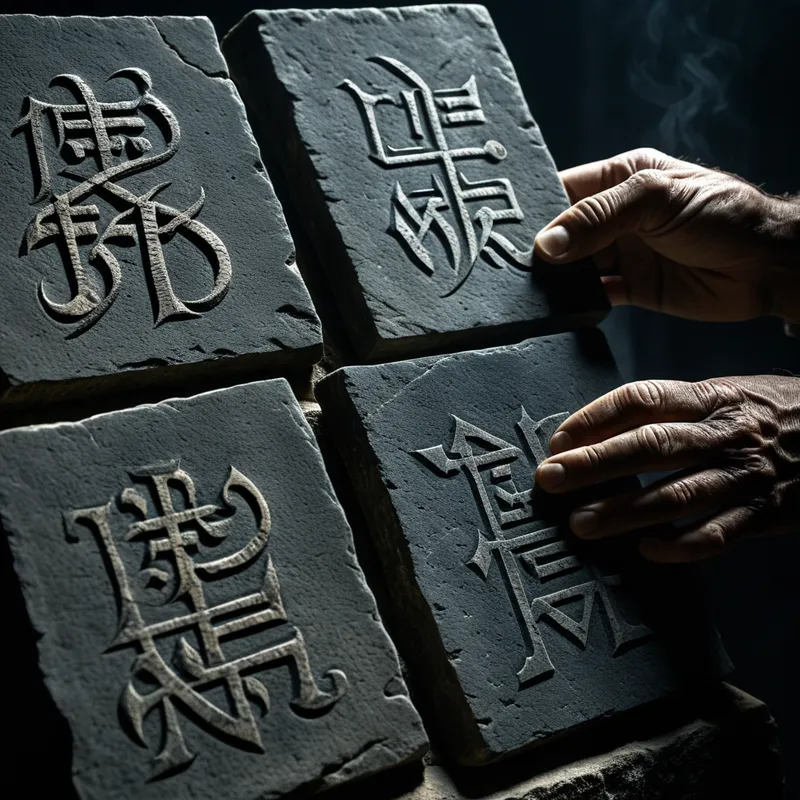
Upon [the summit](/myths/the-summit “Myth from Taoist culture.”/), in the eye of the storm, stands a man. [Moses](/myths/moses “Myth from Biblical culture.”/). His face is turned away, for no mortal can look upon the Source and live. Yet he listens. He becomes a vessel, a hollow reed through which the breath of the divine flows. And what flows is not merely instruction, but architecture—the blueprint for a cosmos in miniature, a society woven from [justice](/myths/justice “Myth from Tarot culture.”/), memory, and sacred time. This architecture is inscribed. First, by the finger of God itself, onto tablets of mountain stone—letters of living fire that sink into the rock, making it not a record, but a living fragment of the encounter.
But the story twists. While the covenant is being written in fire above, the people below, lost in the silence of absence, fashion a god of their own. From the gold of their ears, they pour a calf, a symbol of familiar, tangible power. The shattering echo you hear is not just thunder; it is the sound of the first tablets breaking on the rocks, the sound of a promise fractured by fear.
Yet the conversation is not over. Moses returns to the terrifying intimacy of the summit. He pleads not for himself, but for the soul of the people. And the Voice responds. New tablets are hewn, this time by human hands—a collaboration. The divine fire writes once more. But this time, it is accompanied by a further revelation, a vast and detailed tapestry of law, story, genealogy, and song. This is the Torah, given to Moses to teach.
He descends, his face shining with a reflected light so potent he must veil it. What he carries is no mere book. It is a Sefer Torah, a scroll of parchment, but within it lives the whispered conversation of the mountain. It is placed in an ark, a traveling throne for this portable fragment of heaven. The people are no longer just a multitude; they are a people of the Book, their story now bound to the story of the cosmos, their law a mirror of celestial order. The scroll becomes their compass in [the wilderness](/myths/the-wilderness “Myth from Biblical culture.”/), their constitution, their living memory. It is [the word](/myths/the-word “Myth from Biblical culture.”/) made abode, and the abode is their very identity.
Cultural Origins & Context
The myth of the [Torah Scroll](/myths/torah-scroll “Myth from Jewish culture.”/) is the foundational narrative of Judaism, and through it, a cornerstone of Western consciousness. Its origins are in the ancient Near East, a world of empires and covenants, but it performs a radical inversion. Here, the covenant is not between a king and a god for the benefit of a palace, but between a deity and an entire people, mediated by a prophet, not a monarch.
It was passed down orally for generations before being woven into the written texts we now know as the Tanakh. It was told at pilgrim festivals, recited in homes, and meticulously copied by scribes whose sacred duty was to preserve every letter. Its societal function was multifaceted: it was a legal corpus, a historical charter justifying [the Israelites](/myths/the-israelites “Myth from Abrahamic culture.”/)’ claim to land and identity, a theodicy explaining their suffering, and above all, a means of maintaining a unique, portable culture in exile. It answered the existential question: “Who are we, and what does the divine require of us?” The Scroll was the tangible answer.
Symbolic Architecture
The [Torah Scroll](/symbols/torah-scroll “Symbol: A sacred Jewish text representing divine law, wisdom, and covenant between God and humanity.”/) is not a container of [information](/symbols/information “Symbol: Information signifies knowledge, communication, and the processing of facts or insights.”/), but a symbolic organism. The [mountain](/symbols/mountain “Symbol: Mountains often symbolize challenges, aspirations, and the journey toward self-discovery and enlightenment.”/) represents the [axis](/symbols/axis “Symbol: A central line or principle around which things revolve, representing stability, orientation, and the fundamental structure of reality or consciousness.”/) mundi, the point where the vertical [dimension](/symbols/dimension “Symbol: Represents the fundamental structure of reality, consciousness, or existence beyond ordinary perception.”/) of the transcendent (divine law) pierces the horizontal [plane](/symbols/plane “Symbol: Dreaming of a plane often symbolizes a desire for freedom, adventure, and new possibilities, as well as transitions in life.”/) of [human](/symbols/human “Symbol: The symbol of a human represents individuality, complexity of emotions, and social relationships.”/) [history](/symbols/history “Symbol: History in dreams often represents the dreamer’s past experiences, lessons learned, or unresolved issues that continue to influence their present.”/) and society. Moses is the archetypal [mediator](/symbols/mediator “Symbol: A figure who resolves conflicts between opposing parties, representing balance, communication, and the integration of differences.”/), the [human](/symbols/human “Symbol: The symbol of a human represents individuality, complexity of emotions, and social relationships.”/) who can navigate the terrifying gap between the absolute and the relative.
The breaking of the first tablets is not a mere setback; it is a profound psychological [truth](/symbols/truth “Symbol: Truth represents authenticity, honesty, and the quest for knowledge beyond mere appearances.”/). The first, perfect, divine [revelation](/symbols/revelation “Symbol: A sudden, profound disclosure of truth or insight, often through artistic or musical means, that transforms understanding.”/) is impossible for unaided humanity to hold. It must be shattered by the [reality](/symbols/reality “Symbol: Reality signifies the state of existence and perception, often reflecting one’s understanding of truth and life experiences.”/) of human frailty ([the Golden Calf](/myths/the-golden-calf “Myth from Biblical culture.”/)) so that it can be rebuilt in a collaborative process—humanly hewn [stone](/symbols/stone “Symbol: In dreams, a stone often symbolizes strength, stability, and permanence, but it may also represent emotional burdens or obstacles that need to be acknowledged and processed.”/) receiving divine fire. This is the essence of [the covenant](/symbols/the-covenant “Symbol: A sacred, binding agreement between parties, often with divine or societal significance, representing commitment, obligation, and mutual responsibility.”/): a partnership.
The law is not imposed from without as a cage, but offered as a skeleton from within which a sacred life can grow.
The scroll itself is a profound [symbol](/symbols/symbol “Symbol: A symbol can represent an idea, concept, or belief, serving as a powerful tool for communication and understanding.”/). Its parchment, made from animal [skin](/symbols/skin “Symbol: Skin symbolizes the boundary between the self and the world, representing identity, protection, and vulnerability.”/), signifies the incarnation of [spirit](/symbols/spirit “Symbol: Spirit symbolizes the essence of life, vitality, and the spiritual journey of the individual.”/) into matter. The ink is black fire on white fire, a tradition says, representing the interplay of revelation and [mystery](/symbols/mystery “Symbol: An enigmatic, unresolved element that invites curiosity and exploration, often representing the unknown or hidden aspects of existence.”/), the said and the unsaid. It is kept in an Aron Kodesh, representing the human [heart](/symbols/heart “Symbol: The heart symbolizes love, emotion, and the core of one’s existence, representing deep connections with others and self.”/) or mind as the sanctuary for divine wisdom. To read it is not to study history, but to re-stand at Sinai, to re-enter the [conversation](/symbols/conversation “Symbol: A conversation in a dream often symbolizes the need for communication and understanding, both with oneself and others.”/).
The Dreamer’s Resonance
When [the Torah](/myths/the-torah “Myth from Jewish culture.”/) Scroll appears in a modern dream, it rarely manifests as a literal religious object. It may appear as an ancient, indecipherable manuscript; a column of glowing text on a computer screen; a voice dictating immutable rules; or a heavy, ornate box one is compelled to carry.
This dream signals a profound process in the [psyche](/myths/psyche “Myth from Greek culture.”/): the encounter with the Self as the inner lawgiver. The dreamer is likely grappling with a need for foundational structure, ethical boundaries, or a reconnection with their own deepest values and origins. The somatic feeling is often one of weight, awe, or trembling responsibility—the “Moses on the mountain” sensation. If the scroll is damaged or unreadable, it may reflect a crisis of meaning or a feeling that one’s internal compass (the “law”) is broken or inaccessible. The dream calls the dreamer to their own personal Sinai, to listen for the foundational voice beneath the chaos of daily life.

Alchemical Translation
The alchemical journey modeled by this myth is the process of individuation through sacred structure. The initial state is the “Egypt” of the psyche—a bondage to unconscious impulses, collective norms, or material idols (the [Golden Calf](/myths/golden-calf “Myth from Biblical culture.”/)). The “exodus” is the painful but liberating journey into the wilderness of self-questioning.
The climax is the ascent to the inner mountain, the confrontation with the transpersonal, ordering principle of [the Self](/myths/the-self “Myth from Jungian culture.”/). This is not a gentle experience; it is a terrifying dissolution of old, ego-based structures. The “shattering of the tablets” is the necessary death of naive, idealized notions of perfection or rigid, externally imposed rules.
The true law is revealed not in its first, perfect form, but in its second, resilient form—the one that survives the shattering.
The alchemical gold is the creation of the personal “Torah Scroll.” This is the opus, the life’s work: the conscious, painstaking integration of this inner law (one’s unique destiny, ethics, and authentic nature) into the fabric of one’s daily life. The scribe is [the ego](/myths/the-ego “Myth from Jungian culture.”/), in service to the Self. To “write your Torah” is to incarnate your deepest truth with such care that it becomes a living document, a guide for your journey, and a testament that can, in turn, provide structure and meaning for the community of your own soul. [The veil](/myths/the-veil “Myth from Various culture.”/) Moses wears reminds us that this integrated wisdom often shines with a light that must be mediated with humility, a sacred offering to [the world](/myths/the-world “Myth from Tarot culture.”/), not a blinding proclamation.
Associated Symbols
Explore related symbols from the CaleaDream lexicon: