The Torah as Cosmic Code Myth Meaning & Symbolism
An ancient teaching that the Torah is not merely a text, but a living, divine code from which all reality is woven and sustained.
The Tale of The Torah as Cosmic Code
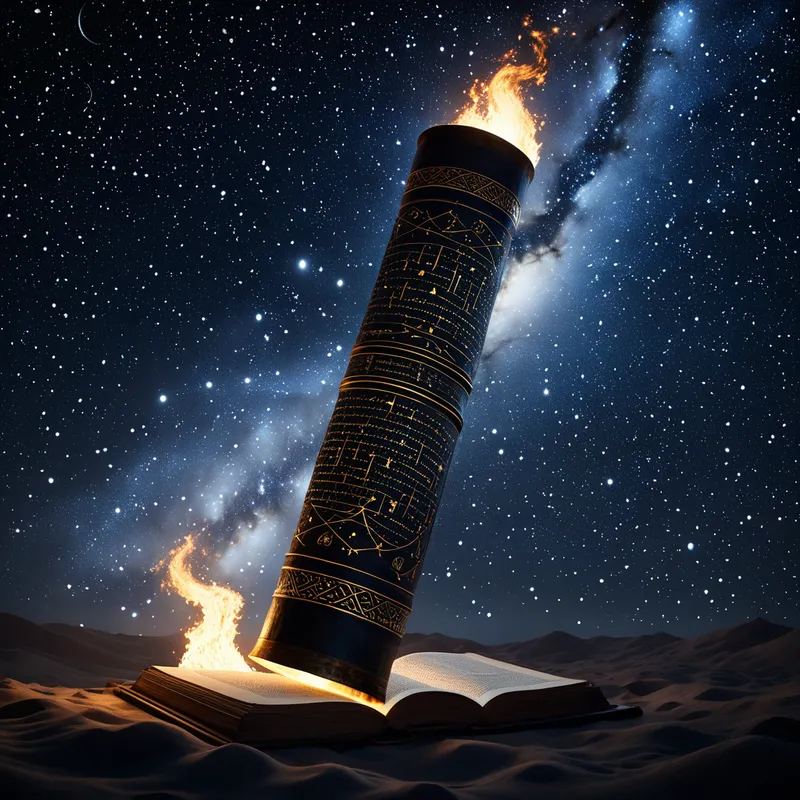
Before the world was, there was the Word. But not a word spoken into a void. It was a Word written in a script of black fire upon a parchment of white fire, a scroll of pure potentiality that was the very essence of the Divine Mind. This was the primordial Torah, not a book of laws, but the blueprint of all that could ever be.
In the infinite stillness before time, the Shekhinah, the Divine Presence, contemplated this scroll. Its letters were not static shapes but living vortices of intention, each one a vessel containing worlds of meaning, sound, and force. The letter Aleph, silent and breath-like, held the secret of the first breath of creation. The letter Bet, with its three closed sides, was the architectural plan for all houses, all structures, all contained universes. Together, in infinite combinations, they sang the song of what would become.
Then came the great contraction, the Tzimtzum. To make room for a world, the Infinite Light withdrew, and into that vacated space, the letters of the Torah began to descend. They cascaded from the realm of pure thought into the realm of formation, not as ink on parchment, but as the fundamental code of reality. The specific sequence of these letters drew down divine energy, channeling it into the vessels of creation: the swirling nebulae, the orbits of planets, the double helix of life, the beating of a human heart. Every leaf, every stone, every soul was a unique permutation of this divine syntax.
But the descent was perilous. As the letters fell through the Sefirot, the vessels of divine attributes, some could not contain the intensity of the light they carried. They shattered. This was the <abbr title="The "Shattering of the Vessels," a Kabbalistic myth of a cosmic catastrophe during creation">Shevirat HaKelim. Fragments of the holy letters, sparks of the primordial light, were scattered and trapped within the husks of the broken vessels, buried in the very fabric of the material world. The perfect code was now encrypted within a fractured reality, its luminous truth hidden beneath the surface of things.
And so, the cosmic drama was set. The physical Torah given at Sinai—the scroll we can read and touch—became the map to the hidden, primordial one. It is the interface. The sages say that when a true student chants its words with proper intention, when they ponder the crown of a letter or the space between words, they are not merely reading history. They are performing an act of cosmic archaeology. They are gently brushing away the dust of the shattered world, searching for a glimmer of those original sparks, striving to reassemble, letter by sacred letter, the lost harmony of the divine name.
Cultural Origins & Context
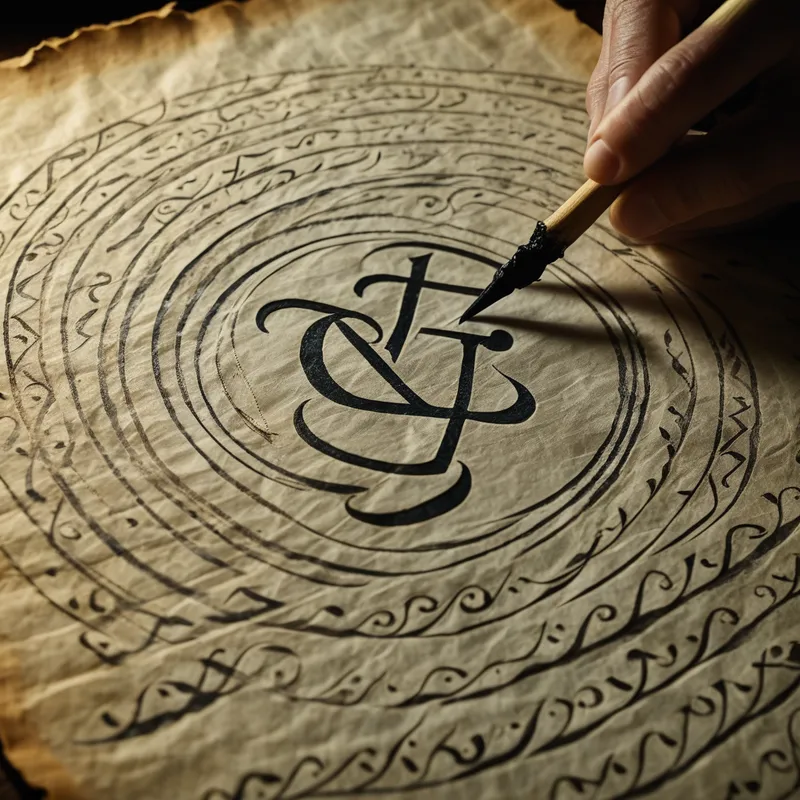
This myth is not a single story but a deep stratum of thought that crystallized within medieval Jewish mysticism, particularly the Zohar. It emerged from circles of esoteric scholars in Provence and Spain who saw the literal, legal, and narrative layers of the Torah as merely the outermost garment. Their pursuit was the soul of the scripture.
Passed down through initiatory chains (masoret), often from master to a single, worthy disciple, this teaching was considered dangerous and powerful. It was not for public discourse but for the contemplative elite. Its societal function was dual: it provided a metaphysical framework that explained the purpose of Jewish law and ritual (as technologies for interacting with the cosmic code), and it offered a theodicy—a way to understand the presence of evil and fragmentation in a world created by a perfect God. The "shattering of the vessels" explained exile, suffering, and the human task of <abbr title="The act of "raising the sparks," of redeeming the divine light trapped in matter">Tikkun Olam, the repair of the world.
Symbolic Architecture
At its heart, this myth transforms our understanding of reality from a mechanical universe into a linguistic and conscious one. The cosmos is not a thing, but a text. Matter is crystallized language.
The universe is a story God is telling Himself, and we are both the characters and the scribes, tasked with remembering the original draft.
The Primordial Torah represents the archetypal realm, the Platonic world of perfect forms and the unconscious wholeness of the Self before the emergence of the ego. The Shattering of the Vessels symbolizes the necessary trauma of individuation—the fragmentation of that wholeness into the multiplicity of the psyche (complexes, personas, the shadow) and the experience of alienation that defines human consciousness. The Scattered Sparks are the fragmented aspects of our deepest potential, our unlived life, our divine core, which become projected onto the world, buried in trauma, or hidden in our compulsions.
The Hebrew Letters are more than an alphabet; they are the fundamental psychic atoms. Each letter is a dynamic archetype with a numerical value (Gematria), a shape, and a sound. To engage with them is to engage with the building blocks of the psyche itself.
The Dreamer's Resonance
When this myth pattern activates in the modern psyche, it often manifests in dreams of encrypted messages, indecipherable blueprints, or lost instruction manuals. One might dream of finding a book in a forgotten language that feels vitally important, or of trying to input a correct sequence of symbols to unlock a door or stabilize a crumbling structure.
Somatically, this can feel like a deep, intuitive knowing that is just out of reach—a tension in the chest or a buzzing in the mind. Psychologically, it signals a process of re-membering. The dreamer is at a stage where the unconscious is offering up fragments of a deeper, more authentic self-structure. The conflict is between the ego, which sees only chaos and randomness (the shattered world), and the Self, which is trying to transmit the pattern of wholeness (the hidden code). The dream is an invitation to move from being a passive reader of one's life story to an active decoder and co-author.
Alchemical Translation
The individuation process modeled here is not one of adding something new, but of recovering and reordering what already is. It is the alchemy of decryption.
The first stage is Contraction (Tzimtzum). The ego must create a space by withdrawing its constant commentary and judgment. This is the meditation, the therapy session, the quiet walk—the vacated space where the symbols from the deeper Self can emerge.
The second stage is Perceiving the Code. This is the development of symbolic sight. It is learning to see the "letters" in one's life: the repeating patterns in relationships (a Bet of containment or a Dalet of poverty?), the archetypal energies that drive one's passions and fears. It is understanding one's personal history not as a random sequence of events, but as a specific, meaningful syntax.
The work of the soul is not to write a new story, but to discover the sacred grammar of the story in which one has always been written.
The core struggle is the Gathering of Sparks (Tikkun). This is the hard, ethical work of integration. It is retrieving the spark of life buried in a childhood trauma (a shattered vessel). It is reclaiming the spark of power projected onto an authority figure, or the spark of love locked in a defended heart. Each act of integration—facing a shadow, healing a wound, owning a talent—rearranges the inner letters, spelling a truer name for the soul.
The ultimate triumph is not escaping the world, but realizing the world is the text. The physical, the emotional, the intellectual—all are layers of the same divine code. Individuation, in this Kabbalistic sense, is the moment the conscious mind humbly aligns with the primordial manuscript, and in doing so, becomes a clear vessel through which the black fire and white fire can once again, however briefly, shine as one.
Associated Symbols
Explore related symbols from the CaleaDream lexicon: