The Three Fates Myth Meaning & Symbolism
Three primordial goddesses spin, measure, and cut the thread of every mortal life, embodying the inescapable architecture of destiny.
The Tale of The Three Fates
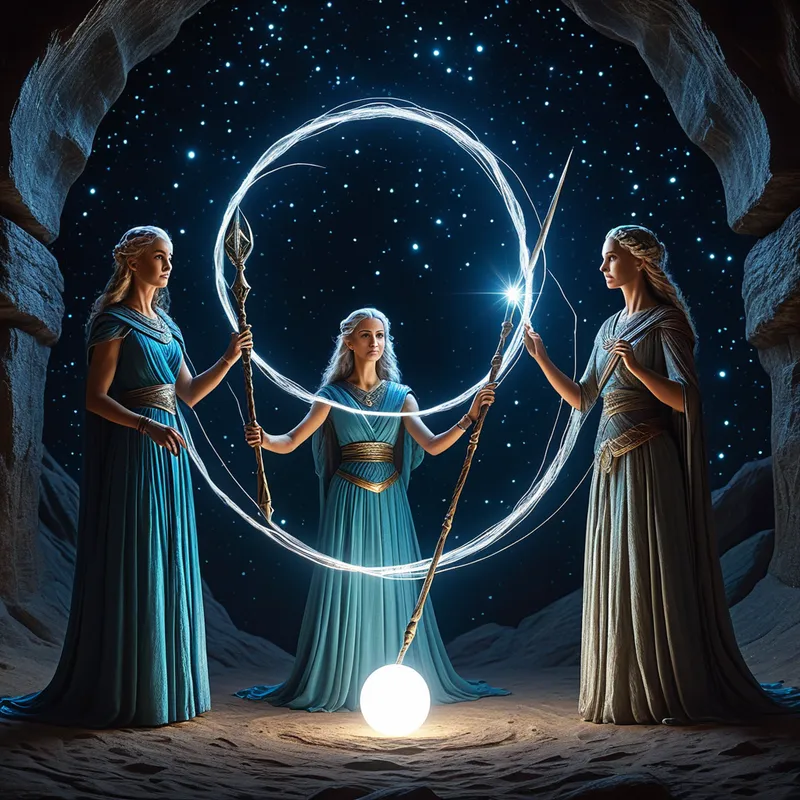
Listen, and hear the hum that underlies [the world](/myths/the-world “Myth from Tarot culture.”/). It is not [the wind](/myths/the-wind “Myth from Various culture.”/) in the olive groves, nor the crash of [Poseidon](/myths/poseidon “Myth from Greek culture.”/)’s waves. It is the low, eternal drone of the spindle, turning in the deepest dark before the first dawn. Here, in a place that is not a place, at the root of the [Yggdrasil](/myths/yggdrasil “Myth from Global/Universal culture.”/) of being, they sit.
First is Clotho. Her fingers, pale as moon-bleached bone, draw the raw stuff of soul from a mist of potential. With a twist of her wrist, the whorl sings, and the thread—luminous, fragile, thrumming with the promise of breath and heartbeat—begins to form. It is the moment of conception, the first cry, the spark of consciousness igniting in [the void](/myths/the-void “Myth from Buddhist culture.”/). The air smells of ozone and damp earth, of beginnings.
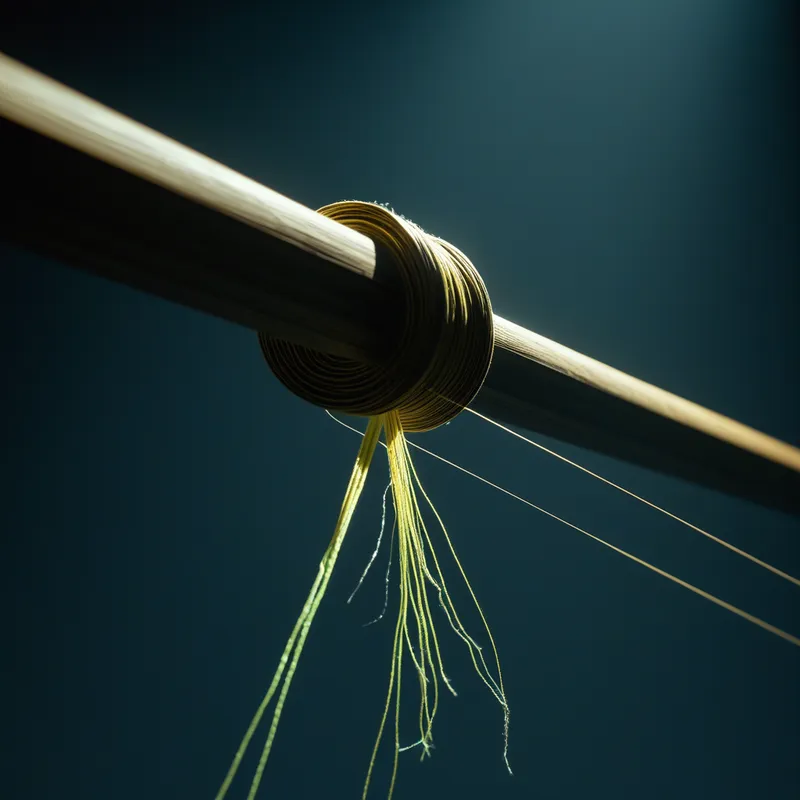
The thread passes to the second sister, Lachesis. Her eyes are the color of a deep, still lake, and in them dance the reflections of all possible paths. She does not look at the thread; she feels it. Her touch is not gentle, but precise. With a rod carved from the branch of [the Tree of Knowledge](/myths/the-tree-of-knowledge “Myth from Jewish culture.”/), she measures. Here, she marks a twist for a great love; there, a knot for a betrayal; a golden stretch for joy, a thin, grey patch for sorrow. She apportions the lot, the moira, the portion of laughter and tears, [triumph](/myths/triumph “Myth from Roman culture.”/) and defeat that will be the shape of a life. The length is decided. The destiny is set.
Finally, it comes to the third. Atropos. She is the eldest, and her face holds the stillness of a mountain that has watched eons pass. In her lap rest shears, their blades forged from a metal that drinks starlight and knows no pity. She waits. She watches the thread, now rich with the texture of a lived story, play out its measured length. There is no haste, no malice, only absolute inevitability. When the final inch of the allotted span trembles before her, she moves. A single, decisive snip. The sound is not loud, but it echoes in the bones of every living [thing](/myths/thing “Myth from Norse culture.”/). The luminous thread goes dark. The hum ceases, for that one life. And in the mortal world, far above, a breath is not drawn, a heart falls still.
They have always been here. They were present when Zeus wrestled [the Titans](/myths/the-titans “Myth from Greek culture.”/), and even he, the Cloud-Gatherer, must bow to their decree. They attend every birth, invisible midwives to destiny. Their law is older than Olympus, colder than [the Styx](/myths/the-styx “Myth from Greek culture.”/), and more absolute than any god’s whim. This is their endless work: to spin, to measure, to cut. The great tapestry of existence is woven from their solitary, relentless labor.
Cultural Origins & Context
The myth of the [Moirai](/myths/moirai “Myth from Greek culture.”/) is not a story told for mere entertainment around a fire. It is a foundational pillar of the Greek worldview, a poetic articulation of a terrifying and comforting cosmic order. Their origins are tellingly obscure, born of Nyx (Night) alone, or of [Ouranos](/myths/ouranos “Myth from Global/Universal culture.”/) and Gaia. This places them among the primordial powers, predating and superseding the later Olympian [pantheon](/myths/pantheon “Myth from Roman culture.”/).
They were invoked in oaths, referenced in the epic poetry of [Homer](/myths/homer “Myth from Greek culture.”/) and Hesiod, and their imagery permeated art and ritual. To the ancient Greek mind, the concept of moira (share, portion) was not a vague notion of “fate” but a specific, apportioned lot given to each person, city, and even god. The Moirai were the personification and administrators of this law. Their myth served a crucial societal function: it provided an explanation for the seeming randomness of fortune and misfortune, for the limits of human power, and for the ultimate equality of all before death. No king, no hero—not even Achilles—could escape their shears. This knowledge bred a specific form of wisdom: profound humility (aidos) in the face of cosmic forces, and a fierce, tragic valor in striving for excellence (arete) within one’s allotted span.
Symbolic Architecture
The [symbolism](/symbols/symbolism “Symbol: The use of symbols to represent ideas or qualities, often conveying deeper meanings beyond literal interpretation. In dreams, it’s the language of the unconscious.”/) of the [Three Fates](/myths/three-fates “Myth from Greek culture.”/) is an elegant, terrifying map of the [human](/symbols/human “Symbol: The symbol of a human represents individuality, complexity of emotions, and social relationships.”/) [condition](/symbols/condition “Symbol: Condition reflects the state of being, often focusing on physical, emotional, or situational aspects of life.”/). They represent the tripartite [structure](/symbols/structure “Symbol: Structure in dreams often symbolizes stability, organization, and the framework of one’s life, reflecting how one perceives their environment and personal life.”/) of time itself: Clotho is the emergent Present, the [moment](/symbols/moment “Symbol: The symbol of a ‘moment’ embodies the significance of transient experiences that encapsulate emotional depth or pivotal transformations in life.”/) of creation and continuous becoming. Lachesis is the unfolding Future, the [realm](/symbols/realm “Symbol: The symbol of ‘Realm’ often signifies the boundaries of one’s consciousness, experiences, or emotional states, suggesting aspects of reality that are either explored or ignored.”/) of potential and probability that is being constantly collapsed into the [linear](/symbols/linear “Symbol: Represents order, predictability, and a direct, step-by-step progression. It symbolizes a clear path from cause to effect.”/) [path](/symbols/path “Symbol: The ‘path’ symbolizes a journey, choices, and the direction one’s life is taking, often representing individual growth and exploration.”/) of a [life](/symbols/life “Symbol: The symbol of ‘Life’ represents a journey of growth, interconnectedness, and existential meaning, encompassing both the joys and challenges that define human experience.”/). Atropos is the immutable Past, the finality of all actions, the closed book that cannot be rewritten.
The thread is not just life, but the narrative of the Self—a story spun from innate disposition (Clotho), shaped by circumstance and choice (Lachesis), and given absolute meaning by its terminus (Atropos).
Psychologically, they symbolize the internalized structures that govern our [psyche](/myths/psyche “Myth from Greek culture.”/). Clotho is our innate temperament, our genetic and [soul](/symbols/soul “Symbol: The soul represents the essence of a person, encompassing their spirit, identity, and connection to the universe.”/)-level [blueprint](/symbols/blueprint “Symbol: A blueprint represents the foundational plan or design for something, often symbolizing potential, structure, and the mapping of one’s inner self or future.”/). Lachesis is [the ego](/myths/the-ego “Myth from Jungian culture.”/)-[consciousness](/symbols/consciousness “Symbol: Consciousness represents the state of awareness and perception, encompassing thoughts, feelings, and experiences.”/), the part of us that measures [options](/symbols/options “Symbol: The presence of multiple potential paths or choices, representing freedom, uncertainty, and the burden or opportunity of decision-making.”/), makes choices, and tries to navigate the [labyrinth](/symbols/labyrinth “Symbol: The labyrinth represents a complex journey, symbolizing the intricate path toward self-discovery and understanding one’s life’s direction.”/) of life with the rod of reason and desire. Atropos is the unconscious [shadow](/symbols/shadow “Symbol: The ‘shadow’ embodies the unconscious, repressed aspects of the self and often represents fears or hidden emotions.”/), the great negator, the [reality](/symbols/reality “Symbol: Reality signifies the state of existence and perception, often reflecting one’s understanding of truth and life experiences.”/) principle that ultimately cuts through our illusions of control and immortality. She is the necessary end that gives shape and urgency to the [story](/symbols/story “Symbol: The symbol of ‘Story’ represents the narrative woven through our lives, embodying experiences, lessons, and emotions that shape our identities.”/). Together, they form the complete psychic apparatus: the id (raw life force), [the ego](/myths/the-ego “Myth from Jungian culture.”/) (navigating reality), and the superego (the internalized, often harsh, law).
The Dreamer’s Resonance
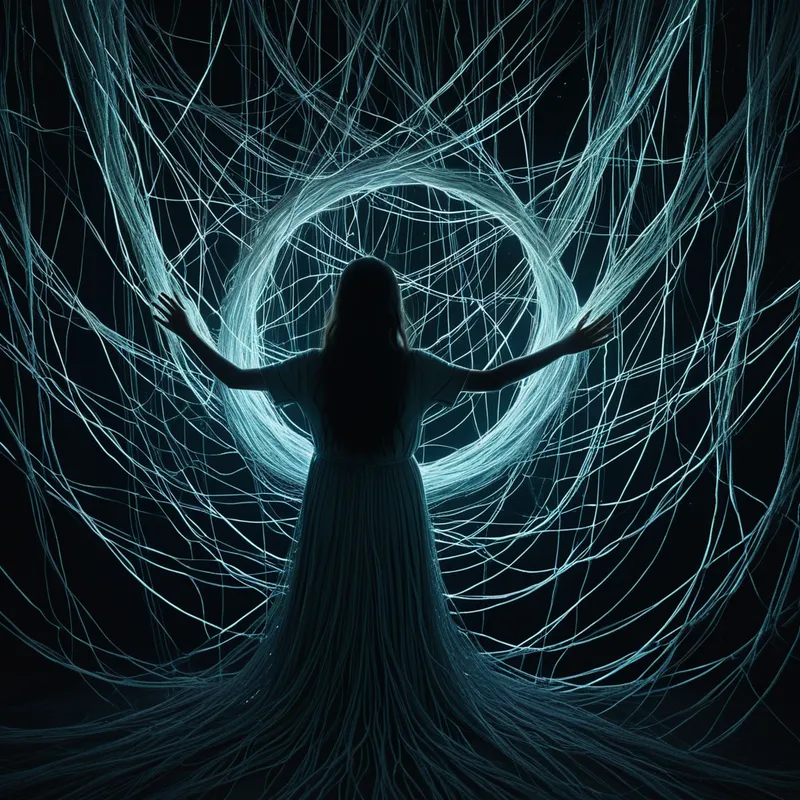
When the Moirai appear in modern dreams, they rarely arrive as classical goddesses. Instead, the dreamer encounters the pattern of their function. One may dream of tangled yarn, of a crucial string breaking, of trying to re-tie a severed cord. One may be in an office where a faceless administrator is measuring a chart of one’s life, or find oneself with a pair of oversized, terrifying scissors.
Such dreams signal a profound somatic and psychological process: a confrontation with personal destiny and limitation. The dreamer is at a threshold where the “thread” of their current identity—a career, a relationship, a self-image—is being measured and felt as finite. The rising action in the dream (tangling, measuring) reflects the ego’s struggle with life choices and the anxiety of commitment. The moment of cutting symbolizes an impending psychic death: the necessary end of an outdated phase, a worn-out [persona](/myths/persona “Myth from Greek culture.”/), or a destructive pattern. The terror in the dream is the terror of transformation, of the ego’s surrender to a larger, impersonal process within the psyche.
Alchemical Translation
The individuation process, the alchemy of becoming whole, is mirrored perfectly in the myth of [the Fates](/myths/the-fates “Myth from Greek culture.”/). The modern individual begins identified with the thread—a passive product of fate (Clotho’s spin) and societal measurement (Lachesis’s rod). [The first stage](/myths/the-first-stage “Myth from Alchemical culture.”/) of awakening is the shocking realization that one is the thread, but also, potentially, the weaver.
The alchemical work is to internalize the Fates: to take up one’s own spindle (conscious creation), one’s own measuring rod (discernment and choice), and, most crucially, to willingly wield one’s own shears (the courage to end what must die).
This is the psychic transmutation. We move from being subject to fate to becoming conscious participants in our destiny. Clotho’s spin becomes active imagination and intentional living. Lachesis’s measure becomes mindful choice and responsibility for one’s path. The triumph is not in escaping Atropos, but in integrating her. To consciously “cut” one’s own thread—to end addictions, toxic relationships, or outworn beliefs—is to perform a sacred, self-directed sparagmos (ritual tearing). It is to accept mortality and limitation not as a curse, but as the defining contour that gives life its beauty, depth, and urgency. In doing so, the individual no longer rages impotently against the impersonal sisters in the dark. Instead, they find that the hum of the spindle, the cool touch of the measuring rod, and the final, clean cut of the shears have all become movements of their own soul, weaving a destiny not of mere length, but of authentic, self-authored meaning.
Associated Symbols
Explore related symbols from the CaleaDream lexicon: