The Threads of the Fates Myth Meaning & Symbolism
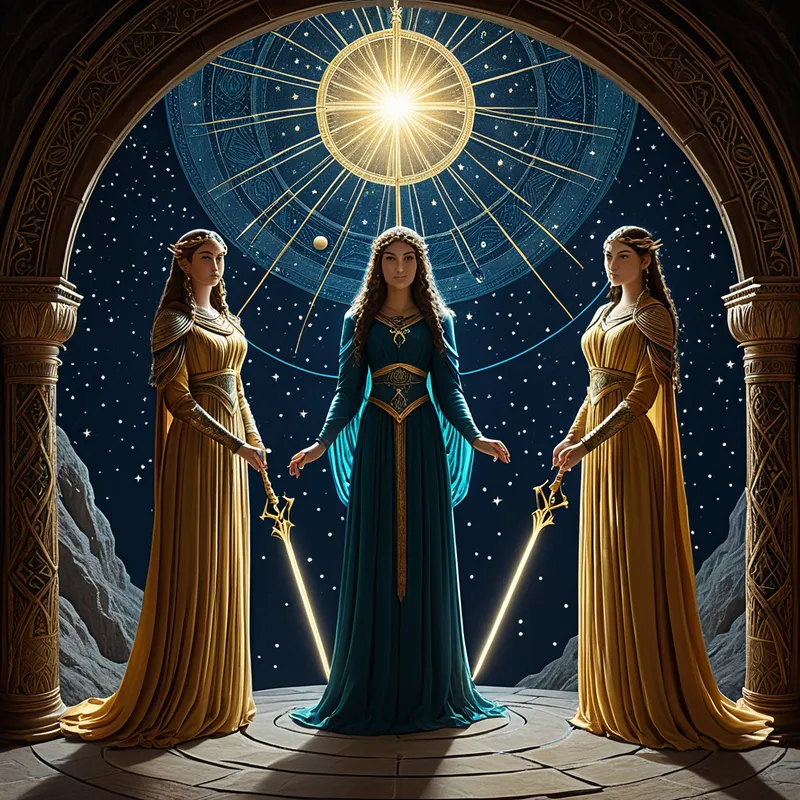
Three primordial goddesses spin, measure, and cut the thread of life for every mortal and god, embodying the inescapable architecture of destiny.
The Tale of The Threads of the Fates
Listen. Beneath the roots of the World-Tree, where the light of the sun dares not reach and the whispers of the dead are the only wind, there sits a chamber older than time. The air is thick with the scent of wool, ozone, and cold stone. Here, in a silence so profound it has weight, the Three work.
They are the [Moirai](/myths/moirai “Myth from Greek culture.”/), daughters of primordial Nyx. They do not speak. The only sounds are the soft, eternal hum of the spindle, the whisper of thread drawn through knowing fingers, and the final, decisive snip that echoes through the halls of Zeus himself.
The first is Clotho. She is youth, the beginning. From a distaff that holds the raw stuff of possibility—starlight, breath, the first cry—she draws forth the thread. Her fingers, pale and swift, give it twist and substance. With every rotation, a life is conceived, a story is born from the formless. The thread glows with potential, fragile and bright.
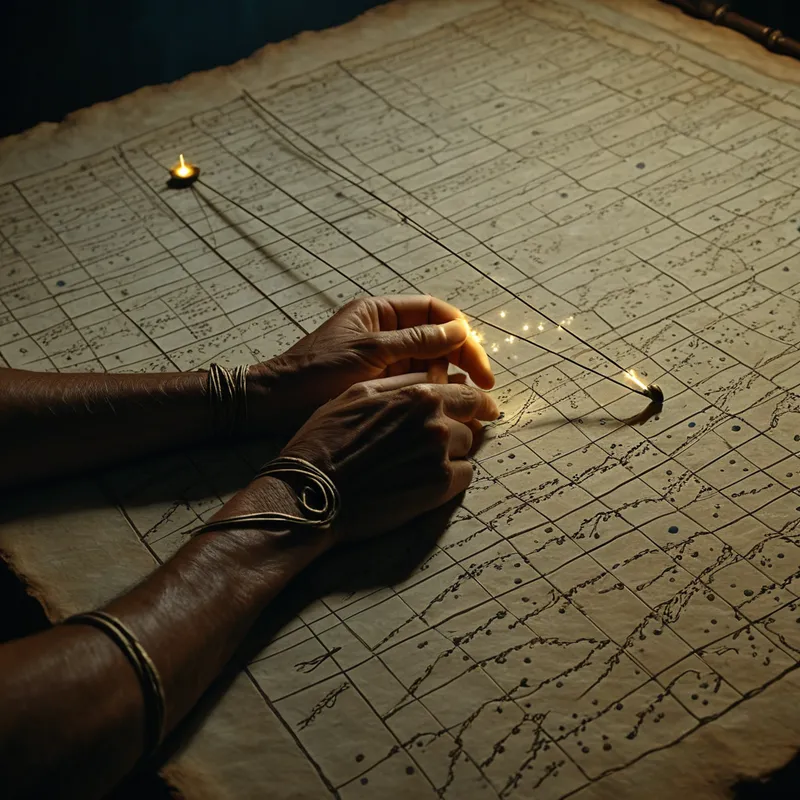
She passes it to her sister, Lachesis. Where Clotho is motion, Lachesis is measure. She is the fullness of time. Upon her lap rests a vast scroll, not of parchment, but of the shimmering paths of the constellations. With a touch both tender and implacable, she lays the glowing thread against this celestial map. Here, she apportions its length. She determines its twists, its knots of trial, its smooth stretches of joy. She does not decide the quality of the thread—that was Clotho’s gift—but she dictates the journey it will take through the tapestry of [the world](/myths/the-world “Myth from Tarot culture.”/).
Then, it comes to the third. Atropos. She is the eldest, her face a landscape of absolute resolve. In her hand, she holds not a tool, but an instrument of divine finality: the shears. She does not hurry. She watches the thread, now measured and defined, run through her fingers. She feels its vibrations—the triumphs, the despairs, the love, the fatigue. And at the precise moment ordained by her sister’s measure, when the thread has sung its entire song, her shears close. The sound is not loud, but it is absolute. A clean severance. The glowing thread goes dark. Its story, in that form, is complete.
Not even the Thunderer on Olympus can alter their decree. It is said that when the hero [Heracles](/myths/heracles “Myth from Greek culture.”/) wrestled with Death for the soul of his friend, it was the unbroken thread, still measured and glowing in Lachesis’s hand, that allowed the victory. But when the thread was cut, no strength, no prayer, no god’s favor could rejoin it. [The Fates](/myths/the-fates “Myth from Greek culture.”/) work in the deep, silent places where the laws of the universe are not written, but woven. They are the weavers, and all of creation—mortal and divine—is the tapestry.
Cultural Origins & Context
The myth of the Moirai is not a story told for mere entertainment around a fire. It is a foundational cosmological principle, a psychic anchor for the ancient Greek world-view. Emerging from the pre-Olympian chthonic traditions, they represent a force older and more fundamental than the gods of Olympus. Their power circumscribes even that of Zeus, who was often said to merely “confirm” or enact the fate they had spun.
This myth was passed down through the epic poetry of [Homer](/myths/homer “Myth from Greek culture.”/) and Hesiod, woven into the tragic plays where heroes rail against their destined ends. Its societal function was profound: it provided an explanation for the limits of human and divine agency, for the seeming randomness of fortune and misfortune, and for the ultimate boundary of death. It instilled a sense of moira (one’s allotted portion), a concept central to Greek ethics, urging acceptance of one’s lot while striving for excellence within its bounds. To know your fate was not to live in passive despair, but to understand the architecture within which your virtue, your arete, could be displayed.
Symbolic Architecture
The [symbolism](/symbols/symbolism “Symbol: The use of symbols to represent ideas or qualities, often conveying deeper meanings beyond literal interpretation. In dreams, it’s the language of the unconscious.”/) of the Fates is an elegant, terrifying map of the [human](/symbols/human “Symbol: The symbol of a human represents individuality, complexity of emotions, and social relationships.”/) [condition](/symbols/condition “Symbol: Condition reflects the state of being, often focusing on physical, emotional, or situational aspects of life.”/). They are not cruel arbiters, but impersonal principles of cosmic order.
The thread is not just life, but the narrative consciousness of a being—the unbroken line of experience from first awareness to last.
The [Spindle](/symbols/spindle “Symbol: A spindle is a tool used for spinning thread, symbolizing creativity, the act of weaving, and the intertwining of life’s stories.”/) (Clotho) represents pure potential, the [moment](/symbols/moment “Symbol: The symbol of a ‘moment’ embodies the significance of transient experiences that encapsulate emotional depth or pivotal transformations in life.”/) of [conception](/symbols/conception “Symbol: The beginning of new life, ideas, or projects; a moment of profound creation and potential.”/)—of a person, an [idea](/symbols/idea “Symbol: An ‘Idea’ represents a spark of creativity, innovation, or realization, often emerging as a solution to a problem or a new outlook on life.”/), a [destiny](/symbols/destiny “Symbol: A predetermined course of events or ultimate purpose, often linked to spiritual forces or cosmic order, representing life’s inherent direction.”/). It is the [unus mundus](/myths/unus-mundus “Myth from Alchemical culture.”/), the undifferentiated [source](/symbols/source “Symbol: The origin point of something, often representing beginnings, nourishment, or the fundamental cause behind phenomena.”/). The Scroll & Measure (Lachesis) symbolizes the unfolding of that potential in [linear](/symbols/linear “Symbol: Represents order, predictability, and a direct, step-by-step progression. It symbolizes a clear path from cause to effect.”/) time—cause and effect, [choice](/symbols/choice “Symbol: The concept of choice often embodies decision-making, freedom, and the multitude of paths available in life.”/) and consequence, the unique [pattern](/symbols/pattern “Symbol: A ‘Pattern’ in dreams often signifies the underlying structure of experiences and thoughts, representing both order and the repetitiveness of life’s situations.”/) of a [life](/symbols/life “Symbol: The symbol of ‘Life’ represents a journey of growth, interconnectedness, and existential meaning, encompassing both the joys and challenges that define human experience.”/). It is the [realm](/symbols/realm “Symbol: The symbol of ‘Realm’ often signifies the boundaries of one’s consciousness, experiences, or emotional states, suggesting aspects of reality that are either explored or ignored.”/) of law, both natural and moral. The Shears (Atropos) embody necessary limit. They represent the defining [truth](/symbols/truth “Symbol: Truth represents authenticity, honesty, and the quest for knowledge beyond mere appearances.”/) that gives any [story](/symbols/story “Symbol: The symbol of ‘Story’ represents the narrative woven through our lives, embodying experiences, lessons, and emotions that shape our identities.”/) meaning: its ending. Without an end, there is no shape, no urgency, no completion.
Psychologically, the Three represent the tripartite [structure](/symbols/structure “Symbol: Structure in dreams often symbolizes stability, organization, and the framework of one’s life, reflecting how one perceives their environment and personal life.”/) of the [psyche](/myths/psyche “Myth from Greek culture.”/) itself: the unconscious potential (Clotho), the conscious ego navigating the world (Lachesis), and [the Self](/myths/the-self “Myth from Jungian culture.”/) that demands the [dissolution](/symbols/dissolution “Symbol: The process of breaking down, dispersing, or losing form, often representing transformation, release, or the end of a state of being.”/) of [the ego](/myths/the-ego “Myth from Jungian culture.”/) for wholeness (Atropos). They are the ultimate [archetype](/symbols/archetype “Symbol: A universal, primordial pattern or prototype in the collective unconscious that shapes human experience, behavior, and creative expression.”/) of inevitability, the internalized understanding that certain patterns—our core wounds, our deepest gifts, our [mortality](/symbols/mortality “Symbol: The awareness of life’s finitude, often representing transitions, impermanence, or existential reflection in dreams.”/)—are the non-negotiable threads of our personal [tapestry](/symbols/tapestry “Symbol: The tapestry represents interconnected stories, creativity, and the weaving of personal and collective experiences into a cohesive narrative.”/).
The Dreamer’s Resonance
When this myth stirs in the modern dreamer, it speaks to a confrontation with personal destiny and limitation. To dream of spinning thread suggests a creative beginning, a pregnancy (literal or metaphorical), or the feeling of crafting one’s own life path. The dreamer is in the role of Clotho, full of agency and potential.
Dreaming of measuring thread, or of a thread that is tangled, knotted, or impossibly long, places the dreamer in the realm of Lachesis. This often coincides with life reviews, mid-life crises, or periods of intense planning and decision-making. The somatic sensation is one of assessment, of trying to “get the measure” of one’s life. Anxiety about wasted time or fear of the future are common companions.
But the most potent and unsettling resonance comes with Atropos. To dream of cutting a thread, or more commonly, of a thread being cut against your will, signals a profound psychological process of ending. This is not necessarily physical death, but the death of an identity, a relationship, a career, or a deeply held belief. The psyche is performing its own necessary severance. The somatic experience can be one of sudden release, shocking emptiness, or a chilling finality. It is the dream-ego confronting a change so fundamental it feels like an annihilation, because it is—the annihilation of a former self to make way for what must come next.
Alchemical Translation
The alchemical journey of individuation—becoming who one is inherently meant to be—is perfectly modeled by the work of the Fates. The modern individual must become, consciously, all [three sisters](/myths/three-sisters “Myth from Native American culture.”/).
The great work is to take up the spindle, the measure, and the shears for oneself, moving from being passive thread to active weaver.
First, we must become Clotho: we must engage with our raw, unconscious material—our dreams, our instincts, our buried potentials—and have the courage to “spin” it into a conscious form. This is the creative act of self-definition.
Then, we must become Lachesis: we must take responsibility for measuring our thread. This is the ego’s long work of making choices, living with consequences, and discerning the unique pattern of our life from the chaos of possibilities. It is the cultivation of consciousness and ethical living.
Finally, and most crucially, we must become Atropos. This is the pinnacle of the alchemical process: sacrificium, the sacred sacrifice. To individuate, we must willingly “cut” the threads of outworn identities, compulsive behaviors, and infantile dependencies. We must perform the psychic severance that the Self demands. This is not self-destruction, but the ultimate act of self-definition—allowing parts of ourselves to die so that the essential pattern, the core of our being, can be revealed and completed.
In this translation, fate is not an external sentence, but the internal, archetypal pattern of the Self. The [triumph](/myths/triumph “Myth from Roman culture.”/) is not in escaping the shears, but in recognizing that the hand that holds them is, ultimately, our own. We submit to the weaving, and in that conscious submission, we find our unique, irrevocable place in the great tapestry of being.
Associated Symbols
Explore related symbols from the CaleaDream lexicon: