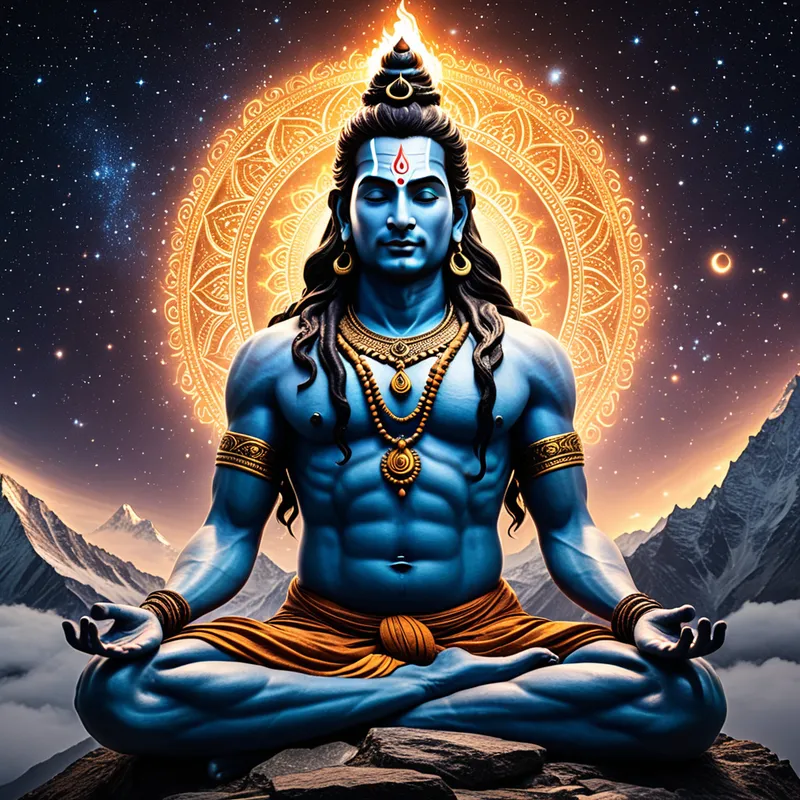
The Third Eye Myth Meaning & Symbolism
The myth of Shiva's Third Eye, a story of divine fury and ultimate truth, where a single gaze incinerates illusion and reveals the nature of reality.
The Tale of The Third Eye
In the beginningless time, when the cosmos was a dance of potential, there sat the great ascetic, [Shiva](/myths/shiva “Myth from Hindu culture.”/). He was not upon a throne, but upon the naked, icy skin of [Mount Kailash](/myths/mount-kailash “Myth from Hindu culture.”/), his body smeared with the ashes of burnt-out worlds, his matted locks coiled like serpents of forgotten time. His eyes were closed, turned inward upon the infinite void within, the nada. In this profound [samadhi](/myths/samadhi “Myth from Buddhist culture.”/), the universe found its axis. The dance of creation and preservation whirled around his stillness, a tempest orbiting a perfect calm.
But a shadow fell upon this equilibrium. A demon, Taraka, had plunged the three worlds into tyranny. The gods, trembling in their celestial halls, knew only one being could father the warrior to defeat him: Shiva. Yet Shiva was lost to [the world](/myths/the-world “Myth from Tarot culture.”/), immersed in the absolute. He had turned his senses to stone; no scent of [jasmine](/myths/jasmine “Myth from Persian culture.”/), no taste of nectar, no whisper of wind could stir him. Most crucially, the arrow of Kama could not pierce his heart, for his heart was the still center of the cosmos itself.
Desperation birthed a plan. The gods implored Kama to awaken Shiva with his flower-tipped arrow of desire. Kama, the beautiful and doomed, crept towards the meditating god. The air grew heavy with the perfume of spring, a scent alien to that high, cold place. He drew his bow of sugarcane, the string humming with the essence of all longing. He aimed for the heart. The arrow flew—a streak of blossoming hope.
In that instant, the universe held its breath.
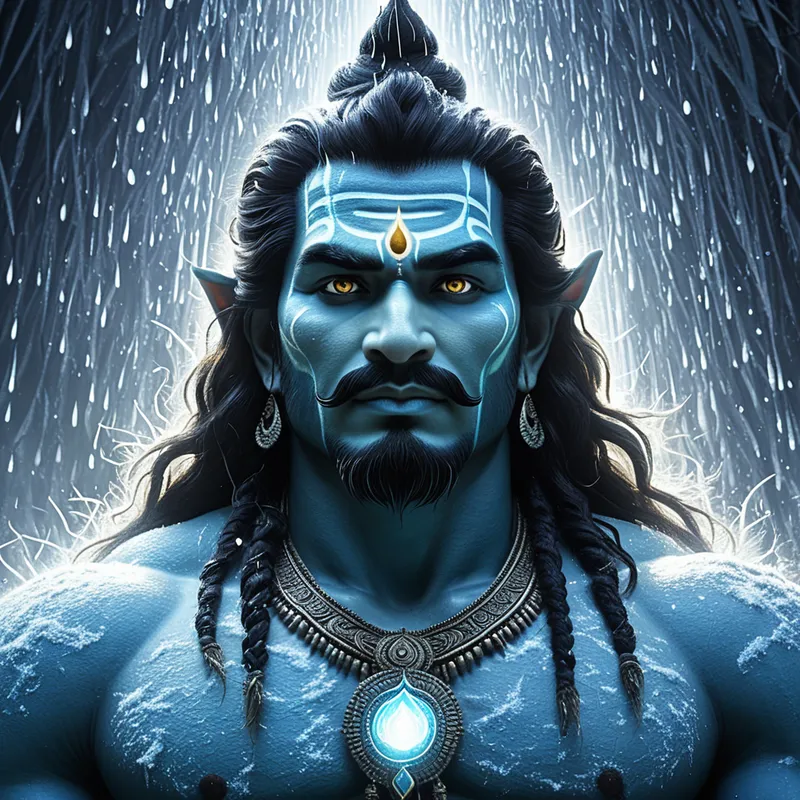
Shiva’s eyelids did not flutter. Instead, the skin of his forehead rippled. A seam, vertical and terrible, split open. Not an eye of flesh, but an eye of primordial fire. It was the sun at the moment of creation, the core of a star, the end of all things. This was the Ajna Chakra made manifest, the Trinetra.
There was no gaze, only a pure, annihilating beam of light. It struck Kama, and the god of form, of touch, of sweet anticipation, was unmade. He did not die; he was reduced—from a deity to a concept, from a body to a whisper in [the wind](/myths/the-wind “Myth from Various culture.”/), Ananga. The fragrant spring air turned to ash. The gods prostrated themselves, not in reverence, but in primal terror before this revelation: that the source of ultimate peace was also the furnace of absolute destruction.
And then, as suddenly as it opened, the [Third Eye](/myths/third-eye “Myth from Hindu culture.”/) closed. The light was reabsorbed. Shiva, having incinerated the distraction, returned to his meditation, the ashes of desire now part of the sacred smears on his skin. The silence that followed was deeper than before, now containing the echo of a truth too fierce to behold.
Cultural Origins & Context
This myth is woven into the vast tapestry of the Itihasas and Puranas, particularly the Shiva Purana and the Kumarasambhava of Kalidasa. It was not merely a story for entertainment but a metaphysical teaching tool, passed down through generations of sages (rishis) and storytellers. Its function was multifaceted: to explain the nature of Shiva as both benevolent ascetic and fearsome destroyer, to illustrate the power of yogic discipline (sadhana) over worldly attachment (moha), and to map the inner cosmology of the human being. The Third Eye was a symbolic anchor for complex philosophical concepts about perception, making the abstract tangibly dramatic and unforgettable.
Symbolic Architecture
The myth operates on a profound symbolic level. Shiva represents pure [consciousness](/symbols/consciousness “Symbol: Consciousness represents the state of awareness and perception, encompassing thoughts, feelings, and experiences.”/), the transcendent Self (Atman) untouched by the phenomenal world. His deep [meditation](/symbols/meditation “Symbol: Meditation represents introspection, mental clarity, and the pursuit of inner peace, often providing a pathway for deeper self-awareness and spiritual growth.”/) is the state of [moksha](/myths/moksha “Myth from Hindu culture.”/) itself—withdrawn, complete, and self-sufficient.
The Third Eye is not an organ of sight, but the aperture of truth. It sees not objects, but the essence; not desire, but the chain of cause and effect that desire forges.
[Kama](/symbols/kama “Symbol: A ritual sickle or curved blade used in Hindu and Buddhist traditions, symbolizing the cutting of attachments and spiritual liberation.”/) is not merely “love” in a romantic sense. He is the personification of all sensory and mental attraction, the very principle of maya that binds consciousness to form. His [arrow](/symbols/arrow “Symbol: An arrow often symbolizes direction, purpose, and the pursuit of goals, representing both the journey and the destination.”/) is any [impulse](/symbols/impulse “Symbol: A sudden, powerful urge or drive that arises without conscious deliberation, often linked to primal instincts or emotional surges.”/)—a thought, a feeling, a craving—that threatens to pull [awareness](/symbols/awareness “Symbol: Conscious perception of self, surroundings, or internal states. Often signifies awakening, insight, or heightened sensitivity.”/) from its center into the [whirlpool](/symbols/whirlpool “Symbol: The whirlpool symbolizes turmoil and the chaotic aspects of one’s life, signaling ongoing struggles and the need for resolution.”/) of identification.
The opening of the Third Eye is the ultimate act of discernment (viveka). It does not negotiate with [distraction](/symbols/distraction “Symbol: A state of diverted attention from a primary focus, often representing avoidance, fragmentation, or competing priorities in consciousness.”/); it annihilates it at its root. The [reduction](/symbols/reduction “Symbol: A tool or process that simplifies, minimizes, or breaks down something into smaller components, often representing efficiency or loss.”/) of Kama to “ananga” (bodiless) is critical. Desire is not destroyed as a force of [nature](/symbols/nature “Symbol: Nature symbolizes growth, connectivity, and the primal forces of existence.”/)—it is stripped of its power to embody, to take concrete form in the mind and lead it astray. The [energy](/symbols/energy “Symbol: Energy symbolizes vitality, motivation, and the drive that fuels actions and ambitions.”/) remains, but now invisible, diffuse, and ultimately harmless to the established Self.
The Dreamer’s Resonance
When this myth stirs in the modern unconscious, it often surfaces in dreams of radical confrontation. One may dream of a laser beam cutting through fog, of a central, all-seeing security camera that cannot be escaped, or of a beloved person or object being vaporized by a light from one’s own forehead. The somatic experience is one of intense heat in the brow or a pressure headache.
Psychologically, this signals a critical phase of de-identification. The dream-ego is undergoing the Shiva-process: something deeply ingrained—a long-held self-image, a compulsive pattern, a cherished illusion (our personal Kama)—is being challenged by a more authentic, but fiercely demanding, aspect of [the Self](/myths/the-self “Myth from Jungian culture.”/). The Third Eye in the dream represents this incorruptible inner witness that refuses to be seduced by our own narratives. It is a painful but necessary incineration of what is false, so that what is essential may continue its meditation undisturbed.

Alchemical Translation
The alchemical journey modeled here is the transmutation of scattered, desire-driven consciousness into focused, sovereign awareness. For the modern individual, the “meditation on Kailash” is the hard-won practice of inner stillness—through therapy, meditation, art, or any discipline that turns attention inward. The “gods” are our own internal pressures—anxieties, societal expectations, [the ego](/myths/the-ego “Myth from Jungian culture.”/)‘s demands—that push us to seek external solutions (a new relationship, status, possession) to quiet our disquiet.
The arrow of Kama is any promise of wholeness found outside the Self. The opening of the Third Eye is the courageous act of turning that searing light of awareness inward upon the promise itself, burning it away to reveal the emptiness at its core.
The “destruction” is not of joy or relationship, but of the dependency on external stimuli for a sense of self. This is the [tapas](/myths/tapas “Myth from Hindu culture.”/) (austerity) that fuels individuation. When Kama becomes Ananga, desire loses its concrete, tyrannical form. It may remain as energy, but it can no longer rule. The individual who integrates this myth does not become an emotionless stone, but a conscious vessel. Like Shiva, who later revives Kama for the world’s sake, they can engage with life’s pleasures without being enslaved by them. The Third Eye, once a mythic weapon, becomes a permanent inner orientation—a steady, non-judgmental awareness that sees the play of the world (lila) without being consumed by it. The ultimate [triumph](/myths/triumph “Myth from Roman culture.”/) is not in burning the world away, but in seeing it truly, for the first time, with eyes that are finally open.
Associated Symbols
Explore related symbols from the CaleaDream lexicon: