The Theory of Forms Myth Meaning & Symbolism
A philosopher's journey from a cave of shadows to the blinding light of perfect, eternal Forms, revealing the archetypal reality behind all appearances.
The Tale of The Theory of Forms
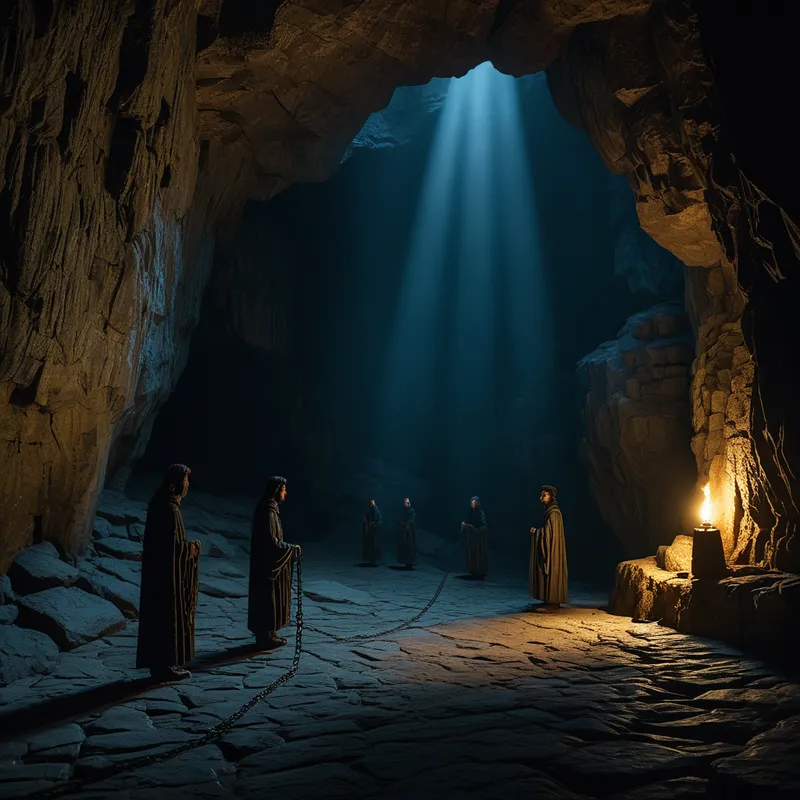
Imagine a deep, subterranean chamber, a womb of [the earth](/myths/the-earth “Myth from Hindu culture.”/) where fire is the only sun. Here, from childhood, dwell a people in bonds. Their legs and necks are fettered so they can only look forward, never turning their heads. Behind them burns a great fire, and between the fire and the prisoners runs a low wall, like the screen at a puppet show.
Along this wall, other people carry all manner of vessels, statues, and figures of animals and men, their shadows cast by the firelight onto [the cave](/myths/the-cave “Myth from Platonic culture.”/) wall before the prisoners. The prisoners see only these dancing phantoms. To them, the shadows are the whole of reality. They name the shadows as they pass: “a horse,” “a jug,” “a man.” They honor those among them who are quickest to name the sequence of shadows, who can best predict what phantom will come next. Their world is one of echoes and silhouettes, a theater of flickering ignorance.
But then, one prisoner is freed.
The bonds are struck from him. He is compelled to stand up, to turn his neck, to walk and to look towards the light of the fire itself. The action is painful. The blaze of the flame assaults his eyes, which have known only dimness. The figures carried along the wall seem less real than their shadows had been, for they are confusing and crude. He longs for his old place, for the comfortable certainty of the wall.
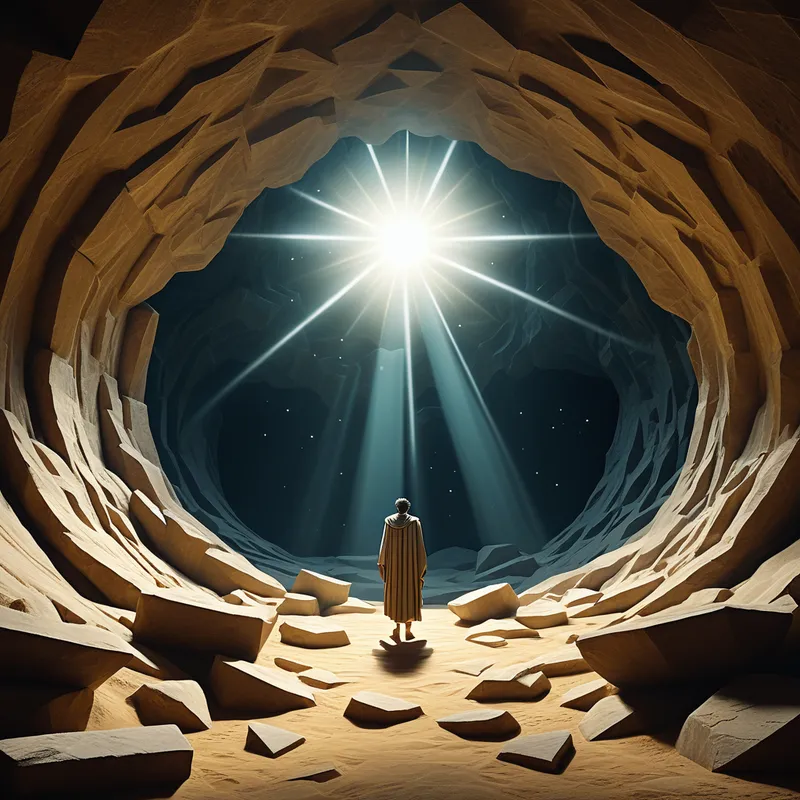
Yet he is dragged further, up a steep and rugged ascent, a birth canal of stone, until he is forced out into the open world. The light of the true sun is an agony. He can see nothing at all of the things we call real. He must acclimatize slowly. First, he looks at shadows cast by the sun. Then, at reflections in [water](/myths/water “Myth from Chinese culture.”/). Then, at the things themselves: trees, flowers, the stars at night. Finally, he can gaze upon the sun itself, not as an image in water or a [thing](/myths/thing “Myth from Norse culture.”/) in [the sky](/myths/the-sky “Myth from Persian culture.”/), but as the source of all light and the cause of all things seen.
He pities his former companions. He understands their prizes—the guessing of shadows—to be empty. His heart burns with a need to return, to tell them, to lead them up. He descends back into the darkness of the cave. But his eyes, now accustomed to the sun, are blind in the gloom. He stumbles. To the prisoners, his journey has ruined him. He can no longer play their game of shadows. When he speaks of a reality beyond their wall, of a sun that gives light to all, they laugh. They think him a fool. And if they could lay hands on the one who freed him, they would kill him.
Cultural Origins & Context
This is not a myth of Olympus, but of the Agora and the Academy. It is a philosophical allegory, a “likely story” told by Plato in his dialogue, [The Republic](/myths/the-republic “Myth from Platonic culture.”/). Its tellers were not bards with lyres, but philosophers engaged in dialectic, seeking the nature of dikaiosyne and the Good.
Its societal function was radical education. In a culture that prized rhetoric and the appearance of wisdom, Plato’s myth was a polemic against the “shadow-guessers”—the sophists and politicians who traded in persuasive images of truth, not truth itself. It was passed down not orally around a fire, but through the meticulous copying of scrolls by students, a technology of the mind meant to preserve a vision of reality that transcended the political turmoil of Athens. It served as the foundational narrative for a way of life dedicated not to power or pleasure, but to the arduous pursuit of the real.
Symbolic Architecture
The cave is [the world](/myths/the-world “Myth from Tarot culture.”/) of doxa—of sensory [appearance](/symbols/appearance “Symbol: Appearance in dreams relates to self-image, perception, and how you present yourself to the world.”/) and conventional [opinion](/symbols/opinion “Symbol: An opinion in a dream symbolizes personal beliefs and thoughts about oneself and the world, often reflecting inner conflicts or uncertainties.”/). It is the [psyche](/myths/psyche “Myth from Greek culture.”/) in its [default](/symbols/default “Symbol: The baseline state, unaltered condition, or standard setting from which all variations and changes originate.”/), unawakened state, mistaking cultural projections and personal impressions for [reality](/symbols/reality “Symbol: Reality signifies the state of existence and perception, often reflecting one’s understanding of truth and life experiences.”/). The shadows are the phenomena of our lives: the ever-changing impressions, emotions, and [material](/symbols/material “Symbol: Material signifies the tangible aspects of life, often representing physical resources, desires, and the physical world’s influence on our existence.”/) objects we take to be substantive.
The journey upward is the painful awakening of the soul to its own conditioned ignorance.
The fire is the dim, imitative light of [human](/symbols/human “Symbol: The symbol of a human represents individuality, complexity of emotions, and social relationships.”/) artifice—the light of culture, ideology, and manufactured consensus. The [ascent](/symbols/ascent “Symbol: Symbolizes upward movement, progress, spiritual elevation, or striving toward higher goals, often representing personal growth or transcendence.”/) is the philosophical turn, the periagoge, where the [soul](/symbols/soul “Symbol: The soul represents the essence of a person, encompassing their spirit, identity, and connection to the universe.”/)’s gaze is wrenched away from becoming and towards being. The sun is the Form of the Good, the first principle that illuminates all other Forms. It represents not a deity to be worshipped, but an intelligible reality to be known, the [source](/symbols/source “Symbol: The origin point of something, often representing beginnings, nourishment, or the fundamental cause behind phenomena.”/) of all [truth](/symbols/truth “Symbol: Truth represents authenticity, honesty, and the quest for knowledge beyond mere appearances.”/), [beauty](/symbols/beauty “Symbol: This symbol embodies aesthetics, harmony, and the appreciation of life’s finer qualities.”/), and unity.
The [prisoner](/symbols/prisoner “Symbol: Being a prisoner in a dream often symbolizes feelings of restriction, lack of freedom, or entrapment in waking life.”/) who returns is the tragic figure of the [philosopher](/symbols/philosopher “Symbol: A seeker of wisdom and truth, representing deep contemplation, questioning reality, and the pursuit of fundamental knowledge about existence.”/), the sage, or the [prophet](/symbols/prophet “Symbol: A messenger or seer who receives divine revelations, often warning of future events or guiding moral direction.”/). His failed [mission](/symbols/mission “Symbol: A mission in dreams represents one’s aspirations and goals, often linked to a sense of purpose or commitment.”/) symbolizes the inherent alienation of one who has seen the archetypal world from those who remain enchanted by the particulars. His [blindness](/symbols/blindness “Symbol: Represents a lack of awareness, insight, or refusal to see truth, often tied to emotional avoidance or spiritual ignorance.”/) in the cave is the price of [vision](/symbols/vision “Symbol: Vision reflects perception, insight, and clarity — often signifying the ability to foresee or understand deeper truths.”/); true [knowledge](/symbols/knowledge “Symbol: Knowledge symbolizes learning, understanding, and wisdom, embodying the acquisition of information and enlightenment.”/) makes one a [stranger](/symbols/stranger “Symbol: A stranger in dreams can represent unfamiliar aspects of the self or new experiences.”/) in the mundane world.
The Dreamer’s Resonance
When this myth stirs in the modern dreamer, it often manifests as dreams of being trapped in a basement, a theater, or a subway tunnel—places of artificial light and repetitive motion. The dreamer may be watching a movie or a screen, unable to look away. The somatic feeling is one of constriction in the neck and chest, a literal embodiment of the “fettered” psyche.
A pivotal dream symbol is the turning point: a door that appears behind the dreamer, a voice telling them to “look back,” or the sudden failure of the projected images, revealing the machinery behind the screen. This marks the psyche’s readiness for the painful periagoge. The subsequent dream imagery is often of arduous climbing—up a sheer cliff, a dark staircase, or through a narrow pipe—accompanied by feelings of anxiety and disorientation. This is the psyche laboring to reorient itself from a perception-based reality to a principle-based one. To dream of emerging into blinding light and not understanding what one sees is to experience the terror and promise of the mind encountering the archetypal layer of reality for the first time.
Alchemical Translation
The alchemy here is not of lead to gold, but of aisthesis to noesis, of shadow to source. The process of individuation modeled is the withdrawal of projections. We are all born chained to the wall, projecting perfect, eternal meaning onto imperfect, temporal things—seeking the Form of the Lover in a person, the Form of [Justice](/myths/justice “Myth from Tarot culture.”/) in an institution, the Form of Home in a place. The initial suffering of the freed prisoner is the agony of disillusionment, of seeing the crude “carriers” behind our beloved shadows.
The goal is not to live in the sun, but to let its light reorganize how you see the cave.
The ascent is the disciplined practice of anamnesis—recollection. It is the psychic work of tracing the imperfect particular back to the perfect universal within oneself. Why does this specific act of courage move me? Because it participates in the archetypal Form of Courage, which my soul dimly remembers. The modern individual’s “ascent” is the therapy session, the meditation retreat, the creative act, or the intellectual pursuit that forces a confrontation with the conditioned self.
The final, alchemical stage is the return. This is the integration. One does not abandon the cave of the world. Having seen [the Forms](/myths/the-forms “Myth from Platonic culture.”/), one re-engages with particulars, but now with understanding. The jug is no longer just a shadow or even just a useful vessel; it is seen as a flawed yet beautiful participant in the eternal Form of the Jug, of Utility, of Symmetry. The struggle is transmuted from one of escape to one of enlightened participation. The psychic gold is the capacity to hold the tension between the perfect archetype and the imperfect manifestation, and to act in [the shadow](/myths/the-shadow “Myth from Jungian culture.”/)-world with the memory of the sun.
Associated Symbols
Explore related symbols from the CaleaDream lexicon: