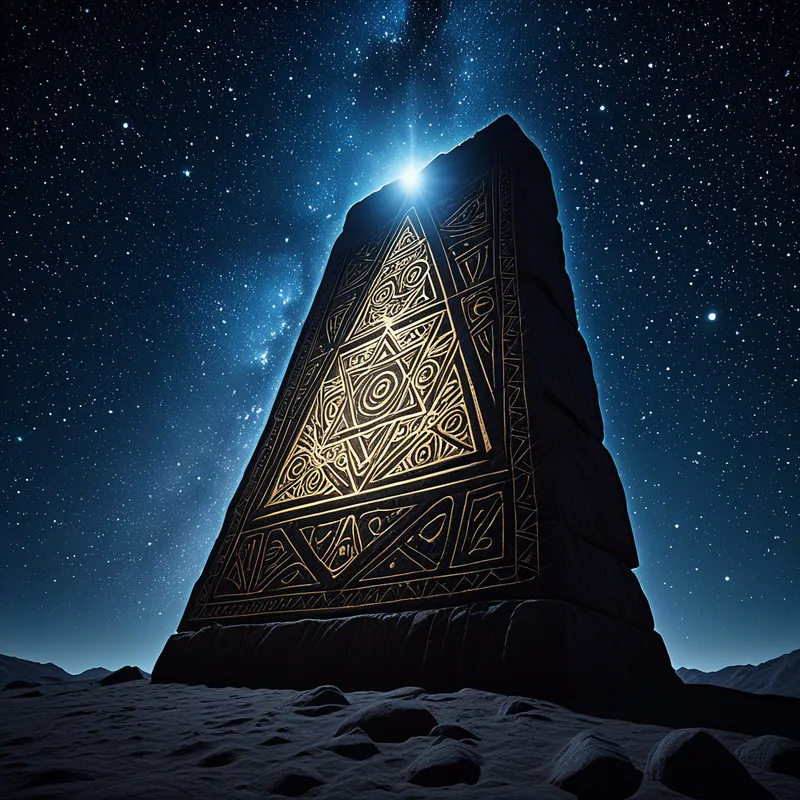
The Tetractys in Pythagorean p Myth Meaning & Symbolism
A sacred pattern emerges from the primordial void, a ladder of ten points revealing the divine order of the cosmos and the soul's path to wholeness.
The Tale of The Tetractys in Pythagorean p
Listen. Before number, before word, there was the Monad—the One, the silent, boundless All. It was not a place, but a condition: perfect, undifferentiated potential. From this stillness, a yearning was born, not a sound but a vibration—the Dyad. The One gazed upon its own possibility and saw Otherness. This was the first separation, the first trembling, the birth of Limit and the Unlimited.
From the tension between these two—the yearning of the One and the formlessness of the Dyad—a third principle emerged: Harmony. This was the Triad. It was the child of unity and diversity, the first shape to hold meaning. Yet the cosmos remained a blueprint, a silent idea.
Then, from the heart of the Triad, a miracle of ordering occurred. The principles began to dance, to relate, to find their stations. This was the birth of the Tetractys. It did not appear with a crash, but with the inevitable, silent certainty of a snowflake forming in cold air.
See it take shape in the mind’s eye of the cosmos: A single, brilliant point of light—the Monad, the source. Below it, two points appear, not side-by-side, but one slightly offset from the other, representing the Dyad—the first polarity, the arche of all things dual. Below these, three points settle into a stable line, the Triad—the surface of the world, the plane of manifestation. And finally, at the base, four points form a solid square, the Tetrad—the solid, sensual reality of the material world.
Ten points in total. Four tiers. A perfect, expanding equilateral triangle. This was the Tetractys, the pattern of all patterns. It was the first map, the first code, the first utterance of the universe that contained within its simple geometry the secret of the musical scale, the motion of the planets, the nature of justice, and the very structure of the soul. The conflict was not of battle, but of chaos seeking form. The resolution was this silent, luminous structure—a ladder descending from the divine mind into the clay of earth, and a ladder ascending back from the confusion of the many to the clarity of the One. The cosmos breathed its first breath, and in that breath was the whisper of the sacred oath: “By him that gave to our soul the Tetractys, which hath the fountain and root of ever-springing nature.”
Cultural Origins & Context
This is not a myth of a single people, but of a school—the Pythagorean community of Croton in Magna Graecia (southern Italy) in the 6th century BCE. It was an oral teaching, a profound secret revealed only after years of ascetic preparation and silence. The myth of the Tetractys was not told around a fire to the public; it was demonstrated in the hushed, lamplit syssition, traced in sand or shown with pebbles (psêphoi).
Its tellers were not bards, but philosopher-mystics who saw the universe as fundamentally mathematical and musical. The Tetractys was their most sacred symbol, so potent that they swore oaths by it. Its societal function was initiatory and unifying. It provided a cosmological framework that connected ethics (the four virtues), science (the four elements), spirituality (the descent and ascent of the soul), and art (the harmonic ratios) into one coherent, holy system. It was the core curriculum of a way of life aimed at purifying the soul and remembering its divine, numerical origin.
Symbolic Architecture
The Tetractys is the ultimate symbol of emanation and return. It is a map of how the One becomes the Many, and how the Many can consciously return to the One. Each tier is a world, a state of being.
The single point at the apex represents the transcendent source, the Monad, which is pure consciousness without object. The second row, the Dyad, symbolizes the primordial split—subject and object, self and other, the birth of awareness and, with it, longing and conflict. The third row, the Triad, is the reconciling principle. It is the child born of the marriage of opposites, the plane where relationships and meaning are born. The fourth and foundational row, the Tetrad, is the solid world of the four elements, the stage of human life with its four seasons, four directions, and four humors.
The journey from the One to the Ten is the story of creation; the journey back from the Ten to the One is the story of enlightenment.
Psychologically, it represents the structure of the psyche itself. The Monad is the Self, the total, often unconscious, psyche. The Dyad is the ego and the shadow, the first division within consciousness. The Triad is the mediating function, the transcendent function that can resolve conflicts. The Tetrad is the four functions of consciousness (thinking, feeling, sensation, intuition) through which we experience reality. The whole pattern is a mandala of wholeness, a schematic for individuation.
The Dreamer’s Resonance
When the Tetractys appears in a modern dream, it is rarely as a literal geometric diagram. It manifests as a profound, often wordless, experience of pattern recognition. One might dream of a tree with branches that split in a perfect 1-2-3-4 progression. One might hear a chord of music that feels cosmically resolved, or see a family tree, an organizational chart, or a crystal lattice that evokes a deep sense of “rightness” and order.
Somatically, this dream often follows or precedes a period of chaotic feeling or intellectual fragmentation. The dream is the psyche’s own attempt at re-integration, showing the dreamer the hidden architecture beneath their turmoil. The psychological process is one of re-membering—not recalling a fact, but putting the scattered parts of the self back into their proper, harmonious relationship. The dream presents the Tetractys as a healing image, a psychic immune response to disorientation, offering a silent, visual proof that chaos has an underlying, beautiful order. The dreamer wakes not with an answer, but with a newfound capacity to trust the process of their own unfolding.
Alchemical Translation
The alchemical work mirrored in the Tetractys is the opus contra naturum—the work against nature’s entropic tendency toward dispersion. It is the conscious reversal of the emanation, the gathering of the scattered fragments of the personality back into the golden vessel of the Self.
The process begins at the base, in the Nigredo of the Tetrad—the confused, conflicting material of our lives (earth, water, air, fire of our emotions and instincts). Through introspection (the Triad, the mediating principle), we begin to see the relationships between our conflicts. We move to the Dyad, the Albedo, where we consciously confront the core oppositions within us: conscious vs. unconscious, persona vs. shadow. This is a stage of intense tension.
The final transmutation is not an addition, but a subtraction—a letting go of all identifications until only the singular point of pure awareness remains.
The ultimate goal is the Rubedo, achieved at the apex of the Monad. This is not an inflation of the ego, but its dissolution into the Self. The alchemist, like the Pythagorean initiate, uses the Tetractys as a meditation device. By contemplating the form, they ritually ascend the tiers: from mastering the four elements of their base nature (Tetrad), to understanding ternary relationships (Triad), to reconciling fundamental dualities (Dyad), and finally, to achieving the non-dual state of the Monad—the philosopher’s stone, which is not a physical object, but the fully integrated and realized psyche. The myth teaches that enlightenment is not a vague spiritual feeling, but a precise, structured return to the source code of existence.
Associated Symbols
Explore related symbols from the CaleaDream lexicon: