The Ten Commandments Myth Meaning & Symbolism
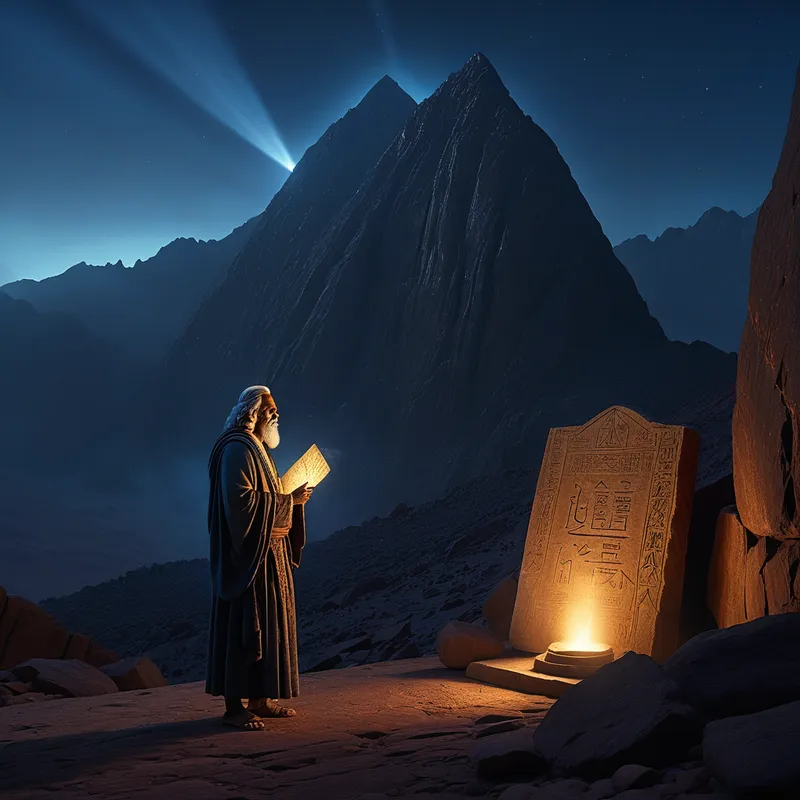
A prophet ascends a trembling mountain to receive a covenant of law from a hidden God, forging the soul of a people from the fire of divine will.
The Tale of The Ten Commandments
The air on the plain was thick with the memory of dust—the dust of Egypt, the dust of [the wilderness](/myths/the-wilderness “Myth from Biblical culture.”/), and now, the dust of fear. For three days, the people had washed their garments and held their breath, forbidden from even touching the foot of the mountain that now dominated their world. [Mount Sinai](/myths/mount-sinai “Myth from Biblical culture.”/) was no longer a place of stone and sky. It was a living entity, wrapped in a thick, roiling cloud that pulsed with a deep, subterranean thunder. Lightning, not from [the sky](/myths/the-sky “Myth from Persian culture.”/) but from within the cloud itself, licked [the summit](/myths/the-summit “Myth from Taoist culture.”/) with a fire that did not consume, only revealed the terrible outline of a Presence.
At the heart of this tempest stood one man, [Moses](/myths/moses “Myth from Biblical culture.”/). His sandals were long removed, for the ground he walked was holy terror. He did not climb; he was summoned, drawn upward as if the mountain itself inhaled him into its smoky heart. The people below watched, a sea of upturned faces bleached pale by the unearthly glow, hearing not words but a Voice—a sound that was all sounds at once: the crack of splitting granite, the roar of a furnace, the whisper of a desert wind, and beneath it all, a tone so profound it vibrated in the marrow of their bones.
The Voice spoke. It did not request. It declared. Each utterance was not a sound heard by the ear, but a truth carved directly upon the soul of [the world](/myths/the-world “Myth from Tarot culture.”/). “I am.” The foundation of all that is. “You shall have no other.” The boundary of the ultimate relationship. “You shall not make a graven image.” The defense of the unknowable mystery against the grasp of human hands. The commandments fell, one after another, like tectonic plates settling into a new order: a sacred architecture for human life. Honor the source. Sanctify time. Honor [the vessel](/myths/the-vessel “Myth from Alchemical culture.”/) of life that is your father and mother. You shall not murder the spark. You shall not violate the covenant of union. You shall not steal another’s story or substance. You shall not bear false witness against your neighbor’s soul. You shall not covet the life that is not yours.
When the Voice ceased, the silence was more deafening than the thunder. Into that silence, Moses was given two tablets of stone, hewn not by human tool but from the mountain’s own heart. Their surfaces bore the inscriptions, the work of the divine finger itself—a permanent, physical covenant. He descended, the weight of the tablets an impossible gravity, a new axis for a wandering world. But the tale does not end in solemnity; it erupts in human frailty. Reaching the camp, Moses found the people, unable to bear the tension of the formless divine, dancing in ecstatic frenzy around a [golden calf](/myths/golden-calf “Myth from Biblical culture.”/)—a god they could see, touch, and control. In a fury of shattered potential, he cast the tablets down, breaking the stone at the foot of the mountain. The first law was broken by the lawgiver himself. Yet, from that rupture came a second chance, a second ascent, and a second set of tablets, this time carved by human hands but inscribed again by the divine. The covenant was remade, not in pristine perfection, but in the hard-won recognition of human failure and divine persistence.
Cultural Origins & Context
This foundational narrative is embedded in the Torah, specifically the books of Exodus and Deuteronomy. It emerged from [the crucible](/myths/the-crucible “Myth from Alchemical culture.”/) of the Late Bronze Age, a time when the fledgling identity of the Israelites was being forged in stark contrast to the imperial, polytheistic cultures of Egypt and Canaan. The myth was not merely a religious code but a nation-founding epic. It was recited, taught, and ritualized to answer a profound existential question: What makes us a people, distinct from the empires we escaped and the tribes we encounter?
The societal function was multifaceted. It provided a constitutional framework, moving from a tribal structure to a people bound by a common law under a single, transcendent sovereign—YHWH. It established a moral and ethical baseline that regulated everything from worship to commerce to family life. Crucially, it was a story of chosenness and responsibility, not of privilege. The covenant was conditional; blessing was tied to adherence, creating a powerful engine for social cohesion and cultural continuity through exile, diaspora, and return.
Symbolic Architecture
At its core, the myth symbolizes the terrifying and necessary encounter between boundless, chaotic potential (the divine) and the [human](/symbols/human “Symbol: The symbol of a human represents individuality, complexity of emotions, and social relationships.”/) need for [structure](/symbols/structure “Symbol: Structure in dreams often symbolizes stability, organization, and the framework of one’s life, reflecting how one perceives their environment and personal life.”/), meaning, and [relationship](/symbols/relationship “Symbol: A representation of connections we have with others in our lives, often reflecting our emotional state.”/). The [mountain](/symbols/mountain “Symbol: Mountains often symbolize challenges, aspirations, and the journey toward self-discovery and enlightenment.”/) is the [axis](/symbols/axis “Symbol: A central line or principle around which things revolve, representing stability, orientation, and the fundamental structure of reality or consciousness.”/) mundi, the meeting point of [heaven](/symbols/heaven “Symbol: A symbolic journey toward ultimate fulfillment, spiritual transcendence, or connection with the divine, often representing life’s highest aspirations.”/) and [earth](/symbols/earth “Symbol: The symbol of Earth often represents grounding, stability, and the physical realm, embodying a connection to nature and the innate support it provides.”/), where the formless takes form.
The Commandments are not a cage for the spirit, but the riverbanks that allow the soul’s waters to flow with direction and power.
The two tablets themselves represent duality in unity: the first traditionally dealing with humanity’s relationship to the divine (the vertical axis), the second with humanity’s relationship to itself (the horizontal axis). Together, they form a cross, a complete map of relational existence. The shattering of the first tablets is not a tragedy but a profound psychological [truth](/symbols/truth “Symbol: Truth represents authenticity, honesty, and the quest for knowledge beyond mere appearances.”/): the perfect, absolute law is incompatible with imperfect, living humanity. The second set, carved by Moses, signifies the internalization of [the law](/symbols/the-law “Symbol: Represents external rules, societal order, moral boundaries, and the tension between personal freedom and collective structure.”/)—a [covenant](/symbols/covenant “Symbol: A binding agreement or sacred promise between parties, often carrying deep moral, spiritual, or social obligations and consequences.”/) that must be participated in, worked upon, and integrated by the human hand and [heart](/symbols/heart “Symbol: The heart symbolizes love, emotion, and the core of one’s existence, representing deep connections with others and self.”/). The hidden, unnameable God represents the ultimate Self, the core of being that can be related to but never fully possessed or imaged.
The Dreamer’s Resonance
When this myth pattern stirs in the modern dreamscape, it often signals a profound crisis or opportunity in the dreamer’s internal governance. To dream of receiving or being given a set of laws, whether on stone, paper, or screen, points to a moment of existential reckoning. The [psyche](/myths/psyche “Myth from Greek culture.”/) is presenting a non-negotiable framework for the dreamer’s life.
Somatically, this may manifest as dreams of immense pressure, of carrying a great weight, or of standing before an awe-inspiring but frightening natural phenomenon (a volcano, a storm). The psychological process is one of confrontation with one’s own moral architecture. Are the “commandments” one lives by authentic, or are they the inherited, golden calves of parental expectation, social conformity, or unexamined trauma? The dream may reveal the “shattering” of an old, rigid self-concept, creating the space for a more authentic, self-carved code to emerge. It is the psyche’s demand for a conscious covenant with one’s own deepest values.

Alchemical Translation
The alchemical journey modeled here is the transmutation of chaotic, enslaved consciousness (Egypt) into a liberated, self-governed individual. The process begins with the [nigredo](/myths/nigredo “Myth from Alchemical culture.”/): the dark, confusing wilderness journey and the terrifying encounter with the numinous at the mountain—the dissolution of old, comfortable idols.
The ascent up Sinai is the ascent into the terrifying clarity of one’s own conscience, where the voice of the Self declares the foundational laws of one’s being.
The receiving of [the law](/myths/the-law “Myth from Biblical culture.”/) is the albedo, the illuminating insight that provides structure. But the crucial alchemical stage is the shattering. This is the [rubedo](/myths/rubedo “Myth from Alchemical culture.”/), the reddening, the painful integration. The perfect, abstract ideal must break against the hard reality of the human community ([the golden calf](/myths/the-golden-calf “Myth from Biblical culture.”/)) and one’s own frailties. Individuation is not about achieving perfect adherence to an internalized divine parent. It is about gathering the broken pieces—the acknowledged failures, shadows, and compromises—and returning to the mountain. The second set of tablets represents the [lapis philosophorum](/myths/lapis-philosophorum “Myth from Alchemical culture.”/), [the philosopher’s stone](/myths/the-philosophers-stone “Myth from Alchemical culture.”/) of the mature personality: a law that is both divinely inspired (aligned with the deep Self) and humanly crafted (conscious, earned, and integrated). The individual becomes the ruler of their own [promised land](/myths/promised-land “Myth from Biblical culture.”/), not through blind obedience, but through a lived, dynamic covenant between their highest Self and their flawed, beautiful humanity.
Associated Symbols
Explore related symbols from the CaleaDream lexicon: