
The Temple Tax Myth Meaning & Symbolism
A tale where a sacred obligation is met not by human toil, but by a coin drawn from the mouth of a fish, revealing a hidden order within the mundane.
The Tale of The Temple Tax
The sun was a hammer on the stones of Capernaum, and the dust of the road tasted of salt and ancient debt. In the shadow of a low doorway, a question hung in the air, heavier than the heat. Two men, their robes bearing the fine silt of the lake, stood before the teacher. Their eyes held the worry of practical men caught in a spiritual snare.
“Teacher,” one began, his voice a dry reed. “Does your master not pay the Temple Tax?”
For a moment, there was only the sound of the distant sea. Then the teacher, Simon Peter, turned and passed through the curtain into the dim coolness of the house. Inside, the air was still. Another sat there, a man whose presence seemed to hold the room in a different kind of gravity. Peter relayed the collectors’ demand.
A smile, subtle as a crack in a clay jar, touched the man’s lips. “What do you think, Simon?” he asked, his voice quiet. “From whom do the kings of the earth collect duty and tax—from their own children or from others?”
“From others,” Peter answered, the logic clear.
“Then the children are exempt,” the man said. His gaze was like a hook cast into deep water. “But so that we may not cause offense… go to the lake and cast out your line. Take the first fish you hook. Open its mouth and you will find a four-drachma coin. Take it and give it to them for my tax and yours.”
The instruction hung in the air, absurd and luminous. Peter, the fisherman who had left his nets to follow a different kind of catch, now found himself commanded back to the familiar water for a most unfamiliar purpose. He walked down to the shore, the old rhythms of his body returning. The lake stretched, a vast plate of beaten silver under the sky. He took his line, the weight of the hook a familiar prayer in his hand.
He cast. The line sang, then sank into the depths. A tug—not the fight of a great catch, but a sure, deliberate pull. He drew it in. There, twisting in the light, was a fish, its scales flashing like a thousand tiny coins. In his hands, it was just a fish from the lake he knew so well. But the command echoed. With a thumb, he pressed the jaw open.
And there it was. Not seaweed, not a pebble. A stater. A silver coin, cool and real, resting on the fish’s tongue as if placed there by a careful hand. It gleamed with the authority of the empire and the sanctity of the Temple. It was the exact amount. The impossible change, drawn not from a purse but from the belly of the world itself. He paid the tax, and the collectors, satisfied with the clink of silver, moved on, never knowing the sea had spoken. The obligation was met, but the world had been quietly unmade and remade in the catching of a fish.

Cultural Origins & Context
This brief narrative is found within the Gospel of Matthew (17:24-27), a text composed for a community navigating a profound identity crisis. They were Jews who followed Jesus of Nazareth as the Messiah, yet they remained within the gravitational pull of Temple piety and Roman occupation.
The Temple Tax was a real, annual half-shekel obligation for every Jewish male, a sacred duty for the maintenance of the cosmic center of their world. The collectors in the story are not villains, but functionaries of a divine order. The tension, therefore, is not between good and evil, but between competing claims of belonging and authority. For Matthew’s community, the story answered a pressing question: Do we, as followers of the Christ, still belong to the old system? The tale provides a paradoxical answer—a “yes, but…” It affirms the obligation (to avoid offense) while simultaneously transcending it through a miracle that originates entirely outside the system’s economy. It is a myth of transition, told to a people in the liminal space between an old covenant and a new, unseen one.
Symbolic Architecture
At its heart, this is a myth about the meeting point of two realms: the realm of Law, obligation, and the civilized order (the Tax, the Temple), and the realm of the unconscious, the deep, and the providential (the Lake, the Fish).
The Temple Tax symbolizes the legitimate, sacred debt we feel to the structures that formed us—family, tradition, society, even our own internalized superego. It is the price of belonging. Peter, here, represents the ego caught between these demands and a new, unsettling consciousness.
The coin is not earned; it is found. It is the latent value hidden within the depths of one’s own nature, waiting to be integrated.
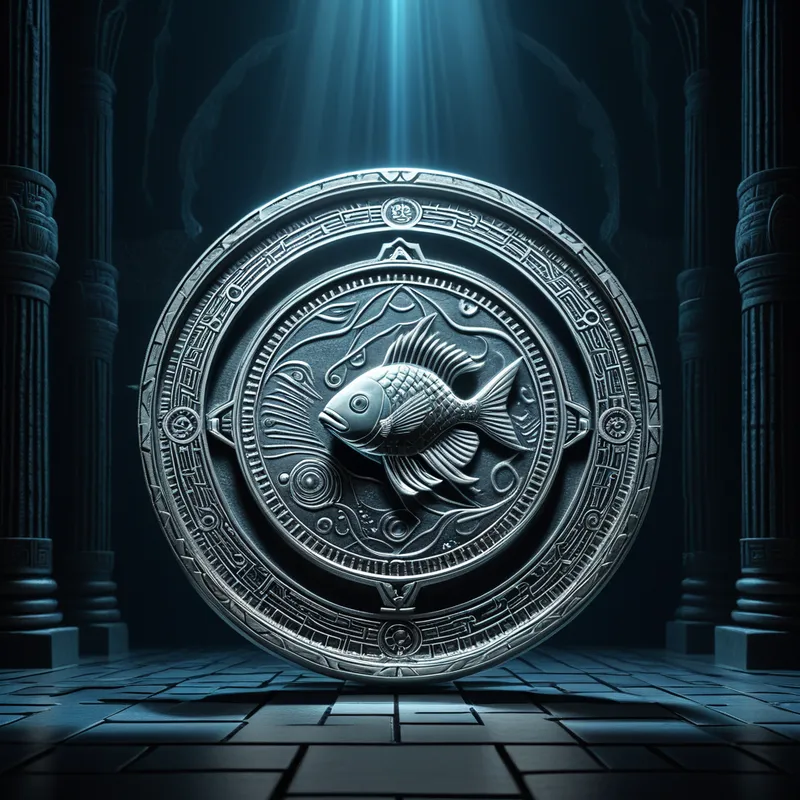
The Fish is an ancient, multivalent symbol. In the depths of the Sea of Galilee, it represents the teeming, unconscious life of the psyche, the instinctual world. That the coin is in the mouth of the fish is critical. The mouth is the organ of intake, expression, and breath (pneuma, spirit). The solution to the conscious dilemma (the tax) emerges from the place where the deep world speaks. The Coin, a stater, is the perfect, pre-measured value. It is the symbol of wholeness (it covers both Jesus and Peter) and of the meeting point: it bears the stamp of Caesar (the worldly order) and is used for the Temple (the spiritual order). It is the redeemed symbol of the world, drawn up from the deep.
The Dreamer’s Resonance
When this myth stirs in the modern soul, it may manifest in dreams of being presented with a bill or a fee that feels both just and impossible to pay from one’s current resources. The setting is often liminal—a train station, a government office at night. The dreamer searches empty pockets in panic.
Alternatively, one might dream of fishing in a familiar yet strangely deep body of water. The catch is never a normal fish; it may be translucent, speak, or, upon inspection, contain a key, a jewel, or indeed, a coin. The somatic sensation is one of surprise and recognition, a release of tension held in the chest and jaw. Psychologically, this dream pattern signals a confrontation with a profound obligation—perhaps to a parent, a past promise, or a societal role—that the conscious mind feels bankrupt to address. The psyche is announcing that the resolution will not come from more striving within the old economy (working harder, people-pleasing), but from a descent into the instinctual, forgotten parts of the self. The “fish” represents the autonomous, life-giving insight from the unconscious that carries the exact “currency” needed to settle the account and move forward.

Alchemical Translation
The alchemical process mirrored here is not one of violent revolution, but of subtle integration and transmutation. The conscious mind (Peter) is given an impossible task that bridges its old loyalties and its new calling. The ego must return to its origins (the lake, the basic instincts) but with a new intentionality—not to catch food for sustenance, but to seek a specific, symbolic solution.
The miracle is in the precise correspondence: the deep world knows the exact measure required by the upper world. This is the individuating promise—that the Self is already in possession of what the ego desperately seeks.
The Lead of the situation is the burden of obligation, the weight of the “should.” The Fish represents the prima materia, the chaotic, living substance of the unconscious. The act of fishing with intent is the opus, the work. The Coin in the Mouth is the lapis philosophorum, the philosopher’s stone—the discovered treasure that transmutes base anxiety into liberated duty. The tax is paid, but the payer has been fundamentally altered. He has learned that the resources for fulfilling his obligations to the collective are not extracted from his weary ego, but are gifted from the boundless, intelligent depth of the psyche itself. The process completes not with the rejection of the Temple, but with a payment that sanctifies both the Temple and the deep sea from which the payment came. The individual becomes a living bridge between heaven and the abyss, law and grace, obligation and freedom.
Associated Symbols
Explore related symbols from the CaleaDream lexicon: