The Temple of Solomon Myth Meaning & Symbolism
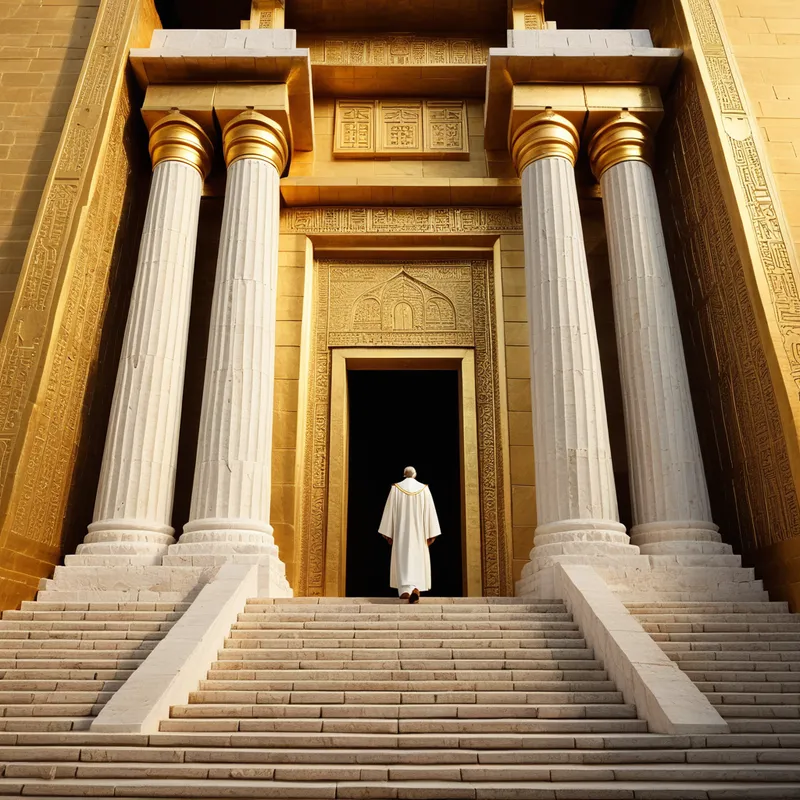
King Solomon builds a magnificent temple to house the divine presence, a sacred center of order, covenant, and cosmic harmony that is ultimately lost and mourned.
The Tale of The Temple of Solomon
Listen, and hear the tale of the House that was not a house, built by a king who was more than a king. In the days when the cedars of Lebanon touched the clouds and the land flowed with the promise of a covenant, there was a king named [Solomon](/myths/solomon “Myth from Biblical culture.”/). His father, the warrior-king David, had dreamed of a dwelling for the Name, a fixed place for the Ark that wandered with the people in a tent. But the sword was in David’s hand, and the task of peace was given to his son.
Solomon, whose wisdom was whispered by [the wind](/myths/the-wind “Myth from Various culture.”/) and sought by queens from distant lands, received the vision. He sent envoys to Hiram of Tyre, and the mountains groaned as the great cedars were felled, their scent a holy incense. From the quarries of [Jerusalem](/myths/jerusalem “Myth from Biblical culture.”/), the sound of iron on stone was a constant prayer—ashlar blocks, cut so precisely that no hammer was heard on site. The wealth of nations flowed in: gold from Ophir, bronze beyond measure, precious stones that held the light of forgotten stars.
For seven years, the mountain of Moriah was a hive of sacred industry. The form emerged from the divine blueprint given to David: a long hall, the Holy Place, leading to a perfect, terrifying cube—the Holy of Holies. Before it stood two great pillars of bronze, Jachin and Boaz, sentinels of stability and power. Within, walls were overlaid with gold, and cherubim of olive wood, their wings spanning [the void](/myths/the-void “Myth from Buddhist culture.”/), guarded the emptiness where the Presence would rest.
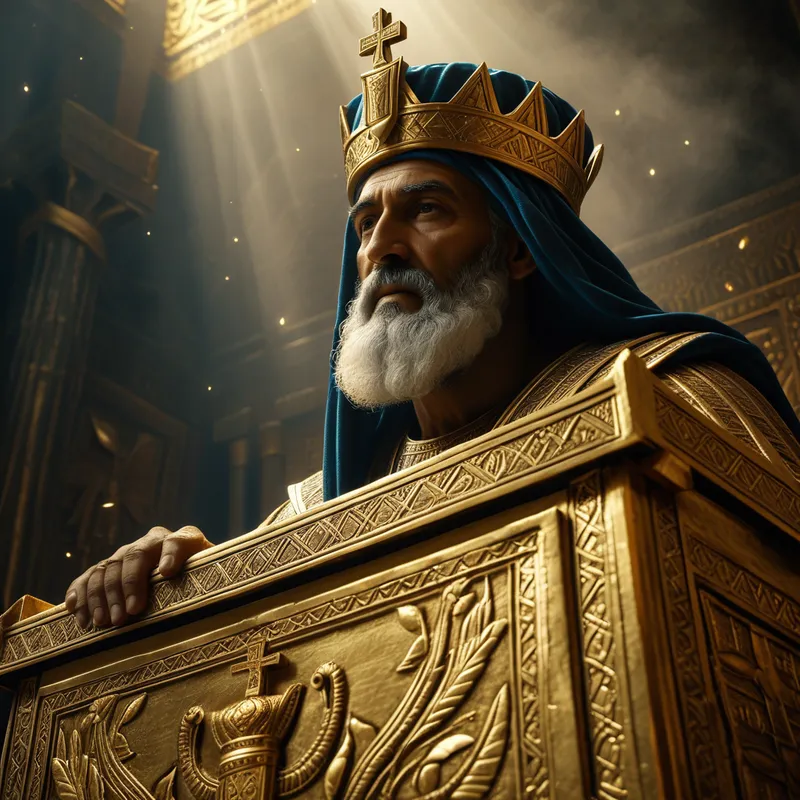
Then came the day of dedication. The air was thick with the smoke of a thousand sacrifices. The Levitical choir’s voices rose as one, and the priests, trembling, brought the ancient Ark of the Covenant from its tent. They carried it through the courts, past the bronze sea, through the Holy Place, and into the utter darkness of [the Holy of Holies](/myths/the-holy-of-holies “Myth from Biblical culture.”/). As they withdrew, a cloud filled the House, a cloud so dense and glorious that the priests could not stand to minister. Solomon spread his hands to the heavens and spoke a prayer that wove together creation and covenant, heaven and earth, pleading that this House would be a place where prayers would be heard.
And for a time, it was so. The glory dwelt there. It was the navel of [the world](/myths/the-world “Myth from Tarot culture.”/), the axis where divine order met human devotion. But the tale does not end in permanence. The glory that filled it could also depart. Generations turned, and the gold grew dim with neglect and idolatry. The echo of hammers returned, not to build, but to break. The Babylonians came with fire. The gold was scraped away, the cedar beams became smoke, and the great stones were pulled down one by one, until only the weeping of the exiles remained, by the rivers of Babylon, remembering Zion.
Cultural Origins & Context
The myth of [the Temple](/myths/the-temple “Myth from Jewish culture.”/) is not a single story but a foundational stratum in the identity of ancient Israel, woven from historical memory, theological aspiration, and national trauma. Its primary sources are the biblical books of 1 Kings and 2 Chronicles, texts compiled and edited by priestly and deuteronomistic scribes during or after the Babylonian Exile. This timing is crucial: the story of its glorious construction was told and codified in [the shadow](/myths/the-shadow “Myth from Jungian culture.”/) of its catastrophic destruction.
It functioned as a national charter myth, explaining the zenith of Israel’s power under Solomon and providing the theological rationale for its downfall. The Temple was the physical anchor of the Davidic Covenant—God’s promise of an eternal dynasty and a secure homeland. It centralized worship, moving from a mobile, tribal [Tabernacle](/myths/tabernacle “Myth from Biblical culture.”/) to a fixed, royal capital. This shift reflected the transition from a confederation of tribes to a unified monarchy. The myth was perpetuated by priests, prophets, and lamenting poets. It served as a measure of fidelity: the people’s obedience was mirrored in the Temple’s upkeep; their apostasy foretold its ruin. In exile, the memory of the Temple became the core of liturgical hope, the blueprint for a future restoration, making it not just a lost building but the soul of a people’s longing.
Symbolic Architecture
The [Temple](/symbols/temple “Symbol: A temple often symbolizes spirituality, sanctuary, and a deep connection to the sacred aspects of life.”/) is the ultimate [symbol](/symbols/symbol “Symbol: A symbol can represent an idea, concept, or belief, serving as a powerful tool for communication and understanding.”/) of sacred order imposed upon [chaos](/symbols/chaos “Symbol: In Arts & Music, chaos represents raw creative potential, uncontrolled expression, and the breakdown of order to forge new artistic forms.”/). It is a [microcosm](/symbols/microcosm “Symbol: A small, self-contained system that mirrors or represents a larger, more complex whole, often reflecting the universe within an individual.”/), a mirror of the [cosmos](/symbols/cosmos “Symbol: The entire universe as an ordered, harmonious system, often representing the totality of existence, spiritual connection, and the unknown.”/) itself. Its three-tiered [structure](/symbols/structure “Symbol: Structure in dreams often symbolizes stability, organization, and the framework of one’s life, reflecting how one perceives their environment and personal life.”/)—the Outer Court (the world of the people), the Holy Place (the [realm](/symbols/realm “Symbol: The symbol of ‘Realm’ often signifies the boundaries of one’s consciousness, experiences, or emotional states, suggesting aspects of reality that are either explored or ignored.”/) of the priests and the light of the [Menorah](/symbols/menorah “Symbol: A seven-branched candelabrum central to Judaism, symbolizing divine light, wisdom, and the enduring covenant between God and the Jewish people.”/)), and the Holy of Holies (the unapproachable, dark center of divine [presence](/symbols/presence “Symbol: Presence in dreams often signifies awareness or acknowledgment of something significant in one’s life.”/))—maps the [human](/symbols/human “Symbol: The symbol of a human represents individuality, complexity of emotions, and social relationships.”/) [journey](/symbols/journey “Symbol: A journey in dreams typically signifies adventure, growth, or a significant life transition.”/) from the profane to the profoundly sacred.
The Temple is not where God is contained, but where the human soul learns to approach the uncontainable.
The Holy of Holies, a perfect cube of darkness, represents the Mysterium Tremendum. It is empty, holding only the Ark, because the true divine cannot be imaged. This [emptiness](/symbols/emptiness “Symbol: Emptiness signifies a profound sense of void or lack in one’s life, often related to existential fears, loss, or spiritual quest.”/) is the most potent symbol of all—a [space](/symbols/space “Symbol: Dreaming of ‘Space’ often symbolizes the vastness of potential, personal freedom, or feelings of isolation and exploration in one’s life.”/) reserved for direct, unmediated encounter, for the terrifying and glorious presence that transcends all form. The pillars Jachin and Boaz symbolize the stable, bipolar structure of [reality](/symbols/reality “Symbol: Reality signifies the state of existence and perception, often reflecting one’s understanding of truth and life experiences.”/) (mercy and judgment, active and receptive) through which one must pass to enter the sacred. The Temple’s destruction, therefore, is not merely a historical [event](/symbols/event “Symbol: An event within dreams often signifies significant life changes, transitions, or emotional milestones.”/) but a profound psychological symbol of the collapse of inner order, the shattering of the [vessel](/symbols/vessel “Symbol: A container or structure that holds, transports, or protects something essential, representing the self, emotions, or life journey.”/) meant to hold meaning.
The Dreamer’s Resonance
When the Temple appears in modern dreams, it rarely manifests as a intact, tourist-site edifice. More often, the dreamer is building it, searching for it in a labyrinthine city, discovering a hidden, ruined wing of their own home, or witnessing its desecration or collapse. These are dreams of profound psychic reorganization.
To dream of building the Temple signals a conscious, arduous process of creating inner structure—integrating ethics, building a coherent worldview, or establishing sacred boundaries (a [temenos](/myths/temenos “Myth from Greek culture.”/)) in one’s life. The feeling is often one of focused, solemn purpose. To dream of a ruined or defiled Temple speaks to a crisis of meaning, a feeling that one’s core values or spiritual center have been violated or neglected. The somatic response can be a deep, grieving emptiness in the chest or gut. Discovering a hidden Temple within one’s own house is a powerful indication of encountering [the Self](/myths/the-self “Myth from Jungian culture.”/)—realizing that the sacred, organizing center has been within all along, merely forgotten or walled off. The dreamer in this pattern is undergoing the essential human work of making a dwelling for the soul.
Alchemical Translation
The myth of Solomon’s Temple is a master blueprint for the alchemical process of individuation. The raw materials—the chaotic forests of Lebanon, the unshaped stone, the unrefined gold—represent the unconscious, instinctual, and fragmented aspects of the [psyche](/myths/psyche “Myth from Greek culture.”/). [King Solomon](/myths/king-solomon “Myth from Biblical culture.”/), the ruling ego-consciousness endowed with wisdom (Chokhmah), is [the alchemist](/myths/the-alchemist “Myth from Various culture.”/) who directs the work.
The seven years of construction mirror the stages of psychic refinement. The precise cutting of stone (squaring the circle) is the difficult work of confronting and shaping one’s complexes. The overlaying of gold is the gilding of the personality with the value of self-awareness. The central operation is the creation of the Holy of Holies—the [vas hermeticum](/myths/vas-hermeticum “Myth from Alchemical culture.”/) or sealed vessel where [the great work](/myths/the-great-work “Myth from Alchemical culture.”/) takes place. This is the protected, inner sanctum of the psyche where the conscious ego must, in a moment of supreme surrender (the dedication), introduce the Ark of the Covenant (the deep, foundational contents of the soul) and then withdraw. One does not dwell in the Holy of Holies; one visits it in prayer and returns to the world.
The final, necessary stage of the alchemy is the destruction. The Babylonian fire is the nigredo, the dark night of the soul, where all constructed identity is burned away. Only through this loss does the Temple cease to be an external object and become an internal, eternal reality—the Self that can never be destroyed, only mourned and remembered, until it is rebuilt from within.
Thus, the individual’s journey is not to possess a static, perfect inner temple, but to engage in the eternal cycle of its conscious construction, devout habitation, tragic loss, and faithful remembrance—a cycle that, each time, forges a more resilient and authentic soul.
Associated Symbols
Explore related symbols from the CaleaDream lexicon: