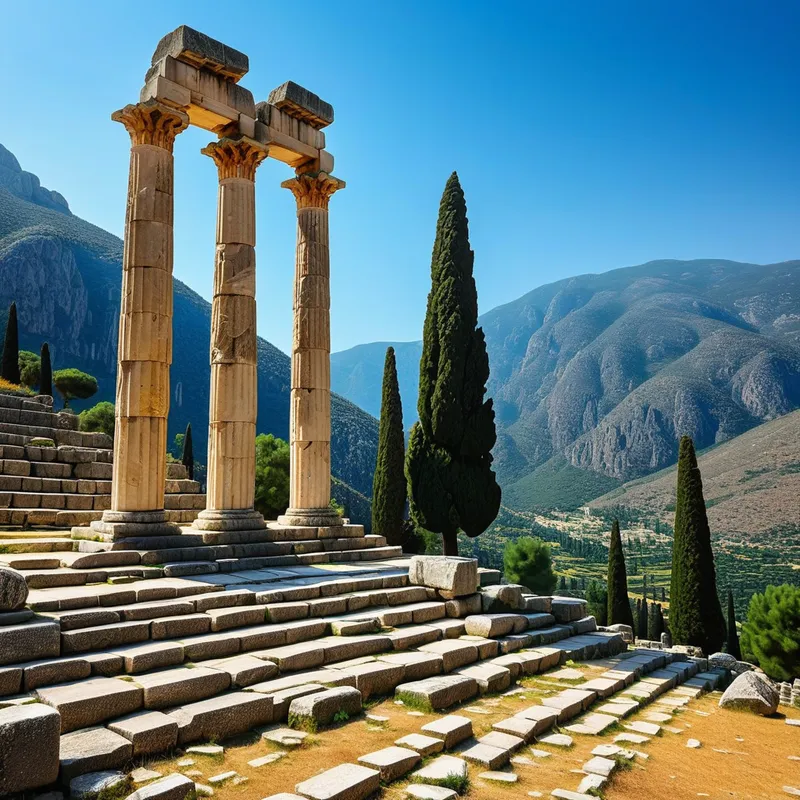
The Temple of Delphi in ancien Myth Meaning & Symbolism
The story of the sacred site where the god Apollo established his oracle, speaking through the Pythia, who channeled the earth's wisdom from a chasm of intoxicating vapors.
The Tale of The Temple of Delphi in ancien
Listen, and let the mists of Parnassus part. Before the gleaming columns rose, this was a place of raw, chthonic power. Here, in a deep cleft of the living rock, the great serpent Python, child of the Earth herself, coiled. Its breath was the very exhalation of Gaia, a potent, intoxicating vapor that rose from the world’s dark heart. To this place came the bright one, the Far-Shooter, Apollo. Fresh from his birth on Delos, a golden youth with a silver bow, he sought a place to speak his truth to mortals.
He descended the mountain slopes, a shaft of sunlight piercing the primordial gloom. Python, sensing the new order, rose to defend its ancient domain. A battle shook the cliffs—not of brute strength, but of essence. The serpent’hisssed the old, earthy wisdom of blood and soil. Apollo’s arrow sang the clear, piercing note of individual will and luminous consciousness. The arrow found its mark. Python fell, its great body sinking back into the chasm from whence it came. But Apollo did not merely conquer; he transformed. He did not seal the fissure. He let its sacred pneuma—the breath, the spirit—continue to rise. He took for his priestess a woman of the land, and he named her the Pythia, in memory of the vanquished serpent.
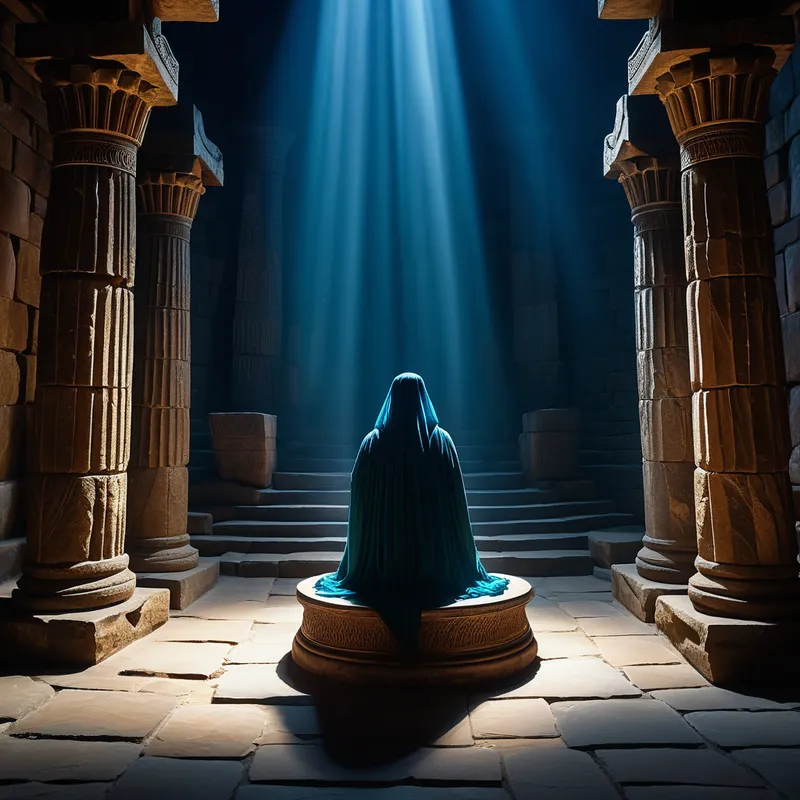
Now, on the seventh day of each warm month, the Pythia would bathe in the Castalian Spring, don simple robes, and descend into the temple’s innermost chamber, the adyton. There, she would seat herself on a three-legged stool, the tripod, placed directly over the chasm. The vapors would envelop her. Her body would tremble, her eyes would roll back, and her voice, no longer wholly her own, would rasp and howl. It was the voice of the god, filtered through the madness of the earth. Attendant priests would translate her ecstatic cries into enigmatic hexameter verse for the kings, generals, and common folk who had journeyed from across the known world, bearing rich gifts and desperate questions. “Know thyself,” was carved at the temple’s entrance, and here, at the very navel of the world—the omphalos—they sought not just knowledge of the future, but a reflection of their deepest selves, however distorted and terrifying the reflection might be.
Cultural Origins & Context
The myth and reality of Delphi are inextricably woven. For over a millennium, from the 8th century BCE onward, the sanctuary was the preeminent spiritual and diplomatic center of the Hellenic world. It was considered the literal center, the omphalos, of the earth. The story of Apollo and Python is an etiological myth that sanctifies a historical takeover, reflecting the ascendancy of the Olympian, patriarchal order over older, earth-centered, possibly Minoan or Mycenaean, cults. The myth was not a fixed text but a living tradition, performed in hymns like the Homeric Hymn to Apollo and reinforced through ritual, art, and architecture at the site itself.
The oracle’s function was profoundly societal. It was consulted on matters of state—foundation of colonies, declarations of war, religious law—and personal dilemma. Its authority stemmed from its perceived neutrality and its sublime, terrifying ambiguity. The priests and the Pythia were the mediators of a divine communication that was inherently unstable and required interpretation. This process turned the sanctuary into a nexus of information, power, and collective psychology, where the will of the gods and the anxieties of humanity met in a cloud of intoxicating vapor.
Symbolic Architecture
At its core, the Delphic myth is a profound symbol of the necessary, yet never complete, integration of opposites. It is not a story of simple victory, but of sacred marriage.
The oracle exists in the tension between the clarity of the sun and the chaos of the chasm. To receive a true word, one must first consent to the divine madness.
Apollo represents the principle of light, order, distinction, and conscious intellect—the archetypal force that says, “Let there be boundaries.” Python and the chthonic vapors represent the unconscious, the undifferentiated, instinctual, and prophetic wisdom of the body and the earth. Apollo slays Python not to eradicate this force, but to harness it, to place it in service of a new consciousness. The Pythia is the living vessel of this integration. Her possession is a state of enthousiasmos—of having the god within. She is the human psyche itself, momentarily shattered so that a transpersonal truth may speak through the cracks. The famous, ambiguous prophecies (“You will go you will return not in war you will perish”) force the supplicant out of passive reception and into active, responsible engagement with fate. The command “Know thyself” at the entrance is the ultimate symbolic key: the journey to the oracle is an externalized quest for the internal oracle of self-knowledge, which always speaks in riddles that we alone must unravel.
The Dreamer’s Resonance
When the Temple of Delphi appears in a modern dream, it rarely manifests as a literal archaeological site. More often, it surfaces as the pattern of seeking cryptic guidance from a numinous, ambiguous source. You may dream of consulting a mysterious authority figure whose words are garbled or paradoxical. You may find yourself in a building with a hidden, lower chamber from which a strange sound or scent emanates. You may be trying to interpret a crucial, but fragmented, message.
These dreams signal a somatic and psychological process of grappling with the unknown within. The “vapors” are the rising contents of the unconscious, intoxicating and disorienting to the ego. The “Pythia” is the dreamer’s own intuitive function, temporarily overwhelmed by this material. The dream is an enactment of the Delphic ritual: the conscious mind (the supplicant) brings a pressing question to the threshold of the deeper self (the adyton), and must withstand the chaotic, non-linear form of the answer. It is a call to develop one’s own capacity for symbolic interpretation—to become both the Pythia and the attending priest, learning to translate the raw, emotional “noise” of the psyche into a meaningful narrative for one’s life.
Alchemical Translation
The alchemical process mirrored in the Delphic myth is that of solutio and coagulatio—dissolution and re-coagulation. This is the heart of psychic transmutation and individuation.
The journey to Delphi is the ego’s quest for direction. The descent into the temple’s depths represents the necessary solutio: the dissolution of rigid, conscious attitudes in the intoxicating “vapors” of the unconscious. The ego’s certainty is broken down, just as the Pythia’s ordinary personality is dissolved. This is a terrifying but fertile chaos, the prima materia of transformation.
The oracle’s power lies not in giving answers, but in breaking the old questions so that new, more profound ones can crystallize from the psychic mist.
From this state, the enigmatic prophecy emerges—the coagulatio. It is not a clear solution, but a new, complex symbol that coagulates from the dissolved elements. The individual’s task is to take this cryptic “stone” (the omphalos of new insight) and carry it back into the world of light and action, to live into its meaning through choices and consequences. The integration is never final; Apollo and the chasm remain in dynamic tension. Thus, the individuated Self is not a state of perfect, static knowledge, but a living temple where conscious life is continually informed by, and respectful of, the deep, murmuring oracle within. To “know thyself” is to commit to this eternal, sacred dialogue.
Associated Symbols
Explore related symbols from the CaleaDream lexicon: