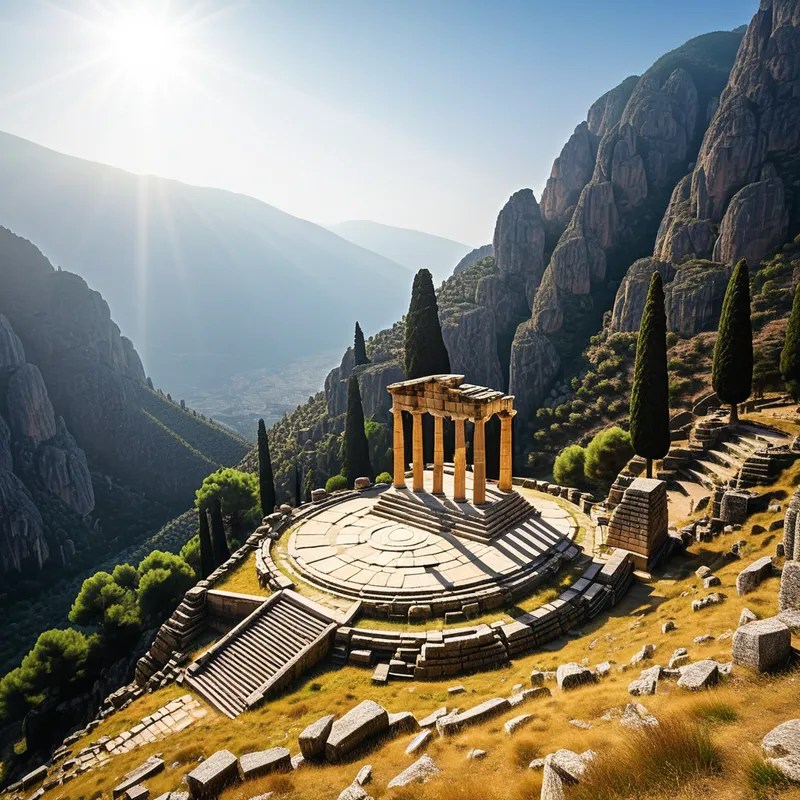
The Temple of Apollo at Delphi Myth Meaning & Symbolism
Apollo slays the serpent Python to claim the omphalos at Delphi, establishing the Oracle where divine wisdom emerges from the chthonic earth.
The Tale of The Temple of Apollo at Delphi
Before the first stone was laid, before the first priestess drew breath, the place was a wound in the world. It was a chasm, a raw fissure in the flank of Mount Parnassus, where the bones of the earth breathed out a vapor that smelled of damp stone and forgotten things. Here, in this primal darkness, coiled the great serpent Python, child of the Earth herself, Gaia. Its scales were the color of tarnished bronze, and its breath was the mist that rose from the crack, a mist that whispered of chaos and the time before order. This was the oracle of the Earth, a place of murmurs and nightmares.
Then came the god of the bright distances. Apollo, golden and terrible, fresh from his birth on the floating isle of Delos, sought a place to speak his will to mortals. His eye fell upon the misty gorge. He saw not a sacred chasm, but a territory of chaos to be conquered, a darkness to be pierced with his clarifying light. With a bow forged by the Hephaestus, and arrows that were shafts of pure sunlight, the young god descended.
The battle was not of clashing armies, but of essences. Python, vast and ancient, rose from its chthonic bed, its hiss the sound of the earth’s core cracking. Apollo, a being of piercing clarity, stood his ground. He loosed his arrows—not once, but again and again—each one a spear of rational truth against the formless dread. The serpent thrashed, its blood, dark as wine, soaking into the sacred ground where it fell. The victory was absolute. From the corpse of the old guardian, Apollo claimed the site. He purified it with laurel branches, and over the very fissure where Python had lain, he built his temple.
But the god was wise. He did not silence the earth’s voice; he harnessed it. He brought priests from Crete, and he chose a vessel: the Pythia. At appointed times, she would descend into the temple’s inner chamber, the adyton. There, seated on a tripod over the fissure, she would breathe the rising vapors—the same pneuma that once inspired Python’s chaos. Now, infused with Apollo’s divine light, the vapors sent her into a sacred frenzy. Her ravings, incoherent and potent, were shaped by the temple priests into the cryptic hexameters that kings and commoners alike would cross the world to hear. And at the heart of the temple, marking the very center of the world, was placed the omphalos. Thus, from the marriage of slain chaos and ordering light, the Oracle of Delphi was born, a place where heaven and earth, clarity and mystery, met in a single, trembling word.

Cultural Origins & Context
The myth of Delphi’s founding is not a singular story from one text, but a tapestry woven from many threads: the Homeric Hymn to Apollo, the works of historians like Herodotus and Plutarch, and the countless local traditions preserved by Pausanias. It functioned as the divine charter for the most important pan-Hellenic sanctuary. In a world of fractious city-states, Delphi was neutral ground, a spiritual and diplomatic center where the entire Greek world—from Sparta to Athens, Corinth to Thebes—acknowledged a higher authority.
The myth served a critical societal function: it explained and legitimized the profound, and potentially unsettling, nature of the oracle. Why would the god of reason and order speak through the incoherent ravings of a possessed woman? The myth provided the answer: the power came from the earth itself, a raw, chthonic force that Apollo had not destroyed, but had sanctified and brought under his patronage. The slaying of Python was the necessary act of culture imposing itself upon nature, but the preservation of the oracle’s mechanism showed that nature’s wild wisdom was indispensable. The priests, the rituals, the laurel crowns—all were Apollonian structures built to channel a power that was fundamentally non-Apollonian. It was a cultural acknowledgment that true wisdom requires both light and shadow, both the clarity of the sun and the vapors of the deep earth.
Symbolic Architecture
At its core, the Delphic myth is a profound map of the psyche’s structure. Python represents the untamed, instinctual, and chaotic forces of the unconscious—the swirling, formless potential that exists before consciousness brings order. Apollo represents the differentiating principle of consciousness itself: light, form, boundaries, and rational understanding. The conquest is not a final eradication, but a necessary differentiation. The ego (Apollo) must establish itself by confronting and ordering the primal, undifferentiated mass of the unconscious (Python).
The Oracle exists in the liminal space where the slain serpent breathes its wisdom into the god’s light. It is the psyche’s sacred chamber where unconscious content is allowed to speak to conscious understanding.
The Pythia is the ultimate symbol of this mediated relationship. She is the human vessel in whom this union occurs. Her frenzy is the unconscious breaking through; the priests’ interpretation is the conscious mind struggling to give it coherent form. The famous maxims inscribed at the temple, “Know Thyself” and “Nothing in Excess,” are Apollonian ideals, but they are advice given from a place that has integrated the Python’s chaotic truth. The omphalos symbolizes the resulting center—not a center of simple, rational order, but the navel of the world, the point of connection to both the maternal earth (Gaia/Python) and the paternal sky (Apollo). It is the Self, in Jungian terms, the midpoint and totality of the personality.

The Dreamer’s Resonance
When this mythic pattern stirs in the modern dreamer, it often manifests as a profound confrontation between structuring principle and chaotic energy. One might dream of a beautiful, orderly building (a library, a temple, one’s own home) that is threatened by an encroaching, wild force—a flooding river, invasive vines, or a lurking serpent in the basement. Alternatively, the dreamer may find themselves in the role of the Pythia: feeling overcome by powerful, incomprehensible emotions or somatic sensations (the “vapors”), struggling to give voice to a truth that feels alien and overwhelming.
Psychologically, this signals a critical phase where long-held structures of identity (the Apollonian temple of the ego) are being challenged by contents rising from the deeper unconscious (the Python). The somatic process is one of disorientation and potential renewal. The body may feel the agitation of the “frenzy”—anxiety, restlessness, powerful but unclear impulses. The dream is an invitation not to flee the chaos, but to find a new, more capacious temple. It asks the dreamer to build a conscious stance strong enough to not be destroyed by the unconscious, yet permeable enough to listen to its oracles.

Alchemical Translation
The journey to Delphi models the alchemical process of individuation—the forging of a whole Self. The initial state is one of identification with either pure chaos (being ruled by unconscious impulses) or rigid order (an ego inflated with rationality, denying the depths). The “nigredo,” or blackening, is the confrontation with Python: the dark, messy, terrifying encounter with all that has been repressed, ignored, or deemed unacceptable in oneself.
Apollo’s act of slaying is the necessary “separatio” and “calcinatio”—the burning away of identification with the primal mass to establish a conscious standpoint. But the alchemy fails if it stops there, resulting in a sterile, disconnected rationality. The crucial next step is the establishment of the oracle, the “conjunctio” or sacred marriage. This is the integration phase, where the energy of the slain serpent is not discarded but becomes the very source of wisdom.
The ultimate goal is not to be Apollo on his throne, but to become the sacred site itself—the place where the fissure and the temple, the vapor and the tripod, exist in dynamic, creative tension.
For the modern individual, this translates to the hard work of building an inner adyton. It means creating a disciplined, regular practice (meditation, journaling, active imagination, therapy)—the Apollonian structure—through which one can consciously and safely engage the rising “vapors” of emotion, memory, and instinct. The interpreted “oracle” that emerges is not a prediction of external fate, but a profound piece of self-knowledge. To heed the command “Know Thyself” is to continually undertake this pilgrimage inward, to the center where one’s own omphalos rests, fed by the deep earth of the soul and illuminated by the discerning light of consciousness.
Associated Symbols
Explore related symbols from the CaleaDream lexicon: