The Temple Market Myth Meaning & Symbolism
A divine figure overturns the tables of commerce within a sacred space, declaring it a house of prayer, not a den of thieves.
The Tale of The Temple Market
The air in the great courtyard of the Herod’s Temple was thick—not with incense, but with the dust of commerce and the sharp cries of the market. It was the time of Passover, and the city swelled like a river in flood. Pilgrims from every corner of the world streamed through the towering gates, their hearts yearning for the sacred. But first, they had to pass through the gauntlet.
In the Court of the Gentiles, the outer ring where all nations were permitted, the sacred space had been hollowed out and filled with a clamorous bazaar. The lowing of cattle, the bleating of sheep, and the frantic cooing of doves in wicker cages created a deafening din. Long tables manned by shrewd-eyed money-changers lined the colonnades. Roman denarii and Greek drachmae, coins bearing the profane images of emperors and gods, clinked and were exchanged for the holy half-shekels. A necessary service, they said. A convenience. But the stench of animal dung and the feverish gleam of profit had replaced the fragrance of devotion.
Then, he entered.
He did not come as a pilgrim with a meek request. He came as a storm. His eyes, usually holding the depth of a calm sea, now flashed like lightning. Without a word, he began to weave cords into a whip. The action itself was a silent, terrifying prophecy. The chatter of bargaining died in throats as people turned to watch.
And then, the tempest broke.
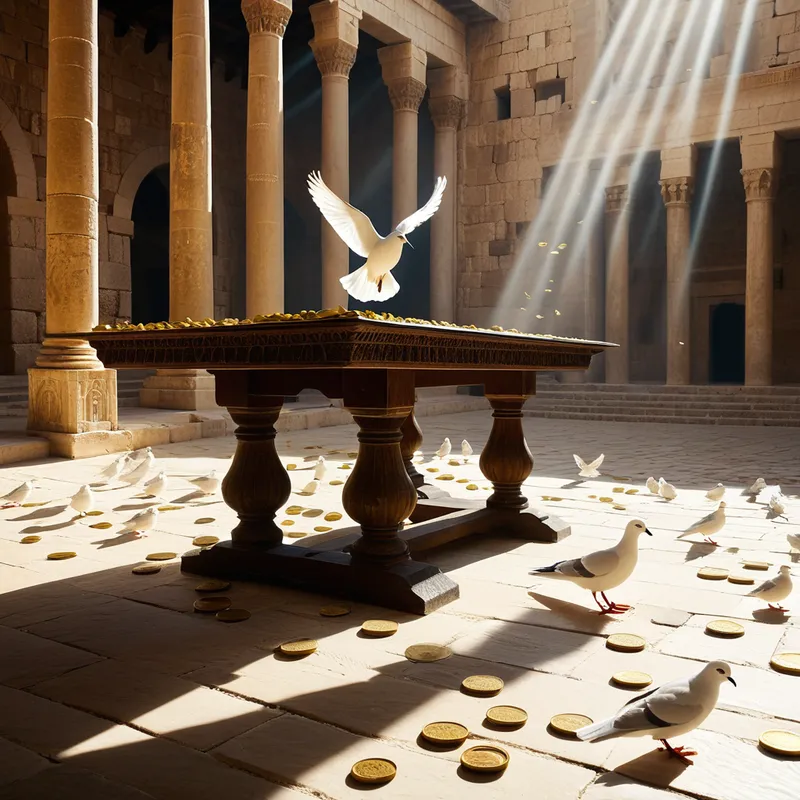
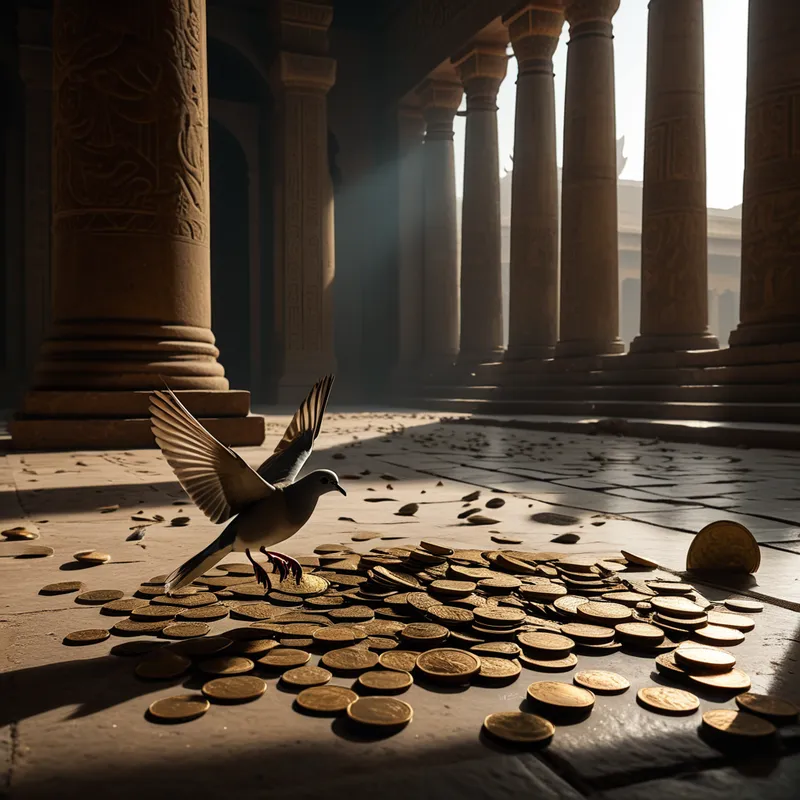
He moved with a terrifying, focused fury. The whip snapped, not upon flesh, but upon the very apparatus of sacrilege. Tables of money-changers, laden with coins, were upended with a crash that echoed off the stone. Wood splintered. A torrent of silver and bronze shekels cascaded across the paving stones, ringing and rolling into the shadows. He strode to the pens, throwing open gates. “Take these things away!” His voice, thunderous, cut through the panic. “Stop making my Father’s house a marketplace!”
The merchants and bankers scrambled in the chaos, clutching at rolling coins, shouting in protest and fear. Doves, suddenly freed, beat their wings in a frantic cloud toward the open sky. Sheep and oxen, confused and lowing, were driven from the porticoes. He stood amidst the wreckage, his chest heaving, the sacred silence rushing back into the space his rage had carved. The courtyard, moments ago a den of noise and trade, was now a shocked, empty arena. The only sounds were the distant prayers from the inner courts and the soft scatter of a last, fleeing coin. The house had been reclaimed.
Cultural Origins & Context
This narrative, found in all four Gospels, is not a quaint anecdote but a seismic event rooted in the tense soil of first-century Judea. The Temple was the absolute center of Jewish religious, economic, and national life. The money-changers and animal sellers provided a necessary service for the Temple tax and for sacrifices, likely sanctioned by the powerful priestly aristocracy. This system, however, was easily corrupted, turning the outer court—the one place where non-Jews could worship the God of Israel—into an inaccessible, profane marketplace.
The act was a direct, public, and violently symbolic challenge to the established religious authority. It echoed the prophets of old, like Jeremiah, who decried those who treated the Temple as a “den of robbers,” a safe haven for corrupt practices. For the early Christian communities telling this story, it served multiple functions: it portrayed Jesus as a prophet greater than Jonah or Solomon, it justified the eventual shift from Temple worship to spiritual worship “in spirit and truth,” and it framed his ministry as a purification of a corrupted covenant. It was a story of revolutionary piety, declaring that the sacred cannot be commodified.
Symbolic Architecture
The myth’s power lies in its stark, almost architectural symbolism. The Temple represents the inner sanctum of the Self, the place of ultimate connection and integrity. The outer court is the threshold between the inner world and the outer world, the interface where sacred intention meets profane necessity.
The marketplace is not commerce itself, but the point where the currency of the soul is exchanged for the coin of the world.
The money-changers symbolize the internal mechanisms that translate pure value—devotion, love, authenticity—into external, negotiable currency: social approval, career success, material security. The sacrificial animals represent our instinctual life, our passions and drives, which become trapped and sold in standardized packages, losing their wild, living connection to the divine. The act of overturning is not mindless destruction, but a necessary deconstruction. It is the psyche’s own immune response, a moment of holy rage that says: This arrangement is a betrayal. This space is for encounter, not transaction.
The Dreamer’s Resonance
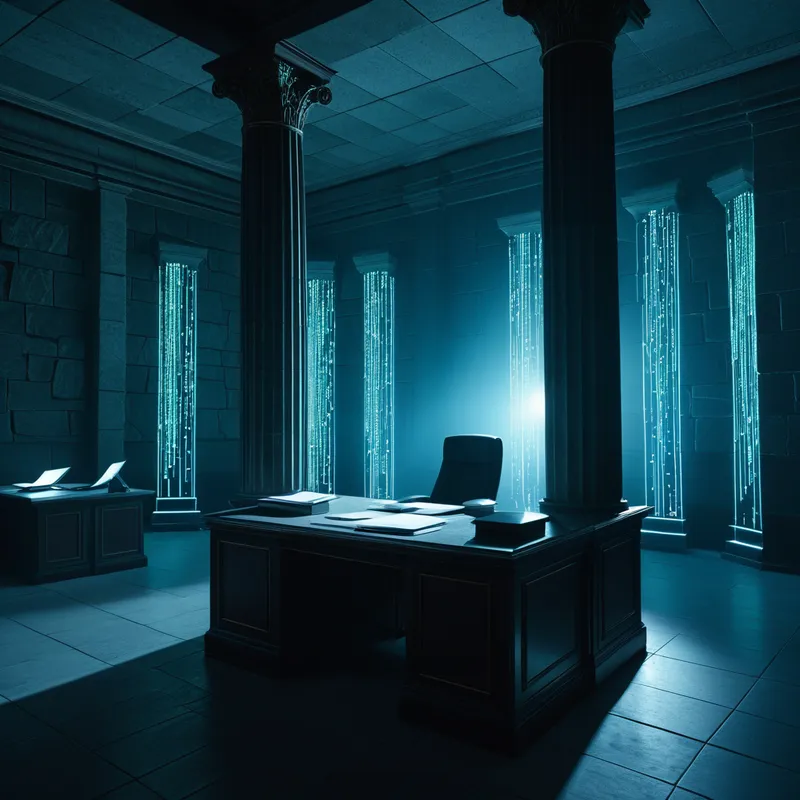
When this myth stirs in the modern dreamer, it often manifests as dreams of violent cleansing or revolutionary acts within familiar, institutional spaces. You may dream of overturning your own office desk, scattering important papers; of tearing down the shelves in a supermarket or a pharmacy; of driving merchants from a grand library or a childhood home turned into a store.
Somatically, this can accompany a feeling of tightness in the chest, a boiling anger that feels righteous yet frightening. Psychologically, it signals a profound intolerance for a life lived on false terms. The “Temple Market” in your psyche is that arena where you have allowed your deepest values (prayer) to be subcontracted to systems of barter (the den). The dream is the eruption of the Self, the Self archetype, refusing the compromise any longer. It is the moment you realize your inner sanctuary has been leased out, and the eviction notice has been served.
Alchemical Translation
The alchemical process mirrored here is separatio and calcinatio—the separation of the pure from the impure through the fierce heat of confrontation. Individuation is not a gentle, linear path. It requires episodes of righteous demolition.
The first stage of building a true inner temple is to clear the courtyard of the merchants who have set up shop in your name.
The “tables” are the ingrained psychological structures, the habitual compromises, the internalized authorities that profit from your fragmentation. Overturning them is an act of psychic rebellion, reclaiming authority from the inner priesthood that manages your spirituality for a fee. The scattered coins represent the devaluation of worldly metrics that once defined your worth. The freed doves—symbols of the spirit and of innocent, natural offering—are your own capacities for love and devotion, released from the cages of transactional relationship.
This myth models the critical, non-negotiable phase in personal transformation where one must become the rebel, not against an external god, but against the profane systems within one’s own soul. It is the violent, beautiful, and terrifying declaration that the core of your being is a house of prayer, and you will suffer no other business to be conducted there. Only after this clearing can the true, silent work of reconstruction begin.
Associated Symbols
Explore related symbols from the CaleaDream lexicon: