The Temple Bell Myth Meaning & Symbolism
A myth of a devoted monk who, through ultimate sacrifice, becomes a great temple bell, his suffering transmuted into a sound that awakens all who hear it.
The Tale of The Temple Bell
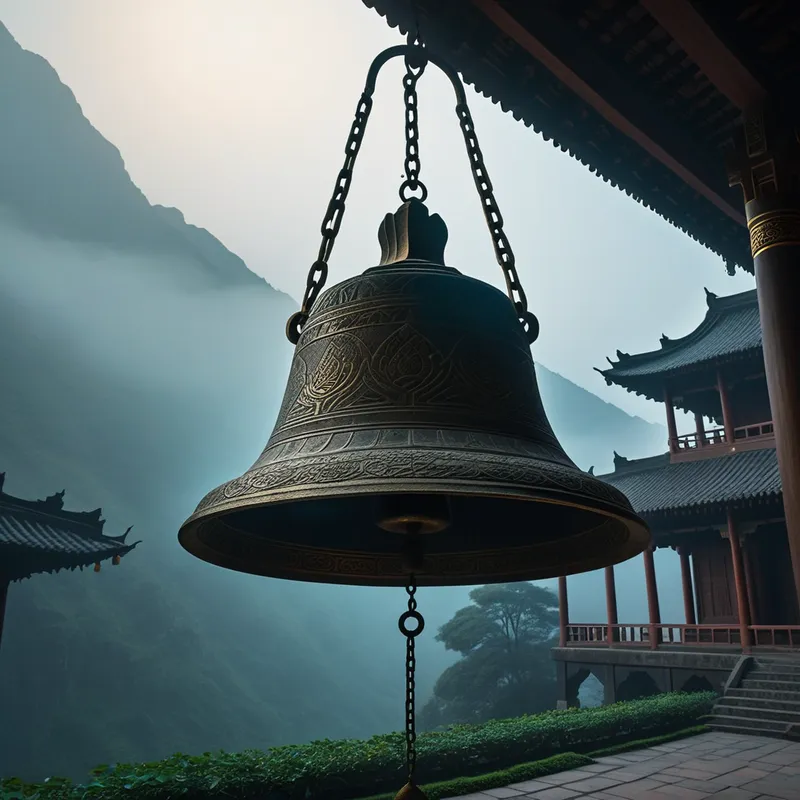
Listen, and you will hear it still, echoing across [the mist](/myths/the-mist “Myth from Celtic culture.”/)-wrapped mountains. In a time when [the world](/myths/the-world “Myth from Tarot culture.”/) was thick with suffering, there stood a monastery so remote it seemed to touch the heavens. Its abbot was an old monk named Lama Tenzin, whose compassion was as deep as the valley below. Yet, a profound sorrow lay upon his heart. The monastery’s great bell, the voice that called the community to practice and marked the hours of contemplation, had cracked. Its call was now a broken, mournful clang, a sound that seemed to mirror the fragmented spirits of the age.
For years, the monks sought to cast a new bell. They gathered copper and tin, they stoked the fires of the foundry until they roared like dragons, but each casting failed. The metal would not sing; it emerged dull, lifeless, or flawed. The silence in the courtyard between the failed attempts grew heavier than stone. One evening, as the last light bled from [the sky](/myths/the-sky “Myth from Persian culture.”/), the monastery’s most devoted disciple, a young monk named Sangye, approached the abbot. His eyes held a terrible, serene clarity.
“Venerable One,” he said, his voice barely a whisper yet heard by all. “The bell lacks a heart. The metal is inert because it has not been consecrated by a true intention. Let my body be the offering. Let my bones strengthen the alloy, my blood temper the bronze, and my spirit become its voice.”
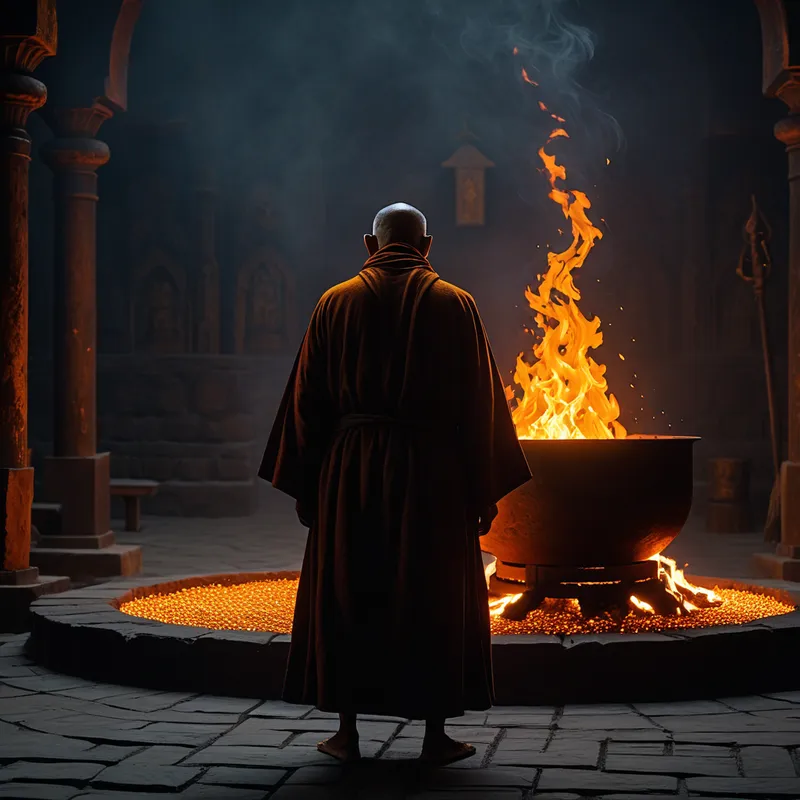
The abbot wept, but in Sangye’s gaze, he saw not despair, but the ultimate Dāna pāramitā. With solemn rites, the community prepared. Sangye bathed, donned pure white robes, and sat in unwavering meditation as [the crucible](/myths/the-crucible “Myth from Alchemical culture.”/) was filled. The fires were lit, and the metals melted into a swirling, golden-orange sea. As the molten tide reached its peak, Sangye stood. He bowed once to his teacher, to his brothers, and to all sentient beings. Then, with a peace that stilled the very wind, he stepped into the blazing heart of the foundry.
There was no cry, only a profound, resonant silence that swallowed all sound. Then, from the flowing bronze, a rich, harmonic hum arose, as if the metal itself was chanting. When the casting was complete and the great bell cooled, it was unlike any other. Its surface bore not just sacred inscriptions, but a subtle, compassionate visage in the patina. When the striker first touched it, the sound that rolled forth was not a mere note. It was a living voice—deep, vast, and infinitely tender. It vibrated in the chest before it was heard by the ear. It did not just mark time; it stopped it. All who heard it—monk, traveler, bird on the wing—felt a sudden, piercing clarity, a moment where all inner noise ceased and only pure, awake presence remained. The bell’s voice became the monastery’s true abbot, calling all back to their original, unbroken nature.
Cultural Origins & Context
This poignant narrative, while not found in the canonical sutras, is a beloved Jātaka-like tale from the Mahayana Buddhist traditions, particularly within Tibetan and East Asian folklore. It belongs to the rich genre of devotional stories that circulated amongst monastic communities and lay practitioners, passed down orally by teachers to illustrate the pinnacle of the Pāramitās. Its primary function was not historical record but profound pedagogy. In a culture where bells are sacred instruments—their sound symbolizing [the Buddha](/myths/the-buddha “Myth from Buddhist culture.”/)‘s voice, wisdom, and the [impermanence](/myths/impermanence “Myth from Buddhist culture.”/) of all compounded things—this myth provided a visceral, archetypal rationale for their power. It answered the devotional heart’s question: “Why does this sound move me so deeply?” The story taught that the most powerful tools for awakening are not merely crafted; they are consecrated by the ultimate generosity, transforming personal sacrifice into a communal resource for enlightenment.
Symbolic Architecture
At its core, the myth is a masterful [allegory](/symbols/allegory “Symbol: A narrative device where characters, events, or settings represent abstract ideas or moral qualities, conveying deeper meanings through symbolic storytelling.”/) for the [alchemy](/symbols/alchemy “Symbol: A transformative process of purification and creation, often symbolizing personal or spiritual evolution through difficult stages.”/) of [consciousness](/symbols/consciousness “Symbol: Consciousness represents the state of awareness and perception, encompassing thoughts, feelings, and experiences.”/). The flawed, broken old [bell](/symbols/bell “Symbol: A bell signifies communication, awakening, and the call to attention, often associated with new beginnings or signals.”/) represents a fractured or merely conventional approach to spirituality—[ritual](/symbols/ritual “Symbol: Rituals signify structured, meaningful actions carried out regularly, reflecting cultural beliefs and emotional needs.”/) without [heart](/symbols/heart “Symbol: The heart symbolizes love, emotion, and the core of one’s existence, representing deep connections with others and self.”/), practice without profound surrender. Sangye, the disciple, embodies the aspiring bodhisattva [consciousness](/symbols/consciousness “Symbol: Consciousness represents the state of awareness and perception, encompassing thoughts, feelings, and experiences.”/), the part of the [psyche](/myths/psyche “Myth from Greek culture.”/) that recognizes a deeper calling beyond [the ego](/myths/the-ego “Myth from Jungian culture.”/)‘s preservation.
The most profound healing often requires the dissolution of the healer. The bell is not forged; it is born from a willing cessation.
The foundry’s blazing fire is the [crucible](/symbols/crucible “Symbol: A vessel for intense transformation through heat and pressure, symbolizing spiritual purification, testing, and alchemical change.”/) of intense practice, adversity, and the heat of transformative [insight](/symbols/insight “Symbol: A sudden, deep understanding of a complex situation or truth, often arriving unexpectedly and illuminating hidden connections.”/) (Prajñā). Sangye’s entry into the molten [metal](/symbols/metal “Symbol: Metal in dreams often signifies strength, transformation, and the qualities of resilience or coldness.”/) is the ultimate act of ego-[death](/symbols/death “Symbol: Symbolizes transformation, endings, and new beginnings; often associated with fear of the unknown.”/)—not as annihilation, but as [transmutation](/symbols/transmutation “Symbol: A profound, alchemical process of fundamental change where one substance or state transforms into another, often representing spiritual evolution or personal metamorphosis.”/). His physical form dissolves, but his essential [intention](/symbols/intention “Symbol: Intention represents the clarity of purpose and direction in one’s life and can symbolize motivation and commitment within a dream context.”/)—[compassion](/symbols/compassion “Symbol: A deep feeling of empathy and concern for others’ suffering, often involving a desire to help or alleviate their pain.”/), the desire to awaken others—is infused into the very substance of the bell. The resulting sound is therefore not an ordinary [vibration](/symbols/vibration “Symbol: A rhythmic oscillation or resonance, often representing energy, connection, or unseen forces. In dreams, it can signal awakening, disturbance, or spiritual communication.”/) but the audible form of enlightened mind: empty of self, yet full of resonant, liberating power. It symbolizes how personal suffering, when fully embraced and offered up, can be alchemized into a universal [medicine](/symbols/medicine “Symbol: Medicine symbolizes healing, transformation, and the pursuit of knowledge, addressing both physical and spiritual health.”/).
The Dreamer’s Resonance
When this myth stirs in the modern unconscious, it often surfaces in dreams of profound personal transformation marked by themes of sacrifice and rebirth. One might dream of melting down prized possessions, of one’s body turning into metal or crystal, or of hearing a sound so beautiful it induces both sorrow and ecstasy. Somatically, this can correlate with a process of “breaking open”—a heartache, a burnout, a crisis of identity that feels like a dissolution.
Psychologically, the dreamer is encountering the individuation imperative at its most intense stage. The ego, the “old bell,” has cracked under the weight of an authentic life. The dream signals a deep, often terrifying readiness to offer one’s familiar identity—its wounds, its stories, its defenses—into the alchemical fire of the psyche. The resonant bell in the dream is the promise: what emerges will not be less, but infinitely more. It will be a tool of authentic expression, a voice that comes not from the small self, but from the integrated, compassionate Self, capable of resonating with and healing others.

Alchemical Translation
For the modern individual navigating a fragmented world, the myth of the [Temple Bell](/myths/temple-bell “Myth from Buddhist culture.”/) models the complete arc of psychic transmutation. Our initial state is the cracked bell: we function, but our call is muted, our essence compromised by trauma, conditioning, and inauthenticity. The call to wholeness—the abbot’s sorrow—is the persistent, often painful, intuition that there must be more.
The alchemical work begins when we consent to enter our own foundry. This is the disciplined, often fiery engagement with therapy, meditation, creative expression, or any practice that heats up our latent conflicts and potentials. The critical, transformative phase is Sangye’s leap: the conscious, willing surrender of the ego’s central claim to autonomy and control. In psychological terms, this is the release of the [persona](/myths/persona “Myth from Greek culture.”/), the facing and integrating of [the shadow](/myths/the-shadow “Myth from Jungian culture.”/), and the humble submission to a process larger than the conscious mind.
Individuation is not about building a better ego; it is about becoming a resonant vessel for what wants to sound through you.
The new bell that results is the individuated Self. Its “sound” is one’s unique, authentic way of being in the world—a presence that is clear, compassionate, and resonant. It does not shout for attention but creates a field of clarity around it. One’s life, like the bell’s tone, becomes an instrument of awakening. Past suffering is not erased; it is transmuted into depth, empathy, and the ability to “sound” a note that can call others, however briefly, out of their own fragmentation and back to the silent, awake space within. The myth ultimately teaches that our greatest gift to the world is not what we achieve, but what we are willing to become—an empty, resonant vessel for a timeless, liberating truth.
Associated Symbols
Explore related symbols from the CaleaDream lexicon: