The Tears of the Pleiades Myth Meaning & Symbolism
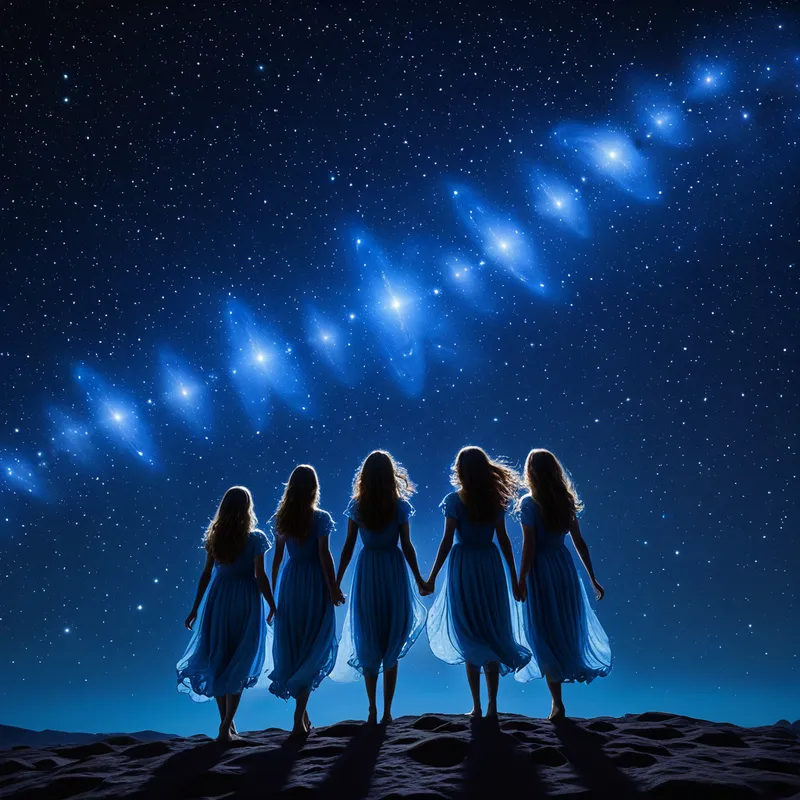
Seven sisters, daughters of Atlas, transformed into stars to escape Orion, their eternal grief manifesting as the shimmering, tearful haze of the Pleiades cluster.
The Tale of The Tears of the Pleiades
Hear now a story written in starlight and sorrow, a tale spun on the loom of the night sky. It begins not in the halls of Zeus, nor in the sun-drenched fields of mortals, but in [the shadow](/myths/the-shadow “Myth from Jungian culture.”/) of a burden no shoulders should ever bear. For their father was Atlas, whose muscles strained eternally against the vault of [the sky](/myths/the-sky “Myth from Persian culture.”/), and their mother was Pleione, whose name means “to sail,” though she was forever moored to his agony.
They were seven: Maia, the eldest, quiet and wise; Electra, shining with a fierce light; Taygete, who loved the wild mountains; Alcyone, steady as [the halcyon](/myths/the-halcyon “Myth from Greek culture.”/) sea; Celaeno, the dark one; Sterope, whose glance was like lightning; and Merope, the youngest, who carried a secret shame. Together they were the [Pleiades](/myths/pleiades “Myth from Greek culture.”/), a constellation of sisterhood, dancing in the glades of Boeotia. Their laughter was the sound of spring [water](/myths/water “Myth from Chinese culture.”/) over stones, and their footsteps caused hyacinths to bloom.
But [the hunter](/myths/the-hunter “Myth from African culture.”/) came. [Orion](/myths/orion “Myth from Greek culture.”/), vast as a mountain range, with a stride that shook [the earth](/myths/the-earth “Myth from Hindu culture.”/) and a desire that burned hotter than the forge of [Hephaestus](/myths/hephaestus “Myth from Global/Universal culture.”/). He saw the sisters and wanted them—not as companions, but as prizes. For seven years he pursued them across [the world](/myths/the-world “Myth from Tarot culture.”/), his shadow blotting out the sun, his breath a hot wind at their backs. The forests grew silent where he passed; the [nymphs](/myths/nymphs “Myth from Greek culture.”/) hid in their trees.
The sisters ran until their feet were bruised and their hearts pounded like captive birds. They fled to the very edges of the earth, to where their father groaned under his celestial load. They cried out to the heavens, their voices a single chord of pure despair. And the heavens listened.
It was Zeus who took pity. Or perhaps it was their own divine essence, seeking refuge in the only realm Orion could not tread. In a moment of desperate grace, the air around the seven sisters began to shimmer like a heat haze. Their forms grew luminous, their flesh becoming as translucent as morning mist. They felt not pain, but a profound unraveling, a dissolution into light. Their flowing hair became trails of cosmic dust, their outstretched hands points of brilliant fire. They were lifted, not by wind, but by the fabric of fate itself, and set into the dark velvet of the night sky.
There they remain, a tight cluster of blue-white stars. But look closely, with the eye of the heart. Do you see the faint, hazy glow that surrounds them? That is the residue of their terror, the condensation of their endless grief. They weep still. Not with sobs, but with a silent, radiant lament. Their tears are the nebulous veil that cloaks their constellation—a permanent atmospheric sorrow, a shimmering memorial to the day they escaped the world by becoming forever apart from it. And there, in the winter sky, the outline of Orion forever chases, never to close the gap, a celestial tableau of pursuit and eternal lament.
Cultural Origins & Context
This myth finds its roots in the deep, practical poetry of ancient Greek life. [The Pleiades](/myths/the-pleiades “Myth from Greek culture.”/) cluster, known as the “Seven Sisters,” was a crucial celestial marker for the agrarian and maritime cultures of the Mediterranean. Their heliacal rising in May signaled the start of the safe sailing season, and their setting in autumn warned of coming storms. The myth, therefore, was not mere entertainment; it was a mnemonic device, a story woven into the practical calendar.
The tale was passed down through oral tradition, likely by bards and farmers alike, as they watched the skies. It is cataloged in sources like the Astronomica of Aratus and referenced by later writers. The “tears”—the faint nebulosity around the stars—were a visible, astronomical reality that demanded explanation. The Greeks, in their profound anthropomorphizing of the cosmos, saw not random gas clouds, but the eternal emotion of the divine made manifest. The myth served to humanize the heavens, turning cold navigation points into characters with whom one could empathize, whose grief mirrored human sorrow, and whose eternal story was written where all could see it every clear night.
Symbolic Architecture
At its core, the myth of the Pleiades is an archetypal [drama](/symbols/drama “Symbol: Drama signifies narratives, emotional expression, and the exploration of human experiences.”/) of [trauma](/symbols/trauma “Symbol: A deeply distressing or disturbing experience that overwhelms the psyche, often manifesting in dreams as unresolved emotional wounds or psychological injury.”/), refuge, and the permanent transformation that [grief](/symbols/grief “Symbol: A profound emotional response to loss, often manifesting as deep sorrow, yearning, and a sense of emptiness.”/) necessitates. The sisters represent a pristine, communal state of being—[innocence](/symbols/innocence “Symbol: A state of purity, naivety, and freedom from guilt or corruption, often associated with childhood and moral simplicity.”/), sisterhood, and [connection](/symbols/connection “Symbol: Connection symbolizes relationships, communication, and bonds among individuals.”/) to the natural world. Orion is the overwhelming, predatory force of the unconscious, a raw, undifferentiated desire or [trauma](/symbols/trauma “Symbol: A deeply distressing or disturbing experience that overwhelms the psyche, often manifesting in dreams as unresolved emotional wounds or psychological injury.”/) that seeks to consume and possess.
Transformation as salvation is also a form of exile. To flee into the sky is to become eternal, but also to become distant, untouchable, and forever weeping.
Their [ascension](/symbols/ascension “Symbol: A profound sense of rising upward, often representing spiritual enlightenment, personal growth, or transcendence beyond physical limitations.”/) is not a triumphant [apotheosis](/symbols/apotheosis “Symbol: The transformation of a mortal into a divine or godlike state, representing ultimate spiritual elevation and transcendence of human limitations.”/), but a desperate [metamorphosis](/symbols/metamorphosis “Symbol: A profound, often irreversible transformation of form, identity, or state, representing a complete journey from one condition to another.”/). They do not become gods on [Olympus](/symbols/olympus “Symbol: In Greek mythology, Mount Olympus is the divine home of the gods, representing ultimate power, perfection, and spiritual transcendence.”/); they become fixed stars, beautiful but isolated, luminous but cold. This is the profound psychological [truth](/symbols/truth “Symbol: Truth represents authenticity, honesty, and the quest for knowledge beyond mere appearances.”/) of the myth: sometimes, the only way to survive a [soul](/symbols/soul “Symbol: The soul represents the essence of a person, encompassing their spirit, identity, and connection to the universe.”/)-threatening [pursuit](/symbols/pursuit “Symbol: A chase or being chased in dreams often reflects unresolved anxieties, unfulfilled desires, or internal conflicts demanding attention.”/) is to fundamentally change the [nature](/symbols/nature “Symbol: Nature symbolizes growth, connectivity, and the primal forces of existence.”/) of your being. The [psyche](/myths/psyche “Myth from Greek culture.”/), to escape annihilation, may crystallize a part of itself—lifting a trauma or a complex out of the muddy, dangerous [realm](/symbols/realm “Symbol: The symbol of ‘Realm’ often signifies the boundaries of one’s consciousness, experiences, or emotional states, suggesting aspects of reality that are either explored or ignored.”/) of earthly engagement and “fixing” it in the symbolic heavens of the inner world. It is saved, but it is also lost to ordinary [life](/symbols/life “Symbol: The symbol of ‘Life’ represents a journey of growth, interconnectedness, and existential meaning, encompassing both the joys and challenges that define human experience.”/). The “tears” are the perpetual, shimmering [evidence](/symbols/evidence “Symbol: Proof or material that establishes truth, often related to justice, guilt, or validation of beliefs.”/) of that [loss](/symbols/loss “Symbol: Loss often symbolizes change, grief, and transformation in dreams, representing the emotional or psychological detachment from something or someone significant.”/), the psychic [energy](/symbols/energy “Symbol: Energy symbolizes vitality, motivation, and the drive that fuels actions and ambitions.”/) that continues to emanate from the crystallized wound.
The Dreamer’s Resonance
When this myth pattern stirs in the modern dreamer, it often signals a profound experience of being pursued or overwhelmed. The dreamer may feel hunted by a looming responsibility, a consuming relationship, a past trauma, or their own shadow aspects. The somatic feeling is one of breathless flight, a tightness in the chest, and a desperate search for an exit that does not seem to exist.
The dream may culminate in images of rising, floating, or becoming light, but this elevation is tinged with melancholy, not [triumph](/myths/triumph “Myth from Roman culture.”/). It is the psyche’s solution of last resort: dissociation, spiritual bypassing, or a retreat into intellectualization—becoming a “star” (aloof, brilliant, untouchable) to escape the “hunter” (the messy, painful, embodied reality). The dream is a snapshot of the psyche in the act of creating its own Pleiades cluster: a beautiful, stellar defense mechanism that forever weeps for the earthly connection it had to sever to survive.

Alchemical Translation
The alchemical journey for the individual haunted by this myth is not to bring the sisters back to earth—that is impossible. The transformation is permanent. The work, instead, is in the relationship to the tears.
The alchemical gold is found not in stopping the celestial weeping, but in learning to drink from the nebula of sorrow and distill meaning from its light.
[The first stage](/myths/the-first-stage “Myth from Alchemical culture.”/) ([nigredo](/myths/nigredo “Myth from Alchemical culture.”/)) is the recognition of the pursuit and the crystallization: “Where in my life have I had to become cold, distant, or perfect to escape being consumed?” The second stage (albedo) is the conscious observation of the “tears”—the melancholic haze, the persistent grief, the sense of beautiful isolation. This is the washing, the acceptance of the luminous wound.
The final transmutation ([rubedo](/myths/rubedo “Myth from Alchemical culture.”/)) involves a sacred paradox. It is the conscious re-integration of the meaning of the tears, not the traumatic event itself. The dreamer must build an inner observatory. They must learn to gaze at their own fixed, stellar sorrow with compassion, to see its light as a guide rather than just a memorial. The grief, once a sign of exile, can become a source of profound empathy and a unique lens through which to perceive the world. The individual no longer is the weeping stars; they are the wise astronomer who understands their story, their necessity, and the poignant, guiding light their eternal tears cast upon the dark sea of the soul’s journey.
Associated Symbols
Explore related symbols from the CaleaDream lexicon: