The Tablets of the Law Myth Meaning & Symbolism
Moses receives divine law on stone tablets, only to shatter them upon human betrayal, forging a deeper covenant from the fragments of failure.
The Tale of The Tablets of the Law
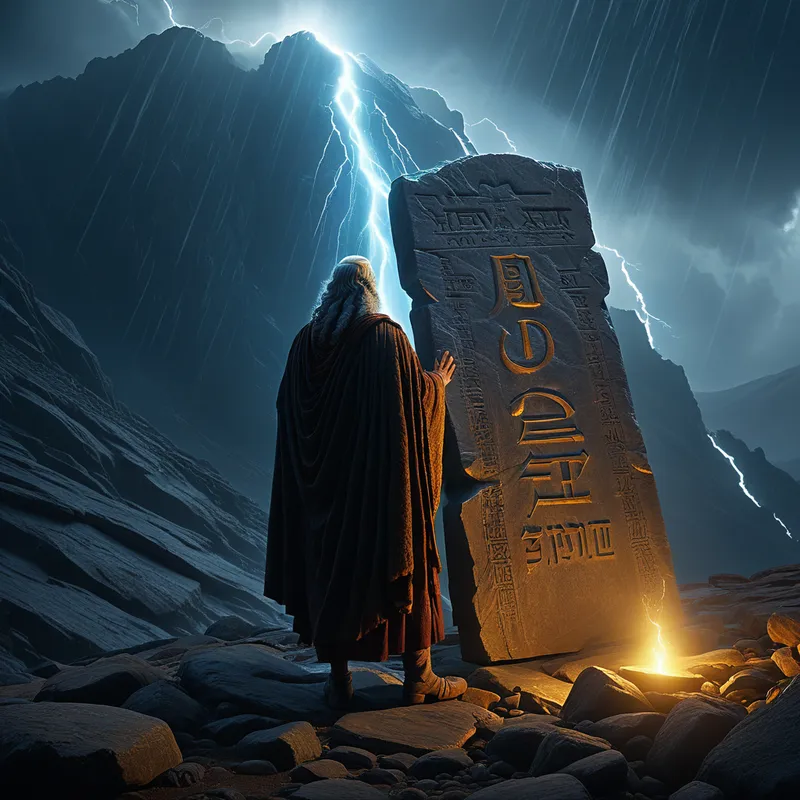
The mountain was a clenched fist of God against [the sky](/myths/the-sky “Myth from Persian culture.”/). Sinai trembled, wreathed in a terrible and beautiful darkness—a cloud of thunder and unapproachable fire. Below, a people, newly sprung from the iron womb of Egypt, camped in the vast silence of [the desert](/myths/the-desert “Myth from Biblical culture.”/), their hearts a wilderness of memory and fear.
Above, in that roiling heart of the storm, a man named [Moses](/myths/moses “Myth from Biblical culture.”/) stood barefoot on holy ground. The voice that spoke was not of wind or flame, but of a foundational will, carving order from the primordial chaos. For forty days and forty nights—a time outside of time—the pattern of a new world was inscribed. Not on parchment, but on the very bones of [the earth](/myths/the-earth “Myth from Hindu culture.”/): two tablets of stone, written by the finger of God. They were not mere rules; they were the architectural blueprint for a sacred society, the terms of a cosmic covenant. Their weight was the weight of a promise between the Infinite and the finite.
Moses descended. The mountain’s fire was upon his face, a terrifying radiance that spoke of his encounter. The tablets, hewn from the mountain itself, were in his hands—the tangible proof of the intangible word.
But the sound that greeted him from the camp was not of awe-struck silence. It was the raucous clamor of celebration, the lowing of a [golden calf](/myths/golden-calf “Myth from Biblical culture.”/). In his absence, the people had forged a god they could see, a god of their own fear and forgetting. The covenant was broken before it was even delivered.
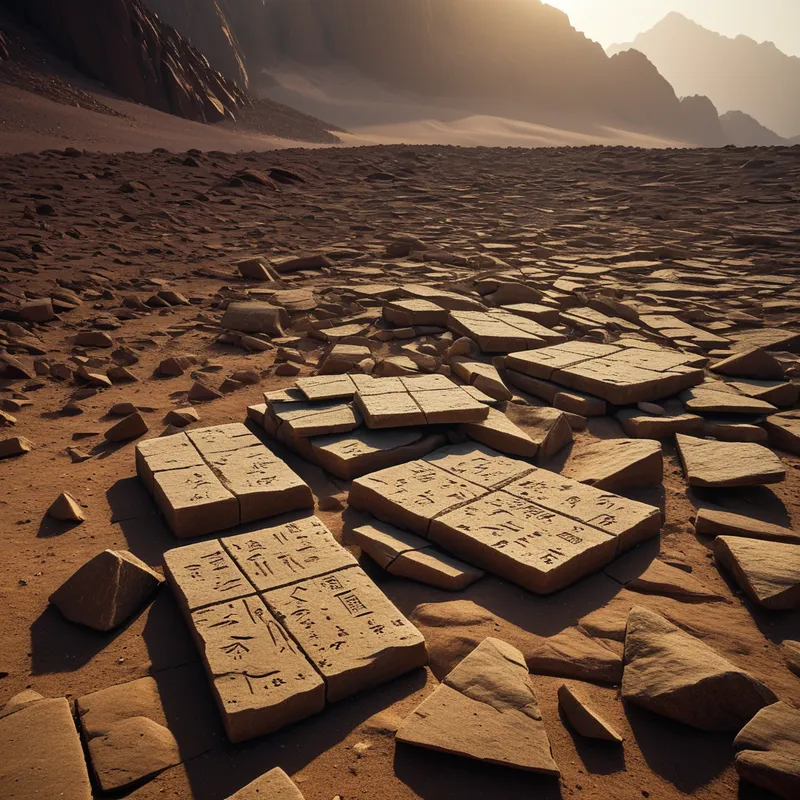
And in that moment, at the crux of divine gift and human failure, a profound human act shattered the stillness. The wrath of Moses was not petty anger; it was the seismic grief of a mediator witnessing the rupture of worlds. He raised the tablets, those perfect vessels of divine law, and dashed them against the foot of the mountain. The sound was not just of breaking stone, but of a breaking dream. The written word of God lay in fragments at the border between the holy mountain and the profane camp.
Yet, the story does not end in shards. From the ashes of that broken idol and those broken tablets, a plea arose. Moses returned to [the summit](/myths/the-summit “Myth from Taoist culture.”/), and there, in a moment of breathtaking intimacy, he was told to carve two new tablets—like the first ones. He was to bring them up the mountain, and God would write upon them again. [The law](/myths/the-law “Myth from Biblical culture.”/) was re-given, but this time, it followed a revelation of mercy. The second set was borne by human hands, inscribed by a divine hand that had just proclaimed its compassionate, patient, and abounding love. The law remained, but it was now framed within grace, born from the very fragments of its own breaking.
Cultural Origins & Context
This foundational narrative is embedded in the Torah, specifically the Book of Exodus. It is the central mythos of the Mosaic Covenant, which defined [the Israelites](/myths/the-israelites “Myth from Abrahamic culture.”/) as a people bound not by bloodline alone, but by a shared ethical and ritual law given directly by their deity. The story was preserved and transmitted by priestly and prophetic lineages, recited during festivals, and formed the bedrock of Jewish identity, law, and theology.
Its societal function was multifaceted. It established the supreme authority of Torah as divine in origin. It graphically illustrated the grave consequences of idolatry and covenant betrayal. Crucially, it also introduced the complex, dynamic relationship between unwavering divine law and profound divine mercy—a tension that would echo through centuries of prophetic teaching and theological debate. The broken tablets were not erased from history; they were remembered, a permanent testament to human frailty and the possibility of renewal.
Symbolic Architecture
The tablets represent the archetypal encounter between the [human](/symbols/human “Symbol: The symbol of a human represents individuality, complexity of emotions, and social relationships.”/) [psyche](/myths/psyche “Myth from Greek culture.”/) and the objective, transpersonal principle of Order—what Jung might [term](/symbols/term “Symbol: The term often represents boundaries, defined concepts, or experiences that have a specific meaning in a given context.”/) the encounter with [the Self](/myths/the-self “Myth from Jungian culture.”/). They are not human inventions; they are received. This symbolizes the [psyche](/myths/psyche “Myth from Greek culture.”/)’s [capacity](/symbols/capacity “Symbol: A measure of one’s potential, limits, or ability to contain, process, or achieve something, often reflecting self-assessment or external demands.”/) to recognize a law, a [pattern](/symbols/pattern “Symbol: A ‘Pattern’ in dreams often signifies the underlying structure of experiences and thoughts, representing both order and the repetitiveness of life’s situations.”/), or a [truth](/symbols/truth “Symbol: Truth represents authenticity, honesty, and the quest for knowledge beyond mere appearances.”/) that comes from beyond [the ego](/myths/the-ego “Myth from Jungian culture.”/)’s whim.
The first tablets, shattered, represent the necessary death of the perfect, impersonal ideal when it meets the flawed reality of the human condition.
The act of breaking them is profoundly symbolic. It is not merely an act of destruction, but a critical, alchemical [moment](/symbols/moment “Symbol: The symbol of a ‘moment’ embodies the significance of transient experiences that encapsulate emotional depth or pivotal transformations in life.”/). The perfect, whole law cannot be integrated by an imperfect, fragmented people. It must be broken so that it can be re-made in a new, more resilient form. [The golden calf](/myths/the-golden-calf “Myth from Biblical culture.”/) represents the psyche’s [shadow](/symbols/shadow “Symbol: The ‘shadow’ embodies the unconscious, repressed aspects of the self and often represents fears or hidden emotions.”/)—its tendency, in [anxiety](/symbols/anxiety “Symbol: Anxiety in dreams reflects internal conflicts, fears of the unknown, or stress from waking life, often demonstrating the subconscious mind’s struggle for peace.”/) and impatience, to regress to older, simpler, more sensual symbols of [security](/symbols/security “Symbol: Security denotes safety, stability, and protection in one’s personal and emotional life.”/) (the gods of Egypt). The [drama](/symbols/drama “Symbol: Drama signifies narratives, emotional expression, and the exploration of human experiences.”/) between the [mountain](/symbols/mountain “Symbol: Mountains often symbolize challenges, aspirations, and the journey toward self-discovery and enlightenment.”/) (the transcendent) and the camp (the collective human psyche) is the eternal [drama](/symbols/drama “Symbol: Drama signifies narratives, emotional expression, and the exploration of human experiences.”/) of incarnation.
The second tablets, carved by Moses but written by God, symbolize the new [synthesis](/symbols/synthesis “Symbol: The process of combining separate elements into a unified whole, representing integration, resolution, and the completion of a personal journey.”/). [The law](/symbols/the-law “Symbol: Represents external rules, societal order, moral boundaries, and the tension between personal freedom and collective structure.”/) is now a co-creation. The human [vessel](/symbols/vessel “Symbol: A container or structure that holds, transports, or protects something essential, representing the self, emotions, or life journey.”/) (the ego, the conscious mind) must prepare itself, must offer its [effort](/symbols/effort “Symbol: Effort signifies the physical, mental, and emotional energy invested toward achieving goals and personal growth.”/) (“carve the tablets”), but the content, the ultimate [authority](/symbols/authority “Symbol: A symbol representing power structures, rules, and control, often reflecting one’s relationship with societal or personal governance.”/), remains transpersonal. [The law](/symbols/the-law “Symbol: Represents external rules, societal order, moral boundaries, and the tension between personal freedom and collective structure.”/) is now carried by a man who has seen both divine glory and human failure, making him a true [mediator](/symbols/mediator “Symbol: A figure who resolves conflicts between opposing parties, representing balance, communication, and the integration of differences.”/).
The Dreamer’s Resonance
To dream of receiving tablets, or any inscribed sacred object, often signals a moment of profound personal revelation. The dream-ego is being given a foundational truth, a new code of conduct, or a clear mandate from the deeper self. It is a call to order and integrity.
Dreaming of breaking such tablets, or seeing them already broken, is equally significant. It rarely indicates simple failure. Instead, it points to a necessary deconstruction. The dreamer may be holding onto an ideal, a rule, a “should,” or a life-plan (the “first tablets”) that is too rigid, too perfect, or imposed from an external authority without inner assimilation. The breaking is the psyche’s violent but necessary act to prevent a lifeless, dogmatic structure from crushing the living soul. The emotional tone is key: grief and righteous anger point to this alchemical breaking; despair might suggest a felt rupture with one’s own values.
Finding or being given the second set of tablets in a dream speaks to a phase of renewal and reconciliation. The core truth has been recovered, but it is now more personal, more merciful, and integrated through the hard-won experience of failure.

Alchemical Translation
The myth models the complete cycle of psychic transmutation, or individuation. The [prima materia](/myths/prima-materia “Myth from Alchemical culture.”/) is the liberated but chaotic collective ([the Israelites in the desert](/myths/the-israelites-in-the-desert “Myth from Abrahamic culture.”/))—a psyche free from an old oppression (Egypt) but not yet structured by a conscious principle.
- Ascensus (The Ascent): The conscious ego (Moses) ascends to engage the Self (the divine on the mountain). It withdraws from the noise of the collective psyche to receive a formative vision, a new ordering principle (the Law).
- The Shattering ([Nigredo](/myths/nigredo “Myth from Alchemical culture.”/)): The return with the new consciousness meets the un-transformed shadow (the golden calf). The confrontation results in the shattering of the ideal. This is the dark night, [the nigredo](/myths/the-nigredo “Myth from Alchemical culture.”/)—the feeling of total failure, when the highest insight seems destroyed by the lowest impulses. It is a crucible of despair and anger.
- The Plea & New Carving (Albedo): From the ashes arises introspection and prayer. The ego, humbled, must now actively participate. “Carve new tablets” — this is the labor of the albedo, the washing clean. It is the conscious work of preparing a new vessel, a more humble and resilient structure of the personality, based on the lessons of the break.
- Re-inscription & Descent ([Rubedo](/myths/rubedo “Myth from Alchemical culture.”/)): The Self writes again upon the human-prepared stone. This is [the rubedo](/myths/the-rubedo “Myth from Alchemical culture.”/), the reddening, the synthesis. The law is the same, but [the vessel](/myths/the-vessel “Myth from Alchemical culture.”/) is different. The transcendent principle is now incarnated in a consciousness that has known fracture and mercy. The individual descends to live the law not as a perfect, external statue, but as a living, breathing covenant, marked by the scars of its own breaking and remaking.
The journey from the first tablets to the second is the journey from a morality of perfection to an ethic of integration, forged in the full acknowledgment of one’s capacity for both revelation and betrayal.
Associated Symbols
Explore related symbols from the CaleaDream lexicon: