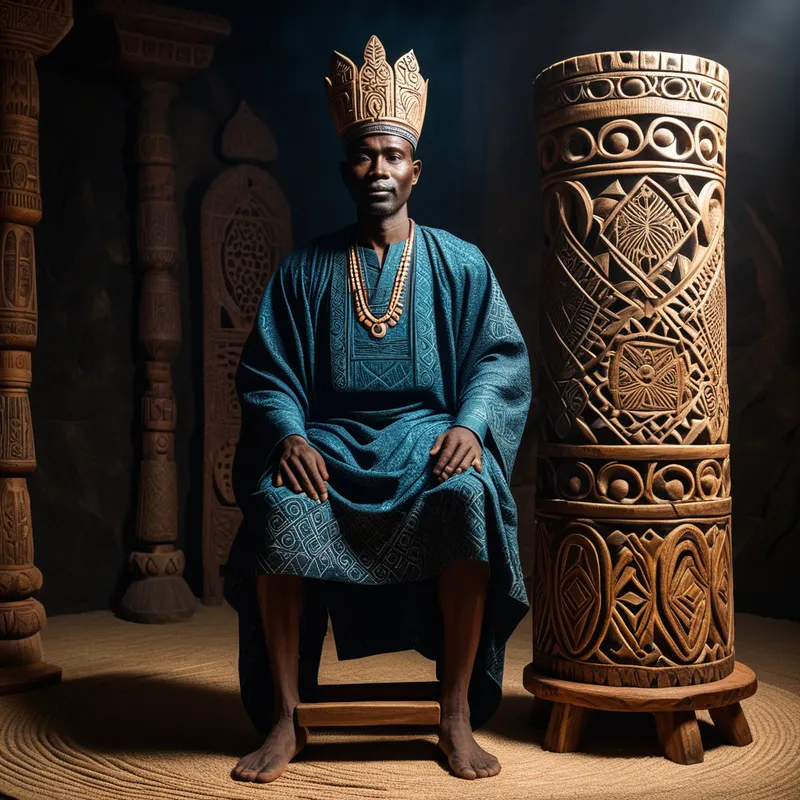
The Stool of Oranmiyan Myth Meaning & Symbolism
A prince's quest for a throne becomes a confrontation with destiny itself, where power is not taken, but forged in sacrifice and self-knowledge.
The Tale of The Stool of Oranmiyan
Listen. The air in Ile-Ife was thick with the scent of iyere leaves and impending rain. It was a time when the boundary between the world of the living and the realm of the ancestors was as thin as a spider’s silk. Oranmiyan, son of the progenitor Oduduwa, was a storm contained in human form—a prince of immense prowess, yet his spirit was restless. A throne awaited him, but not the one of carved ivory and polished wood in the palace. His destiny whispered of a different seat of power.
The elders spoke in hushed tones of a prophecy: that the true king would be known not by conquest alone, but by his ability to commune with the very soul of the land. The sign would be a Stool. Not an object to be crafted, but one to be revealed. It was said to reside in the liminal space between the great Iroko tree and the whispering stream where the Egungun danced at twilight.
Driven by a fire he could not name, Oranmiyan left the comforts of the court. He journeyed into the deep forest, where sunlight fell in dappled fragments. For days, he fasted and prayed, calling upon the wisdom of his father Oduduwa and the ancient mothers of the earth. His quest was not for an object, but for a recognition. On the seventh night, as the moon hung like a silver bowl, he found it. In a clearing bathed in pale light stood a simple, stout stool of dark, living wood. It was unadorned, yet it hummed with a silent, potent energy.
As he approached, the clearing transformed. The air grew heavy. Phantasmal forms of past warriors and kings materialized—the Ara Orun. They did not speak with words, but with visions that flooded his mind: visions of glorious rule, but also of profound loneliness; of justice delivered with an iron hand, and the weight of every decision pressing down on a single soul. The Stool was not a prize. It was a conduit, a point of ultimate connection and ultimate burden.
To claim it was to bind his destiny irrevocably to the land and its people. He understood then the sacrifice: the personal self, the solitary desires of the prince, must be offered up. His life would no longer be his own. With a breath that felt like his first and his last, Oranmiyan sat upon the Stool. A searing current, both painful and ecstatic, shot through him. The wood, once simple, began to change. From its substance emerged carvings of leopards and chameleons, of coiled serpents and watchful eyes. Iron nails, symbols of oath and permanence, seemed to drive themselves into its legs, sealing the pact. In that moment, the prince died, and the King, the true Oba, was born. The Stool had chosen, and in choosing, it had forged.

Cultural Origins & Context
The myth of Oranmiyan’s Stool originates from the rich oral historiography and sacred king traditions of the Yoruba people. Oranmiyan is not merely a folktale figure but a pivotal historical-mythical persona, considered a son of Oduduwa and a foundational Oba whose lineage led to the founding of kingdoms like Oyo and Benin. The story functions as a charter myth for sacred kingship. It was not told for mere entertainment but recited during coronation rites and by official historians, the Arokin, to impart the metaphysical principles of leadership.
The Stool (Ita or Apere) is the ultimate symbol of the Ade, the crown’s foundation. This myth served a critical societal function: it sacralized political authority, framing it not as human ambition but as a divine burden accepted through a transformative ordeal. It taught that the ruler’s power derives from his integration with the ancestral world (Orun) and his conscious self-sacrifice for the community’s Ashe. The story was a living doctrine, passed down to remind both king and subject that true authority is a spiritual office, a terrifying privilege earned through existential confrontation.
Symbolic Architecture
At its core, the myth is a profound map of the psychology of legitimate power and conscious destiny. The Stool is the central symbol—it is not a chair of comfort but the psychic throne of the Self.
The throne finds the king; the king does not find the throne. Sovereignty is a condition of being recognized by a reality greater than one’s own ego.
Oranmiyan’s journey into the forest represents the necessary withdrawal from the collective identity (“the prince”) into the wilderness of the unconscious. The simple, unadorned Stool he first encounters symbolizes the latent, undeveloped potential of the true Self—the core of one’s authentic being before it is shaped by the world’s demands. The subsequent visions from the Ara Orun represent the terrifying and glorious burden of consciousness. To see the full cost of power, love, or creation is the ordeal.
The transformation of the Stool, its adornment with sacred carvings and iron nails, is the critical alchemy. The nails, in particular, are potent. They represent the points of irrevocable commitment, the decisions and sacrifices that permanently define and anchor one’s character and destiny. They pin the ephemeral self to the eternal pattern. Oranmiyan does not take power; he submits to a transformation where his personal will is aligned with a transpersonal mandate. He becomes a vessel.
The Dreamer’s Resonance
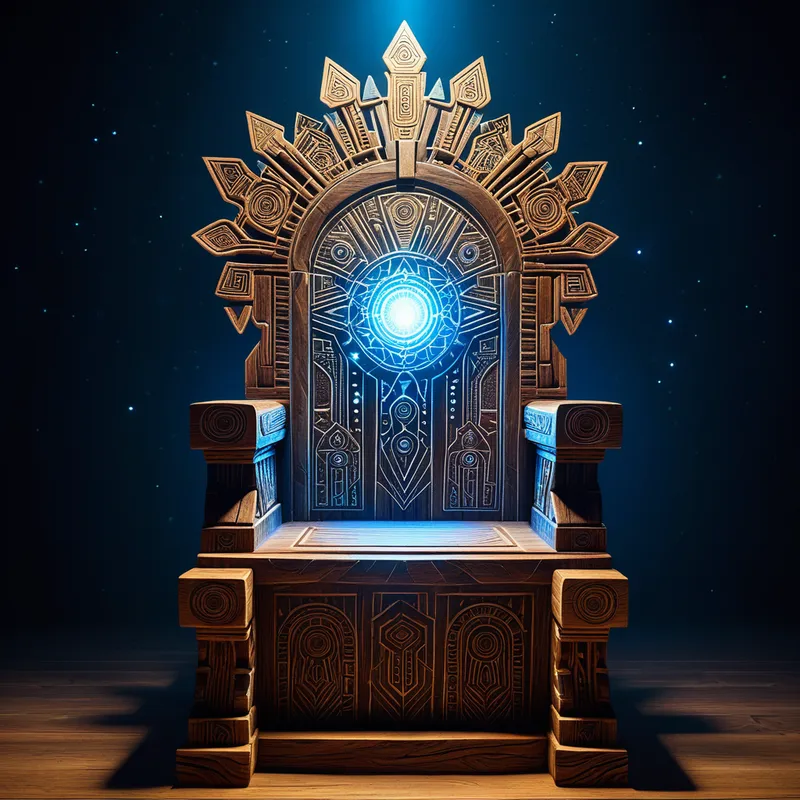
When this myth stirs in the modern psyche, it often manifests in dreams of profound testing and legitimacy. To dream of searching for, finding, or being offered a unique chair or seat is to encounter the Stool archetype. The dreamer may feel immense pressure, a somatic weight upon their shoulders, or a thrilling current of energy—echoing Oranmiyan’s electrifying initiation.
Such dreams often surface at life’s major thresholds: before accepting a significant leadership role, committing to a creative life’s work, or stepping into a mature, responsible identity (parenthood, mentorship). The psychological process is one of grappling with inner authority. The conflict is between the part that wants the prestige of the throne (the ego) and the part that fears its sacrificial demands (the shadow). The dream asks: Are you willing to be forged? Are you prepared for the nails of commitment to be driven into the core of your being, binding you to a path that will demand everything? The dream-Stool’s condition—whether it is crumbling, radiant, or forbidding—reveals the dreamer’s readiness to integrate this sovereign archetype.

Alchemical Translation
The myth of Oranmiyan’s Stool is a masterful blueprint for the Jungian process of individuation—the journey toward becoming an integrated, self-governed individual. The alchemical operation it describes is Fixation: the volatile spirit (Oranmiyan’s restless ambition) must be fixed into a lasting, substantial form (the steadfast King).
Individuation is not about becoming king of the world, but about solemnly taking one’s seat on the stool of one’s own unique and responsible existence.
The first stage, Nigredo, is the prince’s dark night in the forest—the confusion, fasting, and confrontation with the shadowy ancestral forces. The Albedo is the clarifying vision, the revelation of the Stool’s true nature as both gift and burden. The Rubedo, the reddening, is the searing moment of sitting, where passion (life-force) and structure (destiny) fuse. The iron nails are the ultimate symbol of this coagulation.
For the modern individual, the “Stool” is one’s authentic vocation or life-purpose. The “forest” is the introspective journey required to find it. The “ancestral visions” are the inherited complexes, family expectations, and cultural scripts that must be consciously viewed and integrated, not blindly obeyed. To “sit on the Stool” is to make the ultimate commitment to one’s own truth, to say, “This is my station, my responsibility, my joy, and my cross. I accept it fully.” It is the moment the ego aligns with the Self. One is no longer a wanderer seeking a role, but a sovereign presence from which genuine action and creativity can flow. The myth teaches that power, in its deepest sense, is not wielded; it is embodied through conscious, sacrificial choice.
Associated Symbols
Explore related symbols from the CaleaDream lexicon: