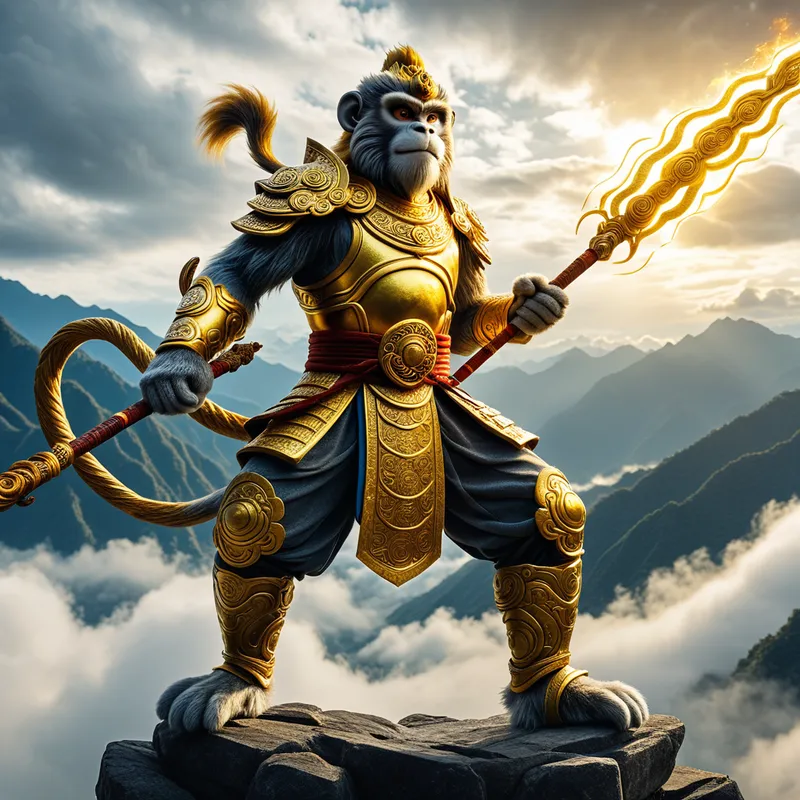
The Stone Monkey Myth Meaning & Symbolism
A stone-born monkey defies heaven, seeks immortality, and embarks on a transformative journey from chaos to enlightenment, guided by a monk.
The Tale of The Stone Monkey
Listen, and hear the tale born from stone and spirit.
In the beginning, before time was measured in dynasties, there was a mountain. Not just any mountain, but the Mount of Flowers and Fruit. At its summit sat a magical stone, shaped by the primal essences of Heaven and Earth, tempered by the light of the sun and moon. For eons it waited, until one day, with a crack that echoed through the valleys, it split open. And from it sprang not a demon, not a god, but a stone monkey, his eyes flashing beams of golden light that pierced the very clouds to startle the Jade Emperor in his celestial palace.
This monkey was king of his mountain realm, but a chill fear of death settled in his heart. He would not be ruled by the underworld’s ledgers. So he built a raft and sailed the Eastern Sea, seeking a master. He found the immortal Patriarch Subhuti, from whom he learned the seventy-two earthly transformations, the cloud somersault that could traverse ten thousand miles in a single leap, and the arts of magic and war. He named himself Sun Wukong.
Armed with this power, his ambition swelled. He descended into the ocean depths and strong-armed the Dragon King for a weapon, finding the Ruyi Jingu Bang, a pillar of divine iron that shrank to fit behind his ear. He stormed the underworld and, in a fury, scratched his name and the names of all his monkey kin from the ledgers of death. Heaven trembled.
To placate him, the Jade Emperor offered a hollow title: Keeper of the Heavenly Horses. Enraged at the slight, the Monkey King declared himself Qitian Dasheng and rebelled. He fought the heavenly armies alone, a whirlwind of chaos against celestial order, undefeated until the Buddha himself intervened. With a wager and a mighty palm, the Buddha transformed five elemental pillars into a mountain and pressed the rebellious monkey down for five hundred years.
His fury unabated but his body imprisoned, his story was not over. Salvation came in the form of a pilgrim, the monk Tang Sanzang, who released him for a sacred purpose: to guard the monk on his westward journey to fetch the true scriptures. To temper his wild nature, the Bodhisattva Guanyin placed a golden fillet upon his head, which tightened with a chant, bringing the pain of obedience. Thus began the true journey—not of conquest, but of endurance; not of rebellion for its own sake, but of a raw, untamed spirit learning the hard path of service, protection, and ultimately, enlightenment.

Cultural Origins & Context
This epic is the heart of the 16th-century novel Journey to the West, attributed to Wu Cheng’en. It did not spring from a vacuum. Its roots tap deep into a rich aquifer of Chinese folk tales, Taoist allegories of immortality, Buddhist pilgrimage narratives, and historical accounts of the real monk Xuanzang’s travels. For centuries before the novel’s compilation, stories of a magical monkey troublemaker circulated in oral traditions and theatrical performances.
The novel’s genius was in synthesizing these streams into a grand, cohesive mythology that served multiple societal functions. On one level, it was a thrilling adventure, a “road story” filled with demons, magic, and humor. On another, it was a vehicle for religious and philosophical syncretism, weaving Buddhist ideals of enlightenment with Taoist practices and Confucian values of loyalty and perseverance. It provided a cultural mirror: the Monkey King’s rebelliousness resonated with a subconscious challenge to rigid hierarchies, while his ultimate taming and redemption reinforced the societal need for order, discipline, and spiritual purpose. It was a story told to entertain, to instruct, and to explore the eternal conflict between the individual’s wild heart and the collective’s sacred path.
Symbolic Architecture
The Stone Monkey is not merely a character; he is a living system of symbols. His birth from stone represents the emergence of consciousness from the prima materia, the undifferentiated “stuff” of the world. He is the uncontained spark of life, the elan vital, bursting forth with no precedent, no lineage, and thus, no inherent rules.
He is the archetypal prima materia of the psyche—raw potential, brilliant, arrogant, and utterly chaotic.
His quest for immortality is the ego’s first, terrified reaction to the knowledge of mortality. His acquisition of magical powers symbolizes the inflation of the ego, believing its newfound competencies (skills, status, intellect) make it invincible and sovereign. The rebellion in Heaven is the inevitable collision of this inflated ego with established internal and external structures—the “shoulds,” the laws, the parental complexes, the super-ego, represented by the celestial bureaucracy.
The five-hundred-year imprisonment under Wuxing Shan is a crucial symbolic death. It is the necessary containment of chaos. The ego is not annihilated, but forced into a period of incubation, where its boundless energy is compressed and reflected upon. Finally, the journey with the monk represents the integration of this powerful, instinctual energy (the Monkey) into the service of a higher, spiritual consciousness (the monk). The golden fillet is the symbol of this hard-won covenant between the wild self and the guiding principle of consciousness—a binding agreement that uses the threat of painful contraction to direct expansive power toward a sacred goal.
The Dreamer’s Resonance
When the myth of the Stone Monkey stirs in the modern dreamer, it often signals a profound psychological uprising. To dream of a monkey causing brilliant, chaotic havoc might reflect a part of the psyche that feels its authentic vitality is being stifled by a “heavenly” order—a corporate job, a restrictive relationship, or a rigid self-concept. It is the rebel archetype knocking loudly on the door of consciousness.
Dreams of being trapped under a mountain speak to a somatic experience of depression, stagnation, or a life situation that feels immovable. The body may feel heavy, leaden. This is not merely oppression; it is the necessary pressure that precedes transformation. The dream may present a seemingly weak or peaceful figure (the monk) offering release, but with a condition—a golden band, a new responsibility, a guiding constraint. The psyche is negotiating the terms for releasing its own pent-up, creative-destructive power. The dreamer is in the alchemical stage of mortificatio, where the old, inflated identity must be dissolved and contained so a more conscious partnership within the self can be forged.
Alchemical Translation
The myth models the complete arc of individuation—the process of becoming an integrated, whole individual. It begins with the nigredo, the blackening: the emergence of the shadow in its most potent, undifferentiated form as the Stone Monkey. His rebellion is the separatio, the forceful differentiation of the self from the collective unconscious and its norms.
The journey westward is the long albedo, the whitening—the laborious purification where the base metal of the personality is scrubbed by the trials of the road.
The imprisonment under the mountain is a pivotal mortificatio and solutio—a death and dissolution of the ego’s tyranny, allowing its essence to be reconstituted. The pilgrim’s journey itself is the coagulatio, the re-forming of the personality around a new center. The monkey does not become the monk; he becomes the monk’s indispensable protector and disciple. The powerful, instinctual, trickster energy is not eliminated but redeemed.
For the modern individual, this translates to the recognition of one’s own inner “monkey”—that brilliant, rebellious, and often troublesome drive for autonomy, recognition, and immortality. The path is not to crush it, nor to let it rule unchecked. The alchemical work is to first confront and contain its chaotic inflation (often through life crises, failures, or periods of depression), and then to consciously enlist its immense energy in service of a “sacred journey”—one’s true vocation, a creative masterpiece, a journey of healing, or the simple, profound duty of living an authentic life. The golden fillet is the conscious agreement we make with ourselves: our wildness must be directed, or it will destroy us. In binding it to a purpose greater than its own whims, we achieve not servitude, but the ultimate freedom of enlightenment. The Stone Monkey, in the end, becomes a Buddha—the triumphant completion of the rubedo, the reddening, where the spirit is fully integrated and radiant.
Associated Symbols
Explore related symbols from the CaleaDream lexicon: