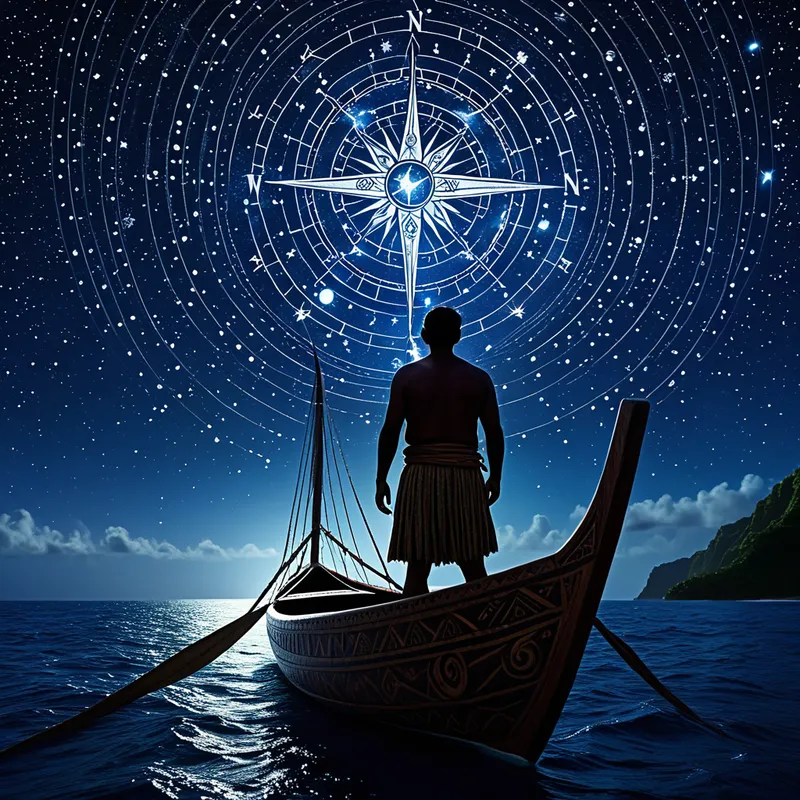
The Star Compass Myth Meaning & Symbolism
A mythic tale of celestial wayfinding, where the stars become a living map for navigating the boundless sea and the deeper currents of the soul.
The Tale of The Star Compass
Listen. The ocean is not empty. [The sky](/myths/the-sky “Myth from Persian culture.”/) is not silent. Before the first canoe carved its path through the moana, there was only the great dark and the great deep, two abysses whispering secrets neither could understand.
Then came Maui, not as a trickster this time, but as a listener. He lay on the back of the great sea turtle, his ear pressed to its shell, and heard the rhythm of currents that had no name. He climbed the cloud-piercing summit of Hawaiʻi, and felt the breath of the four winds—Koʻolau, Kona, ʻEpa, and Lāpana—each a distinct spirit, each a potential path and a potential prison. [The world](/myths/the-world “Myth from Tarot culture.”/) was vast, but it was a vastness without a map. To voyage was to be swallowed.
His conflict was not with a monster, but with the formless. How does one hold direction in a realm with no landmarks but the ever-shifting waves? His rising action was an act of profound attention. Night after night, he did not sleep. He watched. He saw that the stars were not random sparks, but a family. He saw [Hōkūleʻa](/myths/hklea “Myth from Polynesian culture.”/) rise in the same house of the sky each season. He saw the [Maui’s Fishhook](/myths/mauis-fishhook “Myth from Polynesian culture.”/) dip toward [the horizon](/myths/the-horizon “Myth from Various culture.”/), pointing [the way](/myths/the-way “Myth from Taoist culture.”/). He learned [the star](/myths/the-star “Myth from Tarot culture.”/) paths—the ʻAʻa—that certain stars walked as they journeyed from their rising place, their Hikina, to their resting place, their Komohana.
But stars alone were not enough. The ocean spoke its own language. He learned to read the color of the [water](/myths/water “Myth from Chinese culture.”/), the shape of the swells rebounding from unseen islands, the flight of the Kōlea heading toward land. He wove these threads together—star, wind, wave, bird, cloud—until they became a single, living fabric.
The resolution was not a battle won, but a pattern perceived. In his mind’s eye, he conceived the Star Compass. He divided the circle of the horizon into thirty-two houses, each the home of a star, a wind, a current. The canoe itself became the center of this great, invisible wheel. The navigator, standing at the sacred post, hoʻokele, no longer sailed toward a destination. He held his position within a rotating cathedral of stars, keeping the celestial guides in their proper houses as the world turned around him. The map was not on parchment; it was etched in memory, sung in chants, felt in the bones. [The void](/myths/the-void “Myth from Buddhist culture.”/) had been given a name, a structure, a song. The pathway was born from paying attention to the conversation between heaven and sea.

Cultural Origins & Context
This is not a myth of a single event, but the crystallized wisdom of a thousand voyages. The Star Compass is the intellectual and spiritual engine of the Polynesian expansion, the greatest navigation feat in human history. It was not written, but embodied. It was passed down through generations of pwo in the ʻare vananga of the Pacific.
The knowledge was encoded in chants, koʻihonua, that listed stars and sequences. It was modeled with mattang and rebbelib, not as literal maps to be followed, but as mnemonic devices to train the mind in recognizing the interference patterns of swells around islands. Its societal function was survival, identity, and connection. It turned the terrifying expanse of the moana into a known network of pathways, linking the honua into a coherent, navigable whole. The mythologizing of this knowledge in figures like Maui served to sacralize it, ensuring its preservation as a divine gift, not merely a technical skill.
Symbolic Architecture
At its core, the Star Compass symbolizes the [human](/symbols/human “Symbol: The symbol of a human represents individuality, complexity of emotions, and social relationships.”/) imposition of conscious order onto the unconscious vastness. The open [ocean](/symbols/ocean “Symbol: The ocean symbolizes the vastness of the unconscious mind, representing deeper emotions, intuition, and the mysteries of life.”/) represents the unknown, the formless potential of [life](/symbols/life “Symbol: The symbol of ‘Life’ represents a journey of growth, interconnectedness, and existential meaning, encompassing both the joys and challenges that define human experience.”/), the unconscious mind itself—teeming with life and [danger](/symbols/danger “Symbol: The symbol of ‘Danger’ often indicates a sense of threat or instability, calling for caution and awareness.”/), directionless and overwhelming. The canoe is the [vessel](/symbols/vessel “Symbol: A container or structure that holds, transports, or protects something essential, representing the self, emotions, or life journey.”/) of [the ego](/myths/the-ego “Myth from Jungian culture.”/), the conscious self, fragile and adrift.
The Compass is not a tool for conquering the unknown, but for developing a relationship with it. It teaches that orientation comes not from fighting the depths, but from listening to a deeper pattern that encompasses both self and sea.
The thirty-two houses represent the cognitive [structure](/symbols/structure “Symbol: Structure in dreams often symbolizes stability, organization, and the framework of one’s life, reflecting how one perceives their environment and personal life.”/)—the myths, values, and internal [reference](/myths/reference “Myth from Global/Universal culture.”/) points—we must develop to navigate a meaningful life. The stars are the fixed points of [truth](/symbols/truth “Symbol: Truth represents authenticity, honesty, and the quest for knowledge beyond mere appearances.”/), the guiding principles (like pono) that rise predictably in our psychic sky. The winds are the changing emotions, opportunities, and challenges. The navigator’s skill is the integrative function of [consciousness](/symbols/consciousness “Symbol: Consciousness represents the state of awareness and perception, encompassing thoughts, feelings, and experiences.”/), the Self in Jungian terms, which must hold the center while dynamically adjusting to a world in constant [motion](/symbols/motion “Symbol: Represents change, progress, or the flow of life energy. Often signifies transition, personal growth, or the passage of time.”/).
The Dreamer’s Resonance
When this myth appears in modern dreams, it speaks to a profound process of re-orientation. To dream of being on a dark ocean under strange stars is to feel utterly lost in one’s own life—adrift in a career, a relationship, or one’s sense of purpose. The somatic feeling is one of vertigo and profound disconnection.
The dream of finding or using a Star Compass, however, signals the [psyche](/myths/psyche “Myth from Greek culture.”/)’s attempt to rebuild its internal navigation system. It often occurs during a crisis of meaning, when old maps (societal expectations, outdated self-concepts) have failed. The dream-ego is being called to become the hoʻokele. This process involves a shift from seeking external guidance to cultivating internal reference points: What are your fixed stars—your core, non-negotiable values? Can you feel the subtle swells of your intuition? Can you name the winds of your passions and fears? The dream is an initiation into self-trust and deep attentiveness to the unique patterns of your own soul’s journey.
Alchemical Translation
The alchemical work modeled by the Star Compass is the opus of creating an inner [lapis philosophorum](/myths/lapis-philosophorum “Myth from Alchemical culture.”/)—a centered, unshakable point of consciousness from which to perceive the world. [The prima materia](/myths/the-prima-materia “Myth from Alchemical culture.”/) is the chaotic, undifferentiated experience of life.
[The first stage](/myths/the-first-stage “Myth from Alchemical culture.”/), [nigredo](/myths/nigredo “Myth from Alchemical culture.”/), is the dark ocean, the feeling of being lost at sea, the dissolution of old certainties. The albedo is the first perception of a star—a moment of clarity, a remembered value, a glimpse of truth that stands apart from the turmoil. The Star Compass itself represents the citrinitas, the dawning of a systematic, yellow-golden understanding, where multiple points of light are connected into a structure.
The final stage, rubedo, is not reaching a destination, but achieving the state of the master navigator: the ability to remain centered in your own vessel while the entire cosmos—with all its trials, beauties, and movements—revolves around you. You are no longer traveling from A to B; you are in dynamic, knowing relationship with the whole.
For the modern individual, this translates to the work of individuation. We must construct our own compass by identifying our personal stars (archetypal values), learning the language of our inner winds (complexes and emotions), and reading the swells of our unconscious (dreams, intuitions, synchronicities). The goal is not to avoid the dark sea, but to learn to sail it with purpose, guided by a map written in the light of our own awakened consciousness. The myth teaches that we are not meant to drift. We are meant to navigate.
Associated Symbols
Explore related symbols from the CaleaDream lexicon: