The Stag Stone Legends Myth Meaning & Symbolism
A myth of celestial union, betrayal, and transformation, where a divine stag's flight creates the sacred standing stones of the Mongolian steppe.
The Tale of The Stag Stone Legends
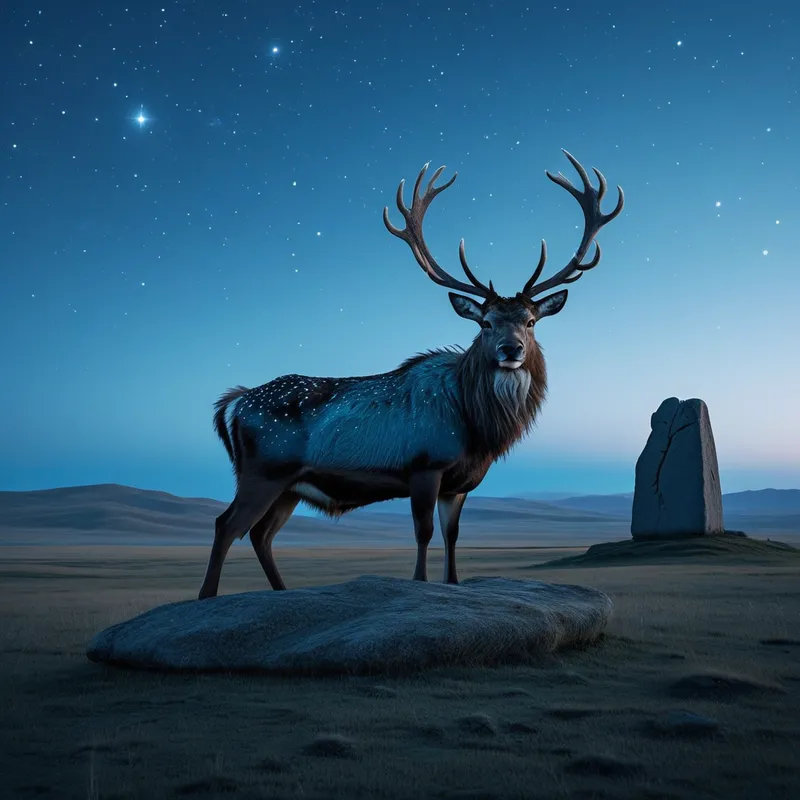
Listen. Before the time of the great khans, when the sky was closer and the earth still whispered with the breath of the first spirits, there was a union of heaven and earth. From the vault of the eternal blue sky, Tengri, descended a spirit in the form of a stag. Not a beast of the forest, but a creature of pure, celestial light—a kök börü, a blue stag. His antlers were not of bone, but of branching lightning and captured starlight. And from the deep, nurturing body of the earth, Etügen, arose a spirit in the form of a doe, her coat the color of rich, dark soil and her eyes like deep, still pools.
Their meeting was the first marriage. Where the stag’s celestial hooves touched the steppe, the grass grew sweeter. Where the doe lay to rest, wildflowers bloomed. From this sacred union were born the first people, the ancestors who knew the language of the wind and the secrets of the animal tracks. The stag was their guide, their protector, the bridge between the high, distant Tengri and the warm, sustaining earth.
But a shadow fell. A human hunter, blinded by pride and the glitter of the stag’s celestial hide, raised his bow. He did not see the spirit, only the prize. The arrow, tipped with greed, flew true. It struck the blue stag not in the flesh, for he had none, but in the very core of his luminous being.
A great cry echoed across the plains, a sound of shattering sky. The stag did not fall as a beast falls. He began to transform. His light, seeking refuge from the betrayal, poured into the earth. His magnificent, star-crowned antlers hardened, twisted, darkened. His legs, once so swift, rooted themselves deep into the soil. His celestial body petrified, turning to solid, unmoving stone. Where the divine stag once stood, a great, rugged standing stone now rose—a deer stone.
The doe’s lament was the wind that never ceases on the steppe. She circled the stone once, twice, three times, her grief seeding the clouds. Then, with a final, longing look, she turned and fled westward, following the path of the setting sun, leaving the people orphaned under the vast, watching sky.
And so the first stone stood. But the legend whispers that this was not an end, but a scattering. In his agony and flight, fragments of the stag’s spirit—each a potential stone—were cast across the length and breadth of the land. Some landed and remained dormant, mere rocks. Others, touched by the prayers of the shaman or the tears of the repentant, began to rise. They pushed up from the earth, these deer stones, each one etched, over centuries, with circles that are the sun and moon, with belts that are the heavens, and, most importantly, with the image of the stag himself, leaping eternally upward, antlers reaching back for the sky from which he came.
Cultural Origins & Context
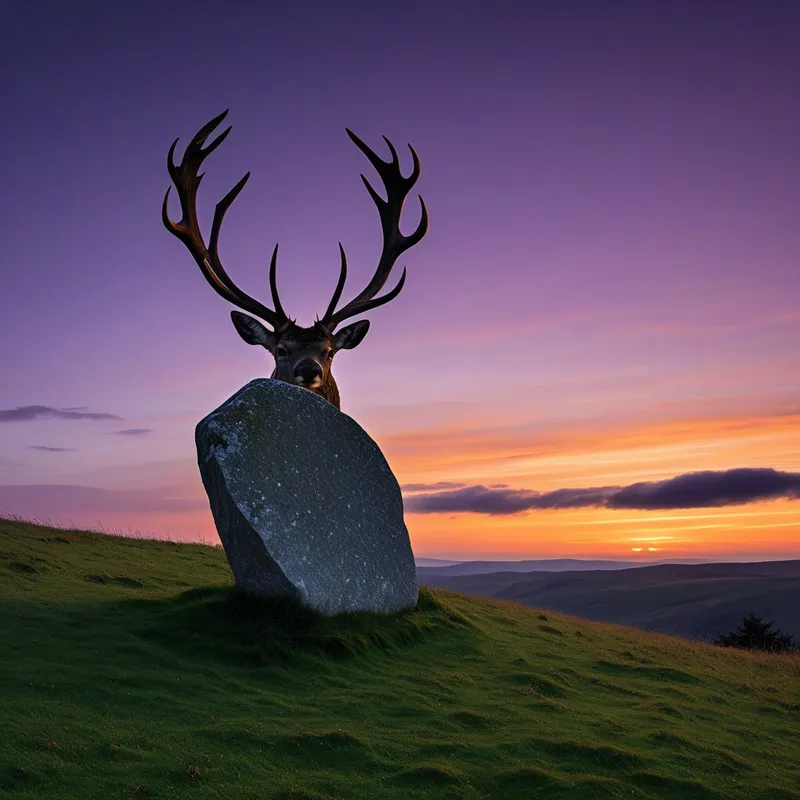
The Stag Stone Legends are woven into the very fabric of the Mongolian nomadic worldview. They are not mere stories for entertainment, but living maps of cosmology and identity. The tales are intrinsically linked to the physical deer stones (also known as khereksüür in some contexts) that dot the Mongolian landscape, particularly in the Arkhangai region. These Bronze Age monuments, dating from 1200 to 600 BCE, served as ceremonial centers, burial markers, and cosmic anchors.
The myths were the domain of the shaman, the böö. They were recited not from books, but from memory, in the flickering light of the hearth or under the boundless starry sky during rituals. Their function was multifaceted: to explain the origin of these mysterious stones that preceded the people, to teach the consequences of hubris against the spirit world, and to provide a narrative of resilience. The stone is not a tomb, but a testament—a symbol that even when the divine is wounded and forced into stasis, its essence and direction (the leaping stag) remain, awaiting reactivation. The stories served as a societal reminder of the sacred contract between humanity, the animal world (Etügen), and the heavens (Tengri).
Symbolic Architecture
At its [heart](/symbols/heart “Symbol: The heart symbolizes love, emotion, and the core of one’s existence, representing deep connections with others and self.”/), this is a myth of catastrophic transformation and arrested [ascension](/symbols/ascension “Symbol: A profound sense of rising upward, often representing spiritual enlightenment, personal growth, or transcendence beyond physical limitations.”/). The celestial stag represents the untethered [spirit](/symbols/spirit “Symbol: Spirit symbolizes the essence of life, vitality, and the spiritual journey of the individual.”/), the pure [connection](/symbols/connection “Symbol: Connection symbolizes relationships, communication, and bonds among individuals.”/) to the divine [source](/symbols/source “Symbol: The origin point of something, often representing beginnings, nourishment, or the fundamental cause behind phenomena.”/) and the instinctual, guiding wisdom of [nature](/symbols/nature “Symbol: Nature symbolizes growth, connectivity, and the primal forces of existence.”/). The hunter’s [arrow](/symbols/arrow “Symbol: An arrow often symbolizes direction, purpose, and the pursuit of goals, representing both the journey and the destination.”/) is not just an act of violence, but the piercing shock of [human](/symbols/human “Symbol: The symbol of a human represents individuality, complexity of emotions, and social relationships.”/) [consciousness](/symbols/consciousness “Symbol: Consciousness represents the state of awareness and perception, encompassing thoughts, feelings, and experiences.”/) separating from its instinctual, spiritual root—the [birth](/symbols/birth “Symbol: Birth symbolizes new beginnings, transformation, and the potential for growth and development.”/) of egoic pride that severs the [connection](/symbols/connection “Symbol: Connection symbolizes relationships, communication, and bonds among individuals.”/) to the Self.
The stone is the embodied memory of the wound, and the etched stag upon it is the undying pattern of the spirit that was.
The [petrification](/symbols/petrification “Symbol: A state of being turned to stone, representing paralysis, permanence, or transformation in the face of overwhelming fear, trauma, or awe.”/) is a profound [symbol](/symbols/symbol “Symbol: A symbol can represent an idea, concept, or belief, serving as a powerful tool for communication and understanding.”/). It is not [death](/symbols/death “Symbol: Symbolizes transformation, endings, and new beginnings; often associated with fear of the unknown.”/), but a freezing, a descent into the unconscious. The spirit becomes [earth](/symbols/earth “Symbol: The symbol of Earth often represents grounding, stability, and the physical realm, embodying a connection to nature and the innate support it provides.”/)—heavy, silent, and seemingly inert. Yet, within that [stone](/symbols/stone “Symbol: In dreams, a stone often symbolizes strength, stability, and permanence, but it may also represent emotional burdens or obstacles that need to be acknowledged and processed.”/), the form of the leaping stag is carved. This is the critical [paradox](/symbols/paradox “Symbol: A contradictory yet true concept that challenges logic and perception, often representing unresolved tensions or profound truths.”/): the [image](/symbols/image “Symbol: An image represents perception, memories, and the visual narratives we create in our minds.”/) of dynamic, upward [movement](/symbols/movement “Symbol: Movement symbolizes change, progress, and the dynamics of personal growth, reflecting an individual’s desire or need to transform their circumstances.”/) is eternally captured in [static](/symbols/static “Symbol: Static represents interference, disruption, and the breakdown of clear communication or signal, often evoking feelings of frustration and disconnection.”/) [stone](/symbols/stone “Symbol: In dreams, a stone often symbolizes strength, stability, and permanence, but it may also represent emotional burdens or obstacles that need to be acknowledged and processed.”/). It represents the core psychic [truth](/symbols/truth “Symbol: Truth represents authenticity, honesty, and the quest for knowledge beyond mere appearances.”/) that within our most hardened traumas, our most frozen emotional states, the [blueprint](/symbols/blueprint “Symbol: A blueprint represents the foundational plan or design for something, often symbolizing potential, structure, and the mapping of one’s inner self or future.”/) for healing and [ascent](/symbols/ascent “Symbol: Symbolizes upward movement, progress, spiritual elevation, or striving toward higher goals, often representing personal growth or transcendence.”/) remains encoded. The stag is the Self, forced into latency. The [stone](/symbols/stone “Symbol: In dreams, a stone often symbolizes strength, stability, and permanence, but it may also represent emotional burdens or obstacles that need to be acknowledged and processed.”/) is the complex, the psychological [defense](/symbols/defense “Symbol: A protective mechanism or barrier against perceived threats, representing boundaries, security, and resistance to external or internal challenges.”/), or the cultural [trauma](/symbols/trauma “Symbol: A deeply distressing or disturbing experience that overwhelms the psyche, often manifesting in dreams as unresolved emotional wounds or psychological injury.”/) that holds it captive.
The Dreamer’s Resonance
When this myth stirs in the modern dream, it often manifests as dreams of paralysis, of being turned to stone while trying to run or speak. One may dream of ancient, moss-covered standing stones in familiar places—a backyard, a city street. The somatic feeling is one of profound weight, density, and immobility, often paired with a fierce, internal longing.
This is the psyche signaling a confrontation with what Jung called the shadow—not as a dark figure, but as a petrified one. The dreamer is encountering a part of themselves that was once vibrant, instinctual, and connected (the stag) but was “shot down” by early adaptation, shame, or trauma, and has since solidified into a rigid pattern, a belief, or a frozen emotion (the stone). The dream of the stag stone is an invitation to acknowledge this internal monument. The process is not about instantly shattering the stone, but about beginning to trace the carved image upon it—to recognize the original, vital pattern trapped within the rigidity.
Alchemical Translation
The individuation process modeled here is the reanimation of the inner stag. It is the alchemical work of freeing spiritus from corpus, not by rejecting the stone, but by transmuting it.
The first stage is Nigredo: the blackening. This is the recognition of the wound—the hunter’s arrow. One must confront the pride, the ignorance, or the betrayal that caused the psychic split. The stone must be seen and accepted; we must circle it like the grieving doe and feel the full weight of the loss.
The second is Albedo: the whitening. This is the careful study of the carvings on the stone. In psychological terms, it is the analysis of the complex. What is the exact pattern of the frozen stag? What specific vitality is trapped? Is it creative expression, sensual joy, or spiritual yearning? This stage involves illuminating the blueprint within the wound.
The final transmutation is not the destruction of the stone, but the stone becoming a conduit. The spirit does not leave the earth; it teaches the earth to fly.
The culmination is Rubedo: the reddening, the dawn. This is the re-integration. The psychic energy bound in the stone (the complex) is liberated and rejoins the conscious personality. The individual does not become the untouchable celestial stag again—that naive unity is forever lost. Instead, they become the living deer stone: a being grounded in the reality of earthly experience (the stone), through which the aspiring, guiding spirit (the stag) can once again flow and provide direction. They become the bridge, the deer stone itself, standing firm on the earth while forever reaching for the sky.
Associated Symbols
Explore related symbols from the CaleaDream lexicon:
- Stone — The primary symbol of petrification, memory, and the weight of the unconscious; the hardened form of a wounded spirit, containing the latent pattern of its true nature.
- Sky — The realm of Tengri, the father principle, consciousness, and the original home of the celestial stag from which the spirit fell and to which it eternally strives to return.
- Earth — The realm of Etügen, the mother principle, the unconscious, and the substance into which the stag’s spirit descends and transforms, representing grounding and containment.
- Journey — The stag’s flight and scattering, as well as the doe’s westward escape, symbolizing the forced migration of spirit, the soul’s path after trauma, and the long process of seeking wholeness.
- Sacrifice — The stag’s transformation into stone, a voluntary-seeming surrender of celestial form for earthly permanence, modeling the necessary sacrifice of naive unity for embodied, conscious existence.
- Spirit — The essential, immortal essence of the stag that precedes stone and survives within it, representing the core Self that cannot be destroyed, only obscured or transmuted.
- Arrow — The instrument of betrayal and separation, symbolizing the piercing shock of trauma, the sudden intrusion of egoic consciousness that severs the connection to instinct and spirit.
- Mountain — Like the solitary standing stone, a symbol of enduring presence, a meeting point between earth and sky, and a monumental testament to a profound event frozen in time.
- Bridge — The function of the deer stone itself, and of the integrated individual; a structure that connects the celestial (spirit, unconscious) with the terrestrial (earth, consciousness).
- Rebirth — The promise encoded in the myth; the stag’s form carved on the stone signifies not an end, but a latent potential for the spirit to be re-recognized and re-animated.
- Shadow — The hunter and the act of betrayal, representing the repressed, prideful, and ignorant aspect of the psyche that attacks its own higher nature, forcing it into unconsciousness.
- Dream — The medium through which the latent stag within the stone communicates, sending images of its trapped form to the conscious mind, urging recognition and reclamation.