The Spirit Walker Myth Meaning & Symbolism
A shaman's perilous journey to the spirit world to retrieve a lost soul, confronting shadow and sacrifice to restore cosmic balance.
The Tale of The Spirit Walker
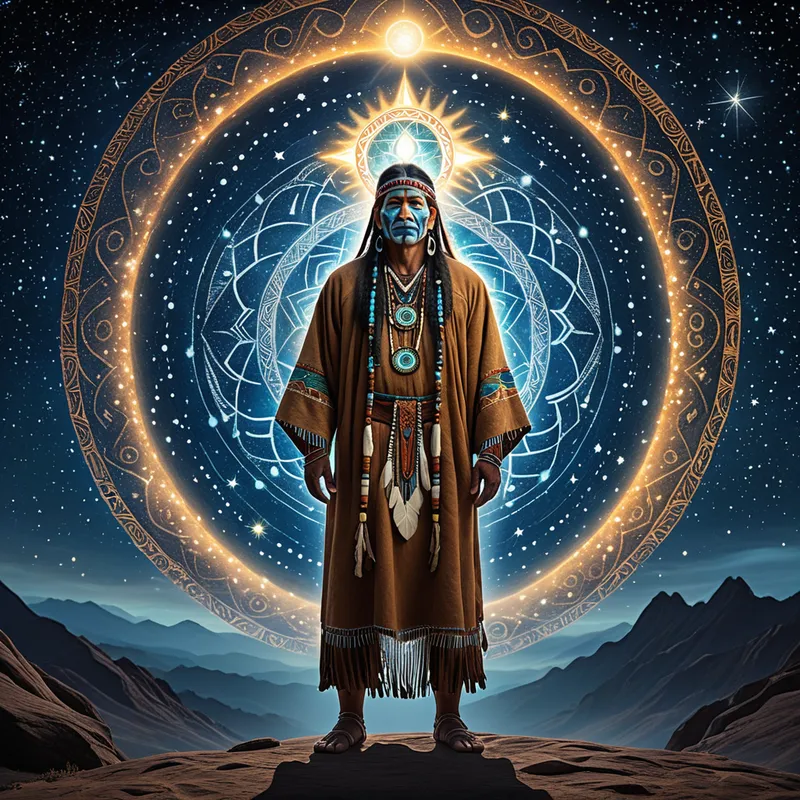
Listen. The wind does not just blow; it carries voices from the other side of the sun. In the time when the world was still soft and the rivers remembered their names, there was a sickness. It was not a sickness of the body, but of the soul—a great forgetting that crept into the lodges. The people grew hollow, their eyes reflecting the firelight but holding no warmth within. The drums fell silent.
In this stillness, a man arose. He was called Heyoka, the one who walks contrary, for he saw the world backwards and spoke in riddles that held the truth. The elders came to him, their faces etched with the fear of a dying world. “The heart of our people is drifting away,” they said. “It is lost in the lands where the dead walk. Bring it back, or we will become ghosts in our own skins.”
Heyoka accepted the burden. He did not pack food or water. He took only his sacred pipe, a pouch of sage, and a single eagle feather. For seven days and seven nights, he sat in the sweat lodge, purifying his flesh until it was as translucent as dawn mist. He sang the ancient songs until his voice was not his own, but the voice of the canyon and the wolf.
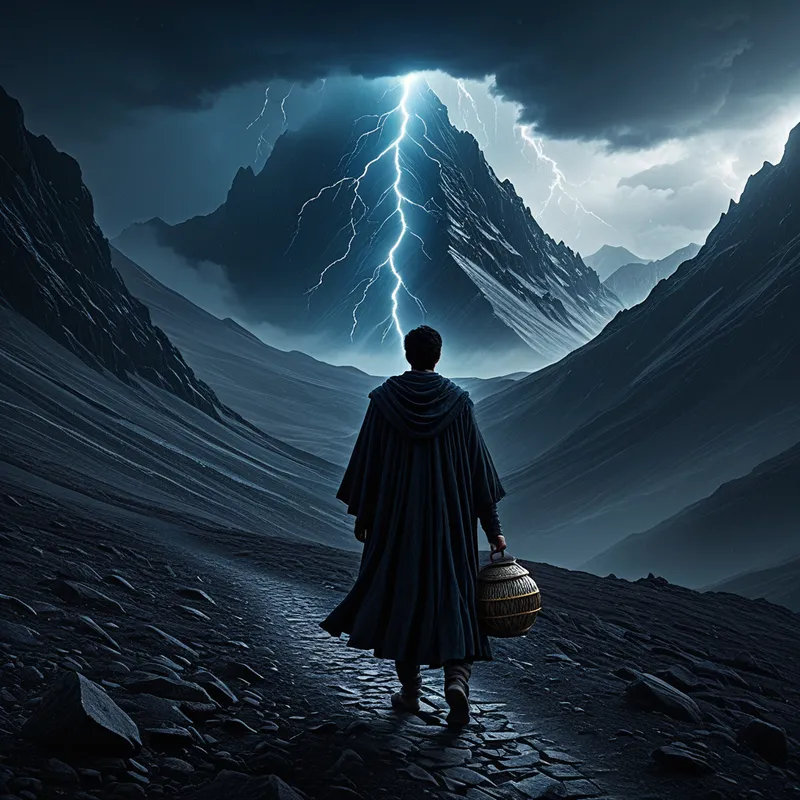
Then, he walked. He walked beyond the last hunting ground, beyond the river that marks the edge of maps, and into the Spirit World. Here, the trees whispered with the memories of ancestors, and the stones watched with patient eyes. The path was not of earth, but of shimmering light and deepening shadow. He met guardians: a great buffalo skull that spoke of scarcity, a twisting serpent that offered forbidden knowledge. To each, he offered smoke from his pipe and passed by, for his quest was singular.
The heart of the people was not a thing, but a child—a luminous, frightened spirit-child huddled at the roots of a great, withered tree in a desolate plain. But guarding it was Mahto, the Shadow-Bear. It was not a beast of flesh, but of collective fear, its form shifting like storm clouds, its eyes voids that pulled at Heyoka’s own spirit.
“Turn back, Walker,” Mahto growled, the sound of crumbling mountains. “This light is mine. It fuels the shadows that make your world real. Take it, and your world becomes flat, without depth or meaning.”
Heyoka felt the truth in the lie. He did not raise a weapon. Instead, he sat. He opened his pouch and began to sing a lullaby, a song so old it predated fear. He sang of the first sunrise, of the taste of berries, of the warmth of a mother’s embrace—simple, human things. He sang of his own sorrows, his failures, his petty angers. He offered not his strength, but his vulnerability.
The Shadow-Bear roared, but its form began to flicker. It was made of unacknowledged darkness, and Heyoka’s honest song was a light it could not absorb. With a sound like a sigh, Mahto dissolved into the plain, not destroyed, but seen and thus transformed.
Heyoka gathered the spirit-child, its light now steady. The journey back was swift, for the path home is always shorter. He returned to his people not as a conqueror, but as a man who had aged centuries in a moment. As he stepped back into the circle of the village, the spirit-child melted into the earth. And from that spot, a spring of clear water bubbled forth, and the people felt a warmth return to their chests. The drums found their heartbeat again. Heyoka simply nodded, his work done, and walked to the edge of the firelight, forever touched by the silence of the other side.
Cultural Origins & Context
The narrative of the Spirit Walker is not a single, monolithic myth, but a profound pattern woven through the oral traditions of many Native American nations, from the Lakota and Ojibwe to the Navajo and Cherokee. It is the foundational template for the Hanbleceya, or vision quest, and the core drama of the shamanic calling. These stories were not mere entertainment; they were living maps of non-ordinary reality, passed down through generations by medicine people and storytellers.
The societal function was multifaceted: it was a teaching story about the role of the healer, who must journey into chaos to restore order. It validated the often-traumatic “shamanic crisis”—the initiatory sickness that precedes spiritual power. Most importantly, it modeled a cosmology where the individual’s psychological journey was inseparable from the health of the collective. The lost “heart” or soul could be that of a single sick person or the entire community, reflecting a deeply interconnected worldview. The story was told with solemnity, often during rites of passage or times of communal distress, to remind the people that healing always requires a courageous journey to the source of the wound.
Symbolic Architecture
At its core, the myth is a masterful depiction of the psyche’s self-regulating function. The “sickness” is a state of psychic imbalance, where vital energy (the spirit-child) has become dissociated and trapped in the unconscious (the Spirit World).
The hero does not go to slay a monster, but to retrieve a forgotten part of himself that the monster guards.
Heyoka, the Heyoka, represents the ego that has been made sufficiently humble and permeable to undertake the journey. His contrary nature symbolizes the necessity of inverting normal logic to navigate the unconscious. The guardians of the path are the complex defense mechanisms and latent potentials of the psyche. The Shadow-Bear, Mahto, is the ultimate symbol of the personal and collective shadow—not evil, but the repository of all we deny, fear, and reject. Its argument is psychologically astute: to deny the shadow entirely is to live in a naive, one-dimensional reality.
The climax—singing a lullaby of vulnerable, human truth—is the alchemical key. It represents the act of conscious relationship with the shadow. The hero triumphs not through force, but through acknowledgment, integration, and the offering of humane consciousness to the inhuman aspect of the self. The return of the soul as a life-giving spring signifies the transformative result: reclaimed psychic energy now nourishes the whole of one’s being and community.
The Dreamer’s Resonance
When this myth stirs in the modern dreamer, it often manifests as sequences of perilous travel: trying to cross a treacherous bridge, navigating a labyrinthine building, or searching for a lost person or precious object in a decaying landscape. The somatic feeling is one of profound urgency mixed with dread.
Psychologically, this signals that a crucial process of soul retrieval is underway. The ego is being compelled to venture into repressed emotional territory—perhaps a childhood trauma, a buried grief, or an abandoned creative gift (the lost spirit-child). The shadow guardians in dreams may appear as threatening figures, impossible bureaucratic hurdles, or even terrifying natural forces. The dreamer is in the “rising action” phase of the myth, experiencing the call, the resistance, and the initial confrontation with the guardians of the threshold. The process is one of deep re-membering, where the psyche is attempting to reclaim autonomy and vitality by reintegrating a split-off complex. It is often a prelude to significant life change, demanding the dreamer bring courageous awareness to their inner wilderness.
Alchemical Translation
For the individual seeking wholeness, the Spirit Walker’s journey is a precise model of individuation. The first alchemical stage, the Nigredo or blackening, is the “sickness”—the feeling of emptiness, depression, or meaninglessness that initiates the crisis.
The descent is not a defeat, but a gathering. One goes into the dark to find the light that was left there.
The journey itself is the Separatio and Mortificatio—separating from the familiar identity and allowing the old, rigid ego to “die” in confrontation with the shadow. Heyoka’s offering of his vulnerable song is the pivotal Coniunctio, the sacred marriage of conscious and unconscious. He does not destroy the shadow but enters into a conscious relationship with it, transforming its raw, terrifying power into meaningful insight.
The retrieval of the spirit-child is the emergence of the Self, the central, organizing principle of the psyche that was always present but obscured. The final stage, the Rubedo or reddening, is the return: the integrated energy now flows back into one’s life as renewed purpose, creativity, and the capacity to nourish both oneself and one’s community. The modern Spirit Walker learns that healing is not about becoming perfect, but about becoming complete—able to hold both the song and the silence, the light and the bear that guards it.
Associated Symbols
Explore related symbols from the CaleaDream lexicon: