The Solve Stage Myth Meaning & Symbolism
The myth of the alchemical vessel's dissolution, where the prima materia must be utterly undone to be made pure and ready for rebirth.
The Tale of The Solve Stage
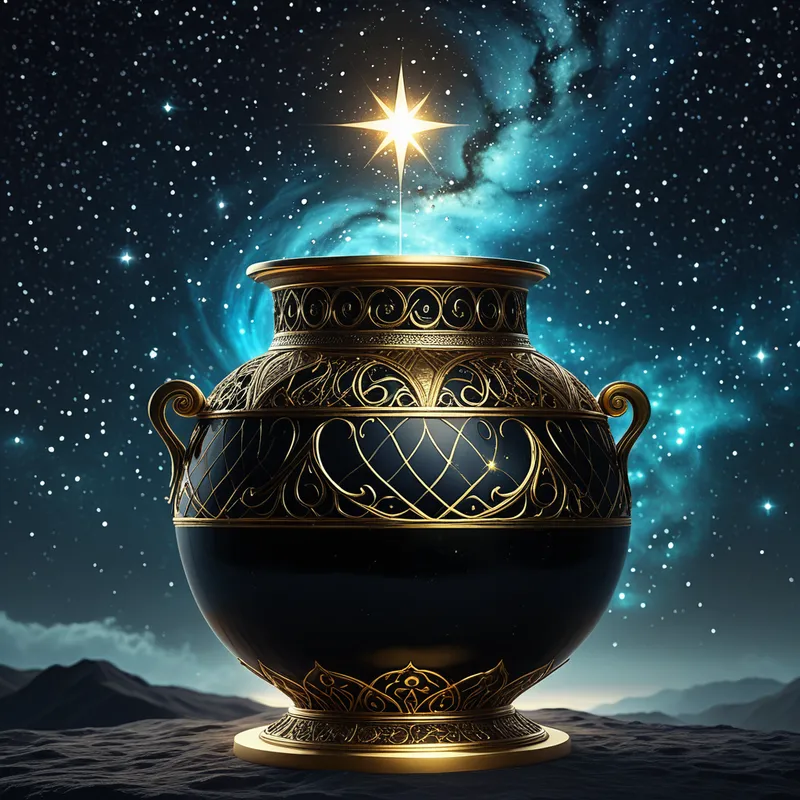
Listen, and hear the tale that is whispered in the hiss of the crucible and the sigh of the alembic. In the time before time was measured, when the world was a great, sleeping Prima Materia, there existed the Vessel. It was not a cup of clay or a bowl of bronze, but a living cosmos of potential, a perfect, sealed Vas Hermeticum. Within its crystalline walls swirled the essence of all that was and could be—starlight and shadow, memory and oblivion, the song of creation and the silence that followed.
The Vessel was tended by the Alchemist, a being whose breath was the wind and whose gaze was the sun. For eons, the Alchemist observed the beautiful, stagnant dance within. The patterns were glorious, but they were fixed. The light never dimmed, the dark never brightened. It was a perfect, eternal stasis—a prison of its own magnificence.
A great sorrow grew in the heart of the Alchemist, a sorrow for the unborn futures trapped in that glittering suspension. To create, the pattern must break. To give life, the form must die. This was the terrible, necessary knowledge.
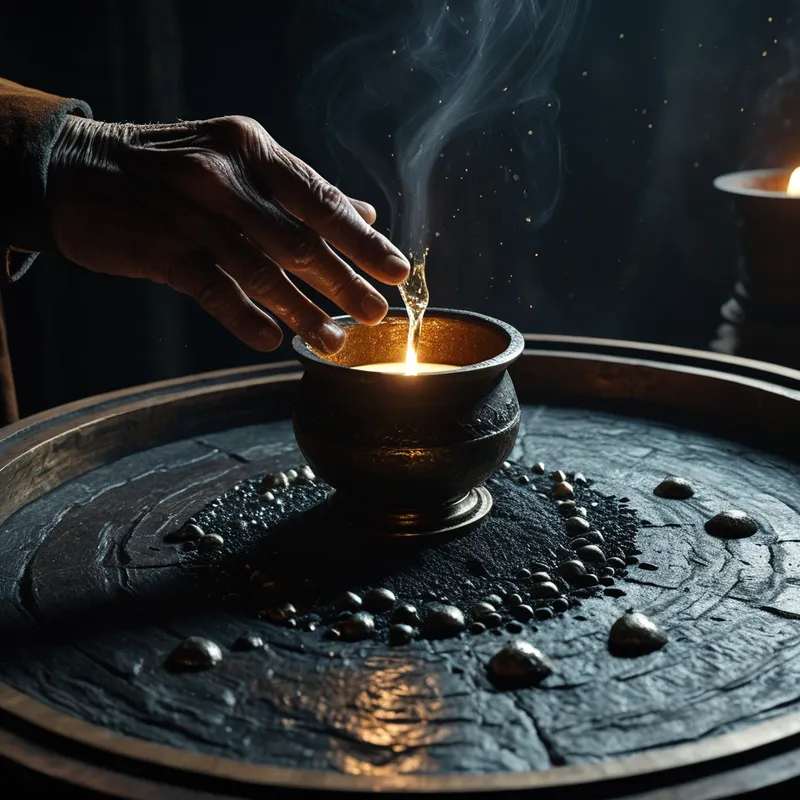
With hands that shook the foundations of mountains, the Alchemist approached the Vessel. Not with fire first, but with a single, silver tear—the Aqua Divina. The tear fell, not onto the surface, but into the very substance of the walls. Where it touched, the unbreakable crystal wept. It began to soften, to blur at the edges.
Then came the invocation, a word that was not a sound but a vibration that unraveled seams. The Alchemist spoke the Verb of Unmaking. The firmament of the Vessel trembled. The beautiful, coherent forms within—the golden geometries, the argent rivers—began to lose their distinction. Colors bled into one another, not into mud, but into a luminous, chaotic grey. Solids became vapors; thoughts became mist. It was not destruction, but a profound, agonizing unclenching.
The Vessel itself did not shatter. Instead, it became diaphanous, then transparent, then it was no longer a container at all, but the very medium of the chaos. The once-separate Alchemist and Vessel and Contents were now one swirling, groaning mass of potential—the Nigredo. All identity was lost in a sea of exquisite, terrifying confusion. The world was dissolved. The Solve was complete. In the absolute stillness that followed the great dissolution, there was only a pregnant, dark humidity, waiting. The first, raw breath before a cry.
Cultural Origins & Context
The myth of The Solve Stage is the foundational narrative of the alchemical tradition, a corpus of esoteric knowledge that flourished in Hellenistic Egypt, the medieval Islamic world, and Renaissance Europe. It was never a single, canonical text, but a living doctrine passed down through cryptic manuscripts, oral instruction, and symbolic art. The tellers were the alchemists themselves—part philosopher, part mystic, part early chemist—who saw their laboratory work (Opus Laboratorium) as a mirror of a cosmic and psychological process (Opus Divinum).
Its societal function was deeply subversive and initiatory. In a world of rigid religious and social structures, the myth taught that truth and transformation required a radical deconstruction of all given forms. It was taught in whispers, its symbols guarding its meaning from the uninitiated. The myth served as a map for navigating the inevitable crises of the soul, framing dissolution not as a catastrophe, but as the essential prelude to any authentic creation. It provided a sacred container for the experience of despair, loss of faith, and existential confusion, legitimizing them as stages on a sacred path.
Symbolic Architecture
At its heart, The Solve Stage is the archetypal drama of necessary undoing. The Vas Hermeticum represents the constructed self—the ego, the personality, the worldview we have carefully built and fortified. It is our identity, comfortable and coherent, yet ultimately limiting. The glorious contents are our talents, memories, beliefs, and traumas, all held in a fixed arrangement.
The Alchemist is the deeper, guiding intelligence of the psyche, the Self in Jungian terms, or the spark of divine consciousness. Its sorrow is the intuition that wholeness lies beyond the current form. The Aqua Divina—the tear—is the solvent of emotion, often profound grief or compassion, which is the only force capable of softening the hardest defenses. The Verb of Unmaking is the shock of insight, the traumatic event, or the deep psychological crisis that initiates the process.
The Solve teaches that you are not the vessel. You are the process occurring within it. To cling to the form is to reject the transformation.
The resulting Nigredo, the chaotic mass, symbolizes the state of psychic dissolution. It is depression, the dark night of the soul, the feeling of having lost all that once made sense. It is not mere emptiness, but a potential-filled confusion, where all elements of the personality are present but without hierarchy or order—a state of profound, fertile disorientation.
The Dreamer’s Resonance
When this myth stirs in the modern unconscious, it announces itself in dreams of profound structural collapse. The dreamer may find their house, the classic symbol of the self, flooding with black water, its walls dissolving into sand. They may dream their teeth are falling out, or their skin is peeling away to reveal nothing beneath. They may be lost in a familiar city that has become a labyrinth, or watch as a cherished object melts into an unrecognizable substance.
Somatically, this is the process of the nervous system and the psyche “unfreezing.” It is the anxiety that feels like coming apart, the grief that feels bottomless, the depression that presents as a heavy, grey fog where all motivation and identity dissolve. The body may feel weak, ungrounded, or plagued by a sense of pervasive entropy. The dreamer is not breaking down; they are, at a deep level, undergoing the Solve. The conscious ego experiences it as a crisis, but the unconscious is executing a sacred, if terrifying, operation: the systematic deconstruction of an outworn mode of being.

Alchemical Translation
For the modern individual seeking individuation—the process of becoming an integrated, whole Self—The Solve Stage is non-negotiable. Our culture prizes construction, accumulation, and positive affirmation, pathologizing the essential, creative function of dissolution. The alchemical myth reframes this “falling apart” as the sacred Solutio.
The process begins when the Alchemist (the Self) determines that the current personality structure (the Vessel) has served its purpose and must be opened. This is often precipitated by a life event—a loss, a failure, a betrayal—that acts as the Aqua Divina, the emotional solvent. The individual must then endure the Verb of Unmaking: the conscious surrender to the process. This is the agony of letting go of who you thought you were—your career identity, your role in the family, your long-held beliefs.
The goal is not to survive the dissolution unchanged, but to allow oneself to be changed by the dissolution. The triumph is in the yielding.
The ensuing Nigredo is the psychological wilderness. Here, one must resist the frantic urge to rebuild the old vessel immediately. This is a time for mourning, for stillness, for allowing the inner chaos to simply be. It is in this dark, fertile soup that the elements of the psyche, freed from their old alliances, can begin to interact in new ways. The Solve makes the subsequent Albedo (purification) and Rubedo (integration) possible. One cannot purify or unite what remains rigidly separate. Thus, the myth models the ultimate act of faith: that from the deliberate and terrifying act of unmaking, a truer, more authentic self will eventually coagulate. The Solve is the death that makes all rebirth possible.
Associated Symbols
Explore related symbols from the CaleaDream lexicon: