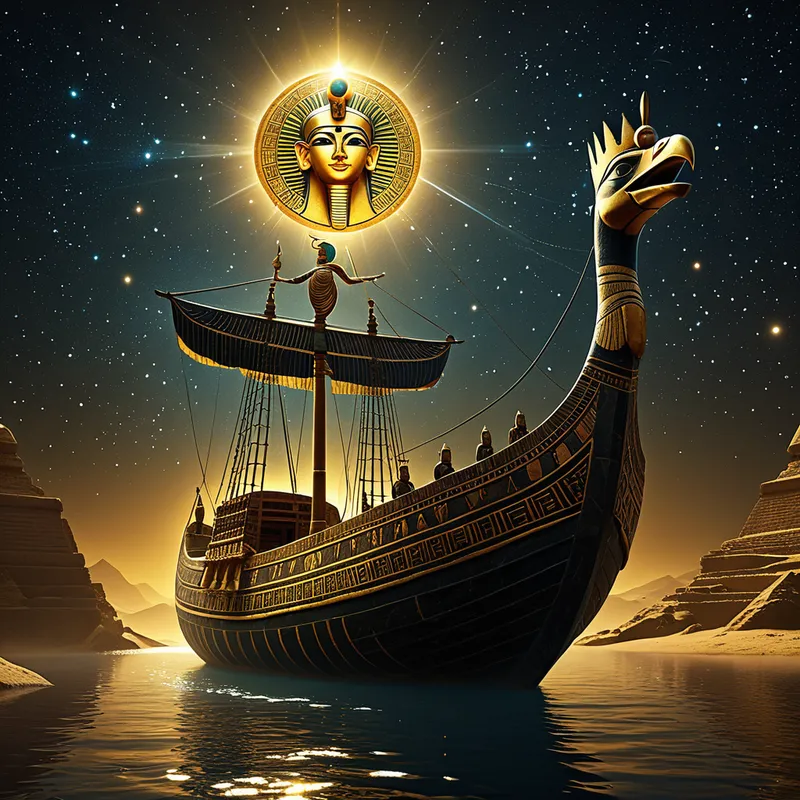
The Solar Barque of Ra journey Myth Meaning & Symbolism
The sun god Ra sails his barque through the twelve hours of night, battling chaos to be reborn at dawn, mirroring the soul's eternal journey.
The Tale of The Solar Barque of Ra journey
Hark, and listen to the journey that stitches the world together, the voyage upon which the breath of life itself depends. The great sun, Ra, has grown weary. His blazing countenance, which bathes the Two Lands in life-giving light, begins to dim as he reaches the western horizon. This is not an end, but a descent. The gates of the Duat yawn open, a mouth of purple twilight and cool, damp air.
Ra boards his vessel, the Mandjet—the Day Barque—but as the last sliver of light vanishes, the ship transforms. It becomes the Mesektet, the Night Barque, a craft of silent cedar and ghostly gold, built to navigate the black waters of the unseen world. He is not alone. A divine crew mans the oars and ropes: Thoth, the measurer of time and speaker of spells; Sekhmet, the fierce one whose breath is fire; and Geb, whose laughter causes the earth to quake. Most crucial is Apep, the serpent of utter chaos, who lies in wait, coiled in the eternal darkness, desiring only to swallow the sun and unmake creation.
The barque slips into the first hour of night. The air is thick and silent, broken only by the drip of primordial water and the chanting of the gods. They pass through regions of fire and regions of mist, where the souls of the justified dead cry out in hope. Ra changes his form; from the falcon-headed king, he becomes a ram-headed elder, then a beetle, then a shrouded figure of light. At the midpoint of the night, in the deepest, most perilous hour, Apep strikes.
The serpent rears from the black river, a mountain of scaled void, its maw a cavern of nothingness. It seeks to still the waters, to halt the barque’s sacred progress. The crew leaps into action. Thoth casts binding spells, his voice weaving nets of sacred syllables. Sekhmet unleashes spears of searing light. The other gods thrust with magical harpoons. Ra himself stands steadfast, projecting a gaze of such pure, concentrated ma’at—cosmic order—that the serpent’s chaotic form recoils. After a titanic struggle, Apep is wounded, beaten back into the mud, but not destroyed. He will return tomorrow night, and every night after, for the battle is eternal.
Wounded but victorious, the barque sails on. In the final hours, Ra approaches the eastern horizon. The waters begin to lighten. The formless dead who have ridden in the barque’s wake are revitalized. As the prow touches the realm of dawn, Ra is transformed once more. He merges with the scarab god, Khepri, the becoming-one. The old sun is gone, consumed by the night. From the hull of the night barque, the new sun is pushed, born anew, a child of gold and fire, rising into the sky to begin the day’s journey. The cycle is complete. Life continues.
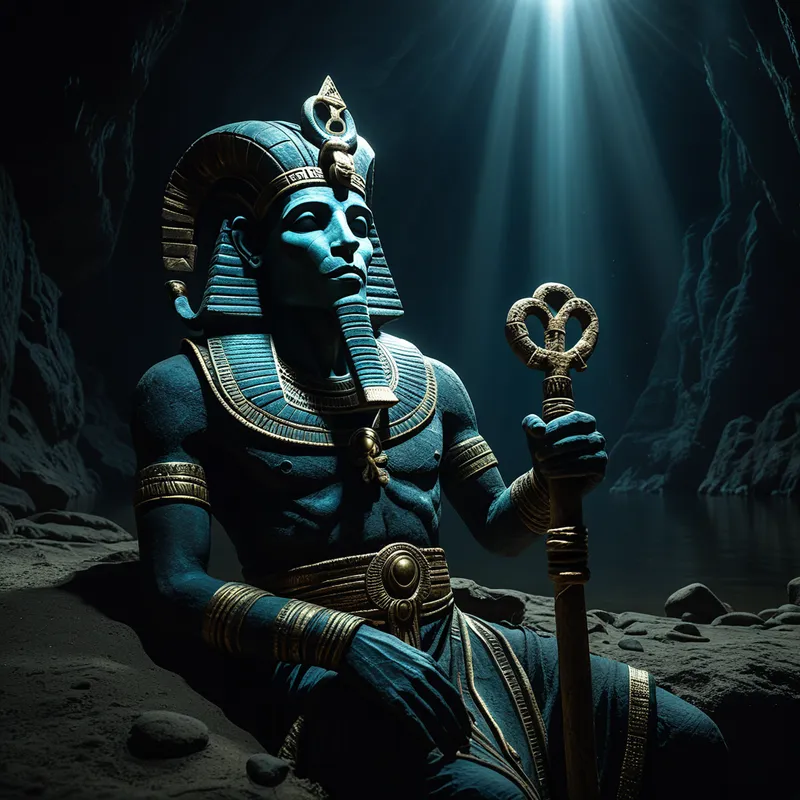
Cultural Origins & Context
This myth formed the pulsating heart of ancient Egyptian state religion and personal cosmology for millennia. It was not a single story but a complex theological narrative detailed in funerary texts like the Book of the Dead, the Amduat, and the Book of Gates, painted on the walls of royal tombs in the Valley of the Kings. It was performed ritually by priests, with the Pharaoh acting as the living embodiment of Ra on earth, ensuring the sun’s—and thus the kingdom’s—victorious rebirth each day. For the common person, their hope for afterlife was tied to this journey; to be among the “blessed dead” was to dwell in the Field of Reeds, but also to potentially join the solar barque’s crew, aiding in the eternal fight against chaos and thus participating in the maintenance of cosmic order, or ma’at.
Symbolic Architecture
The Solar Barque journey is a masterful symbolic map of the psyche’s necessary engagement with the unconscious. The sun, our conscious identity and life-force (the ego), cannot shine forever. It must set, must descend into the Duat—the personal and collective unconscious—where it encounters the contents we have repressed or forgotten.
The night sea journey is not a detour from life, but its most sacred, non-negotiable passage. To avoid the descent is to choose a permanent, sterile twilight.
The twelve hours represent a complete cycle of transformation, akin to the twelve labors or the stages of alchemy. The changing forms of Ra (falcon, ram, beetle) symbolize the ego’s necessary fluidity; to navigate the depths, our daytime identity must dissolve and reform. The divine crew—Thoth (intellect, logic), Sekhmet (instinct, fury), Geb (groundedness)—are the inner resources, the psychic complexes and strengths we must call upon. And then there is Apep, the ultimate shadow. This is not a personal flaw to be corrected, but the archetypal force of entropy, meaninglessness, and primal dissolution. The battle is not for annihilation, but for containment. We do not “defeat” our deepest chaos; we learn to face it, name it, and bind it through the disciplined application of our inner ma’at—our personal integrity and truth.
The Dreamer’s Resonance
When this myth stirs in modern dreams, it often manifests not as a literal barque, but as a profound somatic narrative of cyclical crisis and renewal. One may dream of traveling through a long, dark tunnel (a birth canal into a new self), of fighting a formless monster in a basement (engaging the personal shadow), or of caring for a dying light only to witness it reborn as something new. The body often feels the journey: a weight of deep fatigue (the descent), anxiety or terror (the encounter with Apep), followed by a profound, quiet relief or lightness (the rebirth at dawn). These dreams mark pivotal transitions—the end of a life chapter, a period of depression or “dark night of the soul,” or the slow, painful integration of a traumatic memory. The psyche is announcing it is in its nocturnal phase, performing the essential, invisible work of composting the old self to nourish the new.

Alchemical Translation
For the modern individual seeking wholeness (individuation), the Solar Barque provides the ultimate alchemical recipe. The prima materia is the worn-out conscious attitude, the ego that has become rigid and repetitive. The nigredo, or blackening, is the voluntary descent—entering therapy, confronting a deep fear, allowing a grief to be fully felt. This is the journey through the Duat.
The alchemical gold is not found by fleeing the serpent, but in the radiance forged in the moment of facing it.
The battle with Apep is the mortificatio, the death of the old psychic structure. Here, we must employ our inner “crew”: our Thoth (journaling, analysis), our Sekhmet (righteous anger, protective boundaries), our Geb (connection to the body, nature). The goal is not victory, but the coniunctio oppositorum—the sacred marriage. This is symbolized by Ra’s fusion with Khepri at dawn. The conscious ego (Ra) integrates the transformative, self-generating power of the unconscious (Khepri). The outcome is the albedo and rubedo—the whitening and reddening—the birth of a renewed self that has metabolized the darkness. One does not simply return to the old day, but rises as a new sun, carrying the wisdom of the night within its light. The journey must be repeated daily, for individuation is not a destination, but a faithful, eternal practice of setting and rising, of engaging the depths to renew the surface.
Associated Symbols
Explore related symbols from the CaleaDream lexicon: