The Snow Woman of Yoshiwara Myth Meaning & Symbolism
A courtesan of unearthly beauty reveals her true nature as a vengeful spirit of ice, testing the boundaries of love, fear, and human promise.
The Tale of The Snow Woman of Yoshiwara
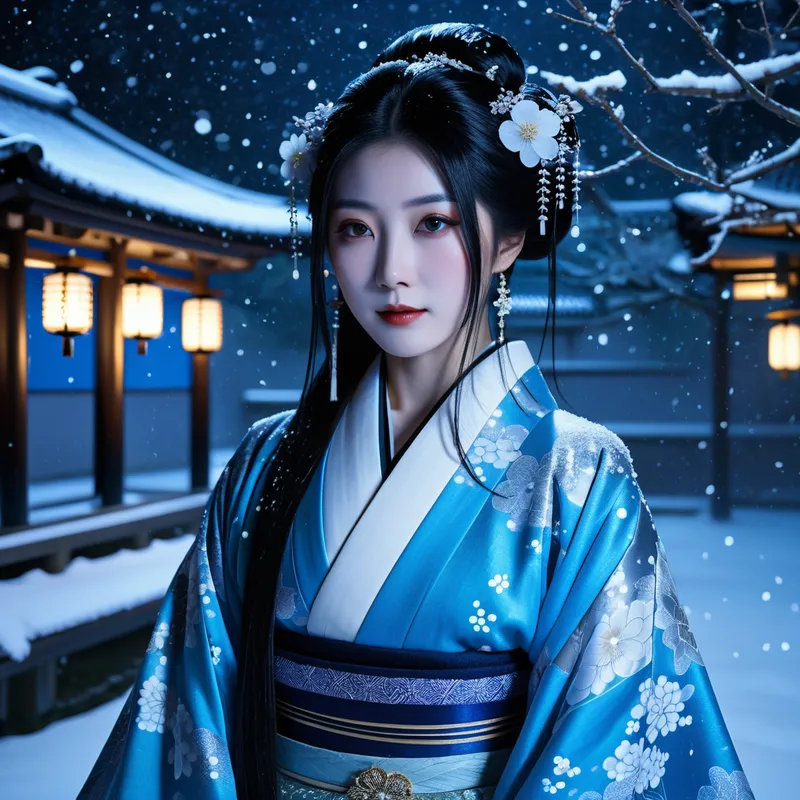
Listen, and let the winter wind carry this tale to you. In the floating world of Yoshiwara, where lanterns glowed like captive fireflies and the scent of incense clung to silk, there lived a courtesan of such beauty it stole the breath. Her name was whispered like a prayer: O-Yuki. Her skin was the pale, flawless white of the first snow, her hair a waterfall of night, and her eyes held the deep, still cold of a mountain lake in January. She was the most desired, the most untouchable, a jewel in the gilded cage of the pleasure quarters.
To her side came a young man, a merchant’s son named Seikichi. He was not the wealthiest, nor the most noble, but his heart was sincere. From the moment he saw O-Yuki, a profound and desperate love took root in him, a love that burned with a feverish intensity. He sold his belongings, he neglected his duties, all for a few precious hours in her presence. He saw not just the perfect entertainer, but a melancholy soul behind the painted smile. He vowed his love was different; it would see her, it would free her.
And O-Yuki, the ice-princess of Yoshiwara, began to thaw. A genuine warmth, fragile as a snowdrop, appeared in her eyes when he visited. She shared secrets with him that were not part of the courtesan’s script—stories of a distant, cold home, of a loneliness as vast as a winter sky. She warned him, her voice a chilling breeze, “Love me, but never question me. Promise me this. Swear you will never speak of what you do not understand.”
Blinded by devotion, Seikichi swore. Their intimacy deepened. He spoke of a future beyond the walls, a small house, a simple life. She listened, a silent tear tracing a path down her porcelain cheek, freezing before it could fall.
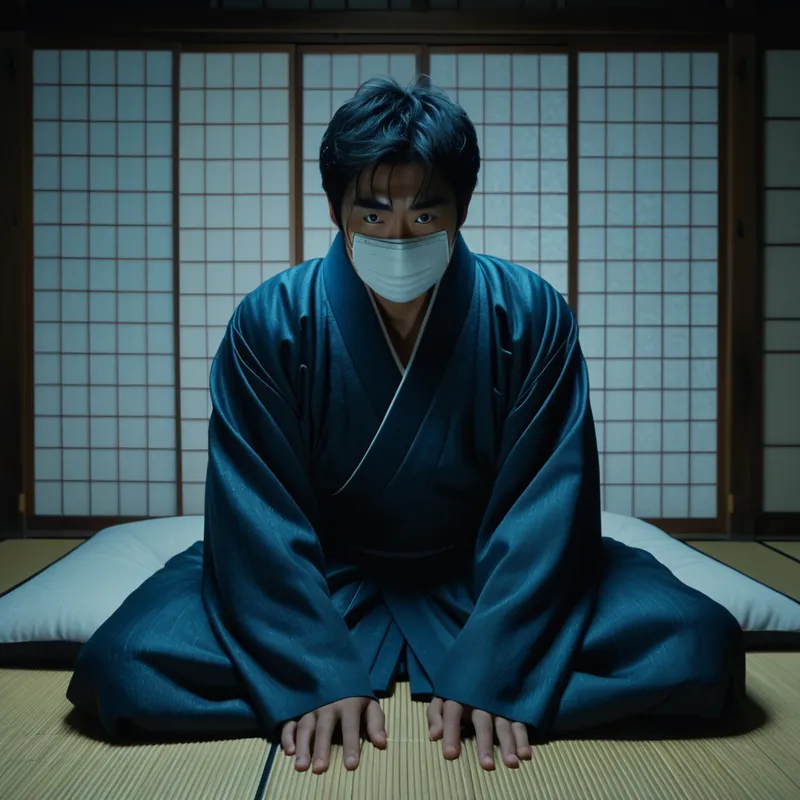
Then came the night. A night of howling wind that seemed to speak in tongues, a night when the cold seeped through the paper screens of the shōji. They lay together, and Seikichi, in a moment of blissful thoughtlessness, brushed a strand of hair from her forehead. His fingers met not warm skin, but a cold so profound it burned. He gasped. In his shock, the forbidden question escaped his lips: “Why are you so cold?”
The air in the room died. The lantern flames guttered and turned blue. O-Yuki sat up, and the beautiful face Seikichi adored began to change. The warmth drained away, leaving the pallor of a corpse. Her eyes, once deep pools, became voids of glittering hoarfrost. Her breath, when she spoke, was a visible mist that coated the room in rime. “You promised,” her voice echoed, no longer musical, but the crackle of ice underfoot. “You promised silence.”
She was no mortal woman. She was Yuki-onna, the Snow Woman, a spirit of the frozen mountains who had taken this form. She had come to the heat and passion of Yoshiwara, a paradox seeking perhaps a forgotten warmth, bound only by the thin thread of a human vow. And he had broken it.
She raised a hand, and a blizzard roared to life within the confines of the room. Silk froze and shattered. “For your love, I spare your life this once,” the spectral voice intoned. “But forget me. Forget this night. Speak of it, and I will return. I will freeze the breath in your lungs and the blood in your heart.” With a final gust that smelled of pine and emptiness, she was gone, leaving only a dusting of fine, inexplicable snow on the tatami and a young man, alive but utterly frozen in soul.
Cultural Origins & Context
This haunting variant of the widespread Yuki-onna legend is uniquely rooted in the Edo period ethos. While the archetypal Snow Woman stalks remote mountain passes, her incarnation in Yoshiwara is a profound cultural metaphor. Yoshiwara itself was a district of artifice and fleeting beauty, a world where emotions were performative and genuine connection was the rarest, most dangerous commodity. Storytellers and Kabuki dramatists saw in this setting a perfect crucible for the myth.
The tale functions as a dark folktale and a sophisticated social commentary. Passed down in Yose and published in Kusazōshi, it served multiple purposes: a supernatural cautionary tale about the perils of obsessive love and broken promises, and a subtle critique of the <abbr title=“The “floating world” of urban pleasure and entertainment”>Ukiyo itself. The courtesan, the ultimate symbol of purchased fantasy, becomes literally supernatural—her beauty is not just skin-deep artifice, but a mask for an utterly inhuman reality. The myth asks: in a world of transactions, what happens when real feeling emerges? It often ends in annihilation.
Symbolic Architecture
The Snow Woman of Yoshiwara is not merely a ghost story; it is a precise map of a psychological constellation. O-Yuki represents the ultimate Anima figure—the soul-image of mesmerizing beauty, captivating coldness, and profound mystery. She embodies the allure of the unconscious itself: fascinating, promising wholeness, yet perilously inhuman.
The promise sworn in the heat of desire is the ego’s fragile pact with the depths of the soul. To break it is to unleash the elemental storm one sought to embrace.
Seikichi’s fatal question—“Why are you so cold?”—is the critical error. It is the ego’s demand for rational explanation of the numinous. He cannot accept the mystery; he must analyze the magic. He tries to bring the cold, unconscious Anima into the warm light of conscious understanding, and in doing so, shatters the necessary tension. The cold is her essence; it is the chilling truth of the unconscious’s otherness, its indifference to human comfort. His demand for warmth from a being of ice is the central paradox and tragedy.
Yoshiwara, the setting, symbolizes the conscious persona-world—brilliant, artistic, but fundamentally constructed and transient. The Snow Woman’s presence there is the intrusion of the eternal, archetypal world into the temporal human one, a haunting that reveals the fragile foundation of our most elaborate social and emotional constructs.
The Dreamer’s Resonance
When this myth pattern stirs in the modern dreamer, it signals a profound encounter with the frozen aspects of the psyche. To dream of a lover or beloved figure who becomes cold, distant, or literally icy is to experience the somatic reality of this archetype.
The psychological process is one of emotional frostbite. The dreamer may be in a relationship or pursuing a creative endeavor (their “O-Yuki”) that initially promised transformative beauty and connection. But the dream reveals the hidden cost: a part of them is freezing. The chilling figure represents an aspect of life or love that has been idealized but is, in truth, devoid of nourishing warmth. The dream is a crisis of promise—the dreamer has made an inner vow to ignore reality for the sake of the fantasy, and the psyche is now enforcing the terms. The somatic feeling upon waking is often a literal chill, a sense of hollow dread, or the ache of a heart that feels encased in ice. It is the soul’s warning that a nourishing connection has become a vampiric one, sucking away vital emotional heat.

Alchemical Translation
The alchemical journey modeled here is not of conquest, but of sacramental witnessing. The myth illustrates a failed Nigredo—the blackening, the first confrontation with the shadowy, cold contents of the unconscious.
The triumph is not in melting the snow woman, but in learning to stand in her blizzard without demanding spring.
For individuation, the Seikichi within us must undergo a different path. First, he must recognize the Anima’s true nature before swearing blind oaths. The initial attraction is valid—the soul draws us to what we lack. The critical work is to sit with the cold, to feel its bite without rushing to explain it away or force it to be warm. This is the mortificatio: the freezing death of naive projections.
The successful alchemical translation would see Seikichi, when feeling that supernatural cold, remain silent. He would behold the transformation not with terror, but with awe. He would witness the blizzard without pleading for it to stop. In doing so, he would no longer be a lover trying to possess a spirit, but a human consciously relating to a power of nature. The promise to “never question” translates psychologically to the discipline of receptive observation over analytical interrogation of deep psychic phenomena.
The Snow Woman might still depart, for she is an autonomous archetype. But she would leave not a frozen man, but a initiated one—chilled to the bone, humbled, carrying forever the memory of the sublime cold. His heart would not be broken, but tempered. He would learn to love the mystery, not the mask, and in that frigid clarity, find a more authentic warmth born of truth, not fantasy. The ice of the Anima, accepted, becomes the crystal that refracts the light of consciousness into newfound spectra of understanding.
Associated Symbols
Explore related symbols from the CaleaDream lexicon: