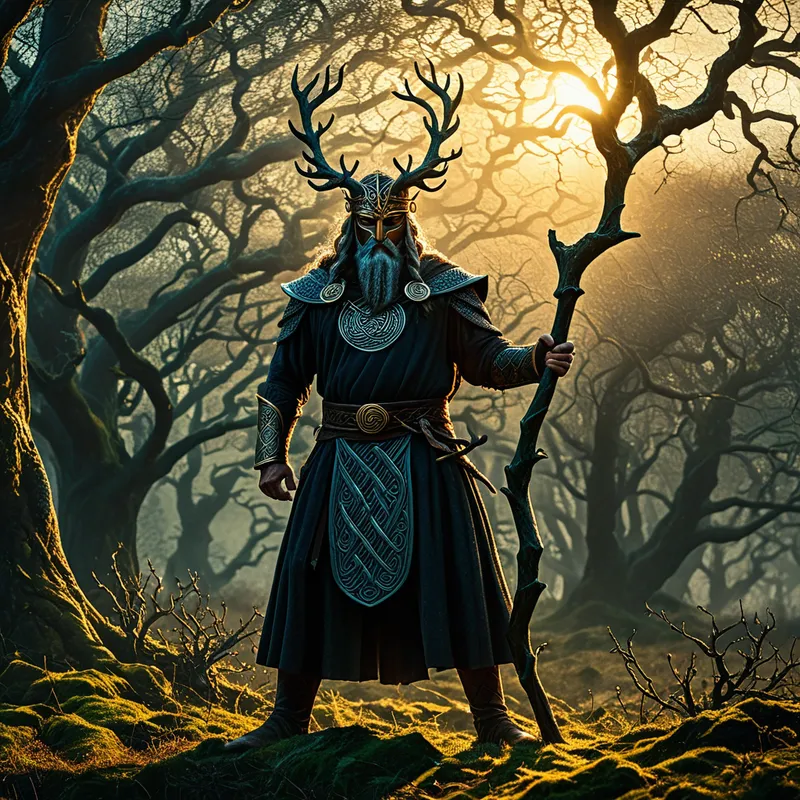
The Shillelagh Myth Meaning & Symbolism
A myth of a king's quest to forge a staff of living oak, binding his soul to the land's spirit to restore order from primal chaos.
The Tale of The Shillelagh
Listen, and let the fire’s crackle become the wind in the oaks. In a time when the world was younger, and the veil between the seen and unseen was thin as morning mist, there was a king. His name is lost to the peat and the rain, but his need is remembered. His land, Ériu, was beautiful but wild. Rivers changed their courses on a whim, forests grew overnight to block the sun, and the very hills seemed to shift in their sleep. The people were scattered, their hearts as unsettled as the weather. The king had a crown of gold, but it held no power over the whispering chaos of the untamed earth.
He sought counsel from the filid, who read the patterns in the flight of birds and the entrails of salmon. “The land has a spirit,” they said, their voices like dry leaves. “She is the Flaitheas. You wear her symbol, but you do not hold her covenant. You rule men, but you do not partner with the soil, the stone, and the root. Without this bond, your reign is a shout into a storm.”
Driven by a despair that tasted of cold iron, the king left his hall. He walked beyond the ringforts, into the heart of the oldest forest, a place of perpetual twilight where the oaks were giants and the silence was a presence. For three days and three nights, he wandered, fasting, his skin pricked by thorns, his soul laid bare. On the third night, as a storm tore the canopy above, he came to a clearing. At its center stood a single, colossal Dair, its trunk scarred by a lightning strike that had not felled it, but had opened a deep, black fissure.
A voice, not in his ears but in the marrow of his bones, spoke. It was the voice of the tree, and of the hill beneath it, and of the river in the distance. “You seek a scepter that is not of metal,” it murmured. “You seek to marry your will to the will of the world. This requires a sacrifice not of blood, but of self. You must take a limb from my living body, and in the taking, you must give a part of your own spirit to the wound.”
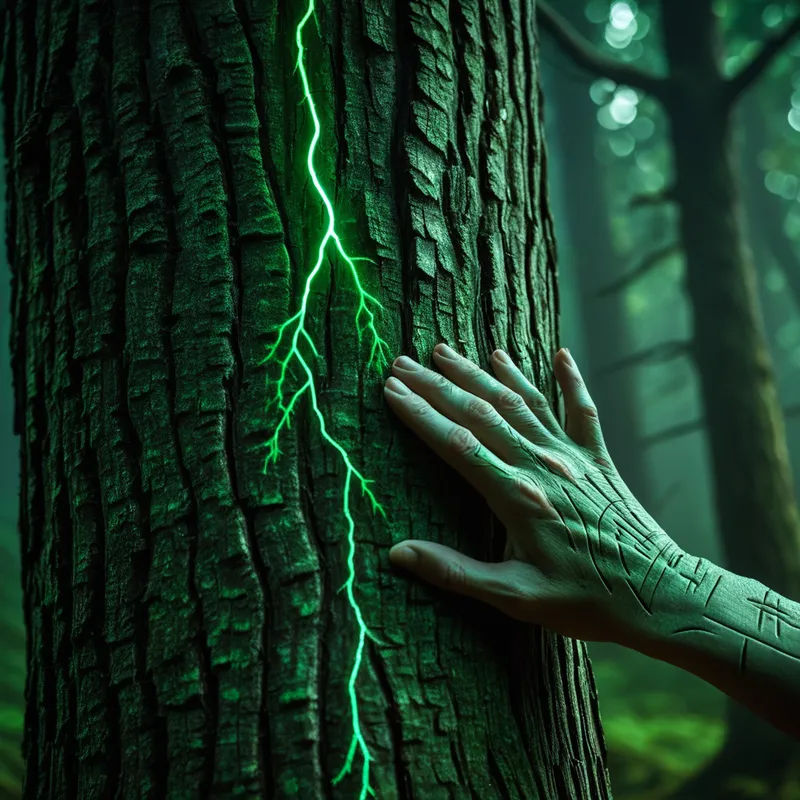
Without hesitation, the king took his bronze axe. But as he raised it, he knew this was no act of conquest. It was a proposal. He did not hack. With each blow, he whispered a promise—a promise of stewardship, of listening, of ruling not as a master, but as a husband to the land. The branch, a limb of blackthorn knotted and hard as iron, fell. From the weeping wound in the oak, a sap as clear and bright as moonlight flowed. The king, guided by the unseen voice, pressed his own forehead against the wound. A cold fire passed between them, a seal.
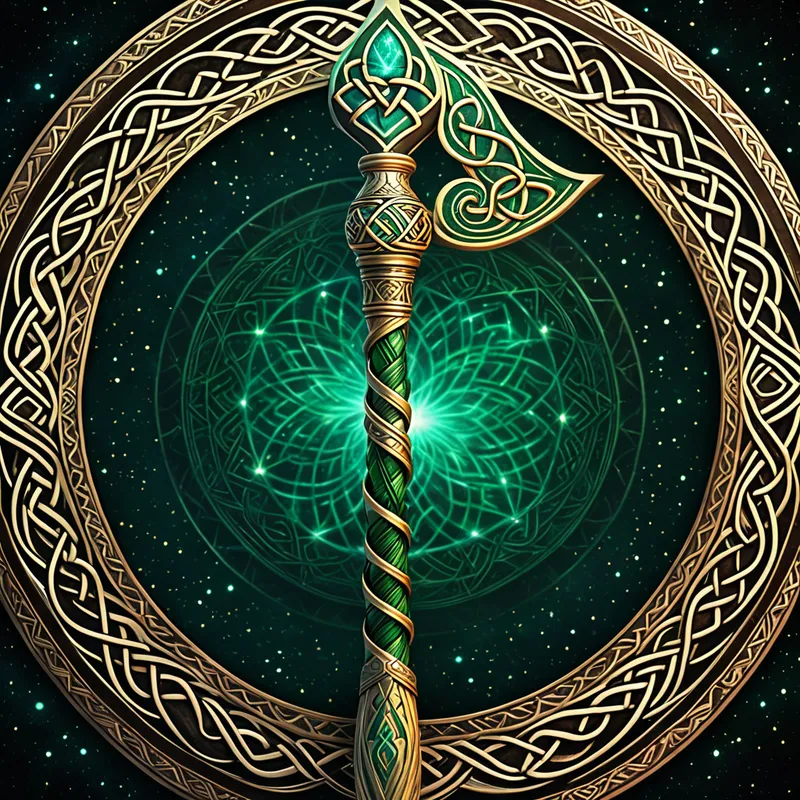
He worked the branch for nine days, not with a servant’s hands, but with his own. He stripped the bark, revealing the wood’s true grain. He hardened its core in the smoke of sacred herbs. He carved it not with jewels, but with the Ogham strokes of his own name and the name of the land, binding them together. When he was done, he held not a mere club, but The Shillelagh. It was heavy, yet balanced. It was of the wild, yet shaped by conscious will. As his fingers closed around it, he felt the heartbeat of the hills. He heard the consent of the forests. The chaotic whispers of the land did not cease, but they now spoke to him, and he could answer.
Returning to his people, he did not need to speak laws. Where he planted the butt of the Shillelagh, disputes settled. Where he pointed it, boundaries became clear. The rivers remembered their banks. The king had become the true Ard Rí, his authority rooted not in fear, but in a sacred, living contract.
Cultural Origins & Context
The shillelagh, as a physical object, is a stout walking stick or cudgel, traditionally made from blackthorn or oak, and is deeply associated with Irish folklore. The myth of its origin, however, transcends its use as a weapon or tool. It belongs to the vast, fragmented tapestry of Celtic sovereignty myths, stories that were the sacred charter for kingship. These narratives were not mere entertainment; they were the psychic and political constitution of the tribe, performed and preserved by the filid.
The myth likely originated in the pre-Christian, pastoral world of Ireland, where the health of the king and the health of the land (Flaitheas) were indivisible. A king’s legitimacy was not inherited by bloodline alone; it was conferred through a symbolic, often mystical, marriage to the spirit of the territory. The story of the Shillelagh encodes this ritual. It was told at times of royal inauguration or during the festival of Lughnasadh, linking the ruler’s fate to the cyclical fertility of the earth. The shillelagh itself became the tangible symbol of this covenant—a piece of the wild, ancestral world, transformed by human craft and consecrated by sacrifice into an instrument of order and justice.
Symbolic Architecture
At its heart, the myth of the Shillelagh is an allegory for the conscious forging of will and the assumption of true responsibility. The king represents the nascent ego, the part of the psyche that seeks to organize, direct, and govern. His unruly kingdom is the inner world of untamed instincts, chaotic emotions, and unconscious drives—the personal and collective wilderness.
The true staff of power is not seized from another; it is fashioned in the liminal space where human intention meets the stubborn reality of the world.
The ancient oak, specifically one struck by lightning, is the Self in its raw, natural state. The lightning scar represents a wounding by the transcendent, a divine intervention that creates a sacred opening. The king’s act of taking a branch is not vandalism, but a hieros gamos (sacred marriage) with this deeper Self. He gives a part of his own spirit (his naive identity) to receive the raw material of authentic power (the branch). The crafting process—the stripping, hardening, and inscribing—symbolizes the difficult, conscious work of individuation: refining one’s crude potential into a functional, personalized tool for navigating life. The finished Shillelagh is the integrated personality, a will that is strong because it is in dialogue with, not at war with, the depths from which it came.
The Dreamer’s Resonance
When this myth stirs in the modern unconscious, it often manifests in dreams of searching for or wielding a unique tool, weapon, or staff. The dreamer may find themselves in a chaotic, overgrown landscape—a metaphor for a life situation or internal state feeling out of control. The pivotal moment is the discovery of the specific tree or the act of shaping the wood.
Somatically, this can correlate with a feeling of gathering one’s strength, of “finding one’s backbone.” Psychologically, it signals a critical transition: the ego is being called to move beyond complaint or victimhood and to actively engage with its own chaos to forge order. The dream may evoke anxiety (the sacrifice, the storm) followed by a profound sense of grounded solidity upon gripping the finished staff. It is the psyche’s way of rehearsing the assumption of personal sovereignty—the decision to stop being buffeted by external or internal winds and to plant one’s feet, to declare, “From this ground, I will govern my life.”
Alchemical Translation
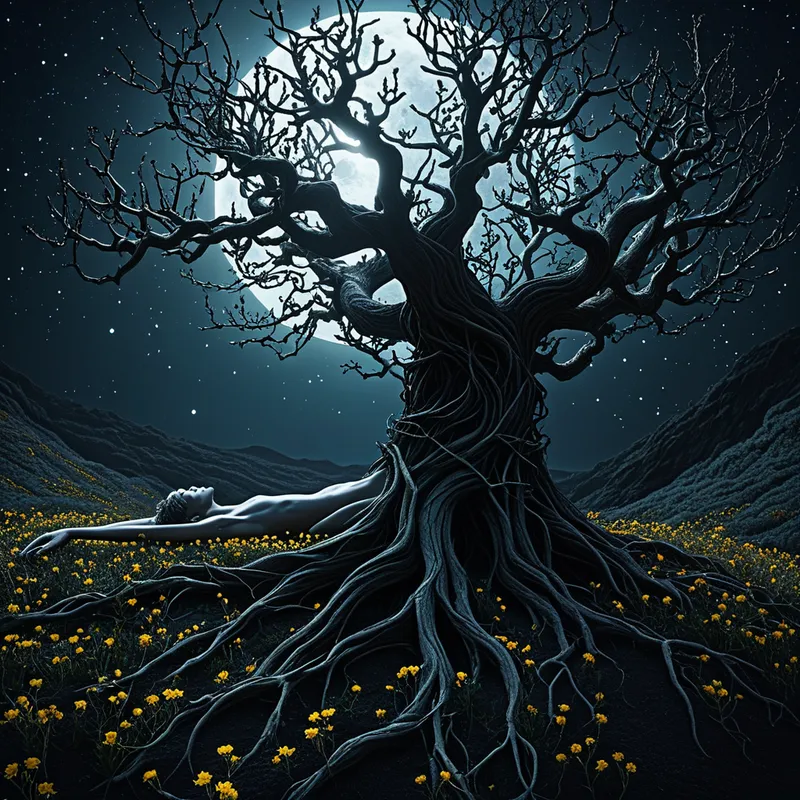
The alchemical journey mirrored in this myth is the transformation of the prima materia—the chaotic, leaden state of an unexamined life—into the philosophical gold of an authentic, self-directed existence. The king’s initial realm is the nigredo, the blackening, a state of dissolution and despair where old forms of control (the gold crown) fail.
His journey into the forest is the albedo, the whitening, a purification through solitude and confrontation with the natural (instinctual) self. The encounter with the oak is the sacred coniunctio, the marriage of opposites: conscious and unconscious, human and natural, will and substance.
Individuation is the craft of taking the knotted, thorny branch of one’s innate nature and, through conscious labor, transforming it into a staff that can both support and defend one’s authentic path.
The nine days of crafting are the citrinitas, the yellowing, the slow, meticulous work of analysis, integration, and inscription of identity. Finally, the return to the kingdom with the Shillelagh represents the rubedo, the reddening, the return of the transformed king to the world, now capable of projecting inner order onto outer reality. For the modern individual, the myth does not promise control over external events, but the forging of an inner authority—a Shillelagh of the soul—that allows one to stand firm, make clear boundaries, and rule the inner kingdom with wisdom drawn from a covenant with one’s deepest, most wild, and most authentic nature.
Associated Symbols
Explore related symbols from the CaleaDream lexicon: