The Shendyt and Kalasiris Myth Meaning & Symbolism
A myth of the divine king's two garments, one of earth and one of sky, whose separation brings chaos and whose sacred union restores cosmic order.
The Tale of The Shendyt and Kalasiris
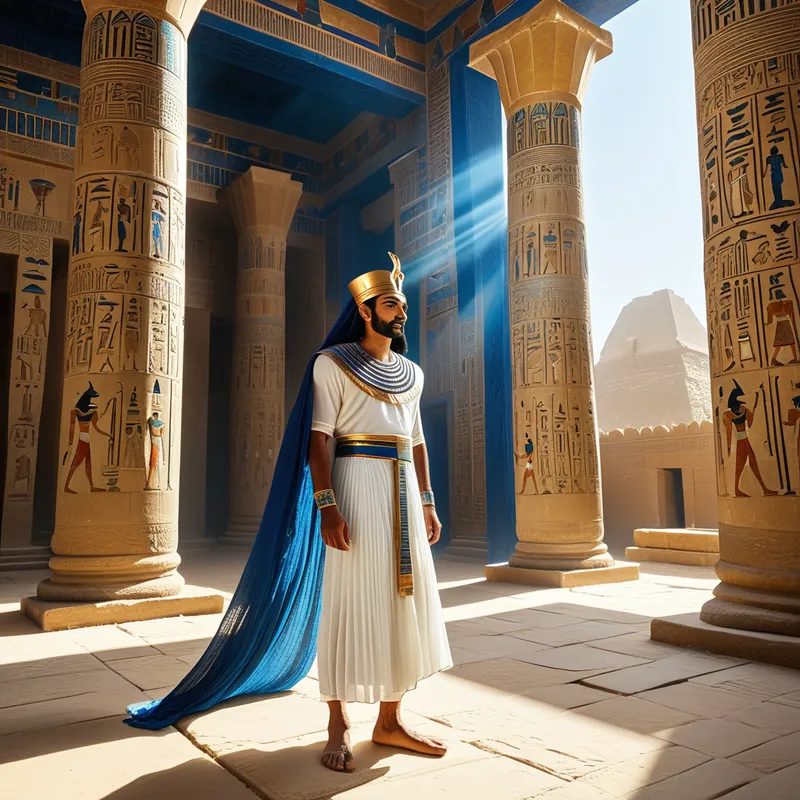
Hear now the whisper of the reeds, the sigh of the Nun. Before time was measured in [the flood](/myths/the-flood “Myth from Biblical culture.”/) and retreat of the Hapi, the Two Lands were one garment upon the body of [the world](/myths/the-world “Myth from Tarot culture.”/). The Divine King, the [Horus](/myths/horus “Myth from Egyptian culture.”/)-on-Earth, wore this garment whole. It was the Shendyt, woven from the flax of the black soil, stiff with the salt of [the desert](/myths/the-desert “Myth from Biblical culture.”/), pleated like the rays of Ra. And it was the Kalasiris, spun from [the mist](/myths/the-mist “Myth from Celtic culture.”/) of the dawn, threaded with the light of the imperishable stars, fluid as the course of [the Milky Way](/myths/the-milky-way “Myth from Greek culture.”/).
This was the Garment of Ma’at, the seamless truth. The King strode the boundary of the fields and the sands, and his stride was the measure. He lifted his arm to make decree, and his gesture charted the heavens. He was the living axis, the Djed made flesh, because the Shendyt rooted him in the tomb and the granary, and the Kalasiris connected him to [the solar barque](/myths/the-solar-barque “Myth from Egyptian culture.”/) and the court of [Osiris](/myths/osiris “Myth from Global/Universal culture.”/).
But in the palace of the human heart, a sleep can fall. A whisper of doubt, a flicker of pride. The King, in a moment of forgotten unity, looked down and saw not one garment, but two. He saw the stark, functional linen of the Shendyt. He saw the ethereal, beautiful Kalasiris. And in that seeing, he named them separate. “This is my power,” he said of the kilt. “This is my spirit,” he said of the robe.
The moment the names were spoken, the stitch that joined them at the hip unraveled. The Shendyt fell, heavy and earthbound, to the dusty floor. The Kalasiris floated, untethered, towards the high ceiling of the hall. The King stood divided. His legs, bared by the fallen Shendyt, felt the chill of the stone, the pull of the grave. His torso, clad only in the drifting Kalasiris, felt weightless, disconnected, a ghost in his own palace.
And the world mirrored its king. The Nile forgot its banks. The desert sands crept into the fertile Kemet. The stars wheeled in chaotic patterns. Order, Ma’at, was fractured because the sovereign principle was cloven in two. The people felt it as a sickness in the soil, a confusion in the seasons. The priests read it in the erratic flight of birds. The kingdom became a body with two heads, each pulling in a different direction.
The resolution came not from a battle, but from a remembering. It began with a stillness. The King, shivering in his dislocation, ceased trying to grasp the floating robe or reclaim the fallen kilt. He stood in the center of the chaos he had authored. He felt the true cold of [the earth](/myths/the-earth “Myth from Hindu culture.”/) on his skin, and the true emptiness of [the sky](/myths/the-sky “Myth from Persian culture.”/) on his soul. In that utter vulnerability, a memory older than his crown stirred: the memory of being woven.
He did not reach for the garments. He reached from the center of his being—from the place where spine meets breath, where will meets surrender. From that sacred junction, an invisible thread, golden as the eye of Horus, extended. It did not pull the Kalasiris down, nor lift the Shendyt up. It called to their essence. The linen of the Shendyt remembered it was flax that once reached for the sun. The silk of the Kalasiris remembered it was a thread that began in [the worm](/myths/the-worm “Myth from Biblical culture.”/) of the earth.
Slowly, gracefully, as if returning home, the Shendyt rose and wrapped once more around his hips, its weight now a dignity, not a chain. The Kalasiris descended and settled over his shoulders, its lightness now a presence, not an absence. They met not as separate things, but as two expressions of one truth. The King was clothed again. And as he took his first step, the Nile sighed back into its course, the stars resumed their faithful dance, and Ma’at was restored, not as an idea, but as the very fabric of his being.
Cultural Origins & Context
This myth, though not inscribed on a single [papyrus](/myths/papyrus “Myth from Egyptian culture.”/), is woven into the very fabric of Egyptian royal ideology and temple ritual. It is the metaphysical blueprint behind the iconic dual crowns—the Hedjet and the Deshret—and the unification symbols held by every [pharaoh](/myths/pharaoh “Myth from Egyptian culture.”/). It was enacted daily in [the temple](/myths/the-temple “Myth from Jewish culture.”/) inner sanctums, where the statue of the god was ritually clothed, a ceremony mirroring the king’s own duty to “wear” the Two Lands.
The story was passed down not as a folktale for the masses, but as a core mystery of kingship, taught to the royal heir and the high priesthood of Atum. Its societal function was paramount: it explained [the Pharaoh](/myths/the-pharaoh “Myth from Egyptian culture.”/)’s absolute and divinely mandated role. He was not just a political ruler; he was the incarnate principle of union, the human locus where the terrestrial (Geb) and the celestial (Nut) conjoined. The myth justified theocracy and provided a cosmological model for stability. If the king’s inner garments were in harmony, the kingdom would be in harmony. His personal integrity was the nation’s integrity.
Symbolic Architecture
The myth is a masterful map of psychic sovereignty. The Shendyt symbolizes [the principle](/symbols/the-principle “Symbol: A fundamental truth, law, or doctrine that serves as a foundation for a system of belief, behavior, or reasoning, often representing moral or ethical standards.”/) of Form, [Structure](/symbols/structure “Symbol: Structure in dreams often symbolizes stability, organization, and the framework of one’s life, reflecting how one perceives their environment and personal life.”/), and [Action](/symbols/action “Symbol: Action in dreams represents the drive for agency, motivation, and the ability to take control of situations in waking life.”/). It is [the ego](/myths/the-ego “Myth from Jungian culture.”/), the conscious will, the [body](/symbols/body “Symbol: The body in dreams often symbolizes the dreamer’s self-identity, personal health, and the relationship they have with their physical existence.”/), the practical [realm](/symbols/realm “Symbol: The symbol of ‘Realm’ often signifies the boundaries of one’s consciousness, experiences, or emotional states, suggesting aspects of reality that are either explored or ignored.”/) of law, agriculture, and governance. It is doing. The Kalasiris symbolizes [the principle](/symbols/the-principle “Symbol: A fundamental truth, law, or doctrine that serves as a foundation for a system of belief, behavior, or reasoning, often representing moral or ethical standards.”/) of Essence, [Spirit](/symbols/spirit “Symbol: Spirit symbolizes the essence of life, vitality, and the spiritual journey of the individual.”/), and Being. It is [the Self](/myths/the-self “Myth from Jungian culture.”/) (in the Jungian sense), the unconscious, the [soul](/symbols/soul “Symbol: The soul represents the essence of a person, encompassing their spirit, identity, and connection to the universe.”/), the [realm](/symbols/realm “Symbol: The symbol of ‘Realm’ often signifies the boundaries of one’s consciousness, experiences, or emotional states, suggesting aspects of reality that are either explored or ignored.”/) of [vision](/symbols/vision “Symbol: Vision reflects perception, insight, and clarity — often signifying the ability to foresee or understand deeper truths.”/), [intuition](/symbols/intuition “Symbol: The immediate, non-rational understanding of truth or insight, often described as a ‘gut feeling’ or inner knowing that bypasses conscious reasoning.”/), and [connection](/symbols/connection “Symbol: Connection symbolizes relationships, communication, and bonds among individuals.”/) to the transcendent. It is [presence](/symbols/presence “Symbol: Presence in dreams often signifies awareness or acknowledgment of something significant in one’s life.”/).
The fatal [error](/symbols/error “Symbol: A dream symbol representing internal conflict, perceived failure, or a mismatch between expectations and reality.”/) is not in perceiving the two, but in identifying with one as the whole self. To claim “I am only the Shendyt” is to become a tyrant of action, all [efficiency](/symbols/efficiency “Symbol: A tool or object representing optimization, streamlined processes, and maximum output with minimal waste. It symbolizes the pursuit of perfection in function.”/) and no meaning, rooted in [dust](/symbols/dust “Symbol: Dust often symbolizes neglect, forgotten memories, or the passage of time and life’s impermanence.”/). To claim “I am only the Kalasiris” is to become a disembodied mystic, all vision and no manifestation, lost in the air.
True sovereignty arises from the sacred junction, the point of tension and creative fusion between the earthly and the celestial, where doing is infused with being, and being is expressed through doing.
The unraveling is the experience of psychic [dissociation](/symbols/dissociation “Symbol: A psychological separation from one’s thoughts, feelings, or identity, often experienced as a journey away from the self during trauma or stress.”/), where our inner ruler is deposed. The golden thread that re-weaves the garments is the function of [consciousness](/symbols/consciousness “Symbol: Consciousness represents the state of awareness and perception, encompassing thoughts, feelings, and experiences.”/) itself—not a forceful egoic will, but a witnessing, reconciling [awareness](/symbols/awareness “Symbol: Conscious perception of self, surroundings, or internal states. Often signifies awakening, insight, or heightened sensitivity.”/) that remembers the original unity.
The Dreamer’s Resonance
When this myth stirs in the modern dreamscape, it rarely appears as pharaonic regalia. Instead, one may dream of being split between two irreconcilable jobs or identities; of wearing clothes that are too tight and too loose at the same time; of trying to stitch two different fabrics together that won’t hold; or of feeling like a ghost in one’s own body or home.
Somatically, this can manifest as a feeling of being “ungrounded” yet “trapped”—a paradoxical anxiety. Psychologically, the dreamer is in a critical phase of differentiation and integration. They have likely over-identified with one aspect of themselves (the practical achiever or the spiritual seeker) to the severe neglect of the other. The [psyche](/myths/psyche “Myth from Greek culture.”/) is presenting the crisis of the divided king to force a confrontation with this one-sidedness. The dream is the chaotic kingdom, reflecting the inner state. The process underway is the painful, necessary stillness that precedes the emergence of the golden thread of reconciling consciousness.

Alchemical Translation
The individuation journey modeled here is the Coniunctio Oppositorum—[the sacred marriage](/myths/the-sacred-marriage “Myth from Various culture.”/)—applied to the very structure of the personality. It is not about marrying another person, but about marrying the Shendyt and Kalasiris within.
[The first stage](/myths/the-first-stage “Myth from Alchemical culture.”/) is Union (the original, unconscious wholeness of childhood or a rigid identity). The second is Separation (the necessary, painful fall into duality, where we discover our distinct parts—the “king’s error” is actually the beginning of consciousness). The third is the Crisis (the chaos of dissociation, where the separated parts war against each other, creating suffering). The fourth is the Remembering (the active, conscious work of holding the tension of opposites without collapsing into one). The final stage is the Reintegration (the birth of a new, conscious sovereignty where the opposites are harmonized, not eliminated).
The goal is not to return to the unconscious unity of the first garment, but to consciously re-weave the two into a new garment of the Self, one that has known the desert and the stars and chosen to embody both.
For the modern individual, this means building a life where our deepest values (Kalasiris) find authentic expression in our daily actions and responsibilities (Shendyt). It is the artist who masters their craft. The executive who leads with soul. The parent who finds the sacred in the mundane. It is the moment we stop asking, “Am I a body or a spirit?” and begin living as the singular mystery that gracefully wears both.
Associated Symbols
Explore related symbols from the CaleaDream lexicon: