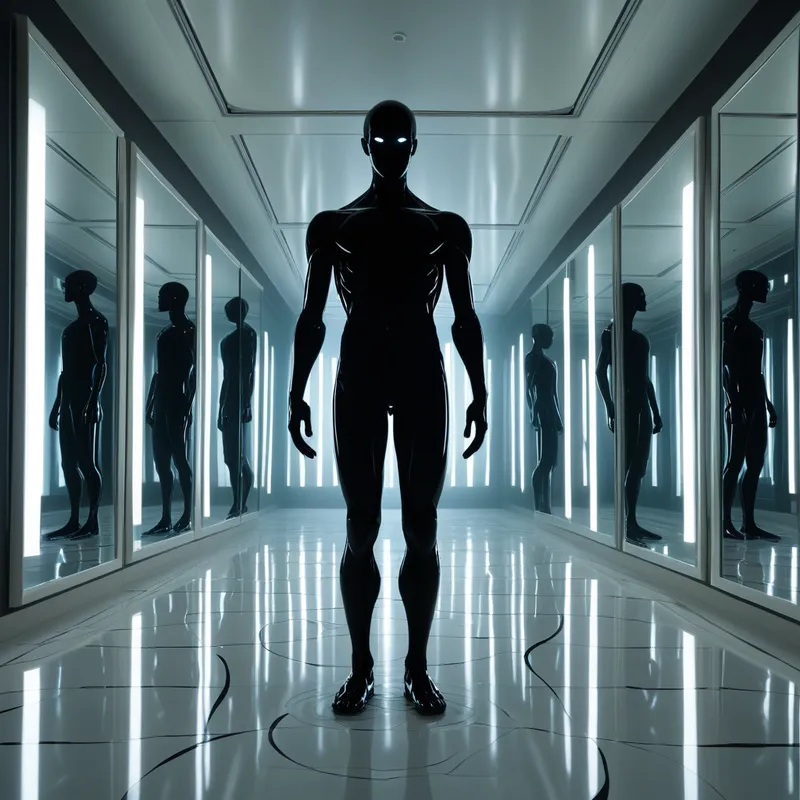
The Shadow Myth Meaning & Symbolism
A myth of the denied self, a dark twin born of repression, whose confrontation and integration is the only path to psychic wholeness.
The Tale of The Shadow
In the beginning, there was the Ego, a being of light who walked in a sun-drenched garden of cultivated virtues. It was a realm of order, where every flower was named, every path was clear, and the air hummed with the certainty of “I am this.” But for every step the Ego took in the light, a second step was taken in the unseen. From the heel of its footfall, from the breath it refused to exhale, from every “I could never” and “that is not me,” a substance began to gather. It pooled in the forgotten corners of the garden, in the dry wells of abandoned impulses, behind the high walls where wild things were once caged.
This substance coalesced, drawn by a gravity of its own. It did not have a name, for names are a power of the light. It was simply the Absence that followed the Presence, the Silence that answered the Declaration. As the Ego built its tower of identity, stone by conscious stone, the Absence grew denser, darker, mirroring each chosen virtue with a disowned possibility. For every act of kindness consciously performed, a spark of ruthless self-interest was cast off. For every moment of disciplined control, a whisper of chaotic desire was silenced. These cast-off sparks and whispers flowed into the Absence, feeding it, giving it a crude, magnetic form.
One day, the Ego walked to the edge of its garden, to the great, polished mirror-lake that showed it only its chosen reflection: noble, composed, complete. But as it gazed, a tremor passed through the water. The pristine image rippled, and for a fleeting instant, another face looked back. It was the Ego’s own, yet utterly alien—contorted with a rage the Ego had never felt, grinning with a cunning it had never owned, eyes burning with a hunger it had never acknowledged. The Ego recoiled, calling it a trick of the light, a flaw in the water. It built a wall around the lake.
But the Absence was now a Presence. It had become The Shadow. Denied a place in the sun, it grew in the subterranean realms of the psyche. It began to speak, not in words, but in symptoms: in inexplicable moods that clouded the sunny disposition, in cruel words that slipped unbidden from the mouth of kindness, in attractions to precisely what was deemed forbidden. The Shadow projected itself onto others, so that the Ego saw its own hidden greed in the neighbor, its own secret lust in the stranger, its own buried fury in the critic.
The conflict could not be walled away forever. The garden began to sicken. Flowers of virtue wilted for no reason. The orderly paths were crossed by the tracks of unseen, heavy things. The Ego’s dreams became theaters where The Shadow played every villainous role. The crisis came not in a battle, but in a confrontation. Exhausted by the constant, unseen war, the Ego was drawn, against its will, to the oldest, deepest well in the garden—the Well of Forgetting. Peering into its black depths, it did not see water. It saw a face looking up. Its own face, but whole in a terrifying way. It held everything the Ego had rejected: the cowardice, the pettiness, the primal fury, the raw creativity, the unbridled joy.
There was no battle. There was only the unbearable act of recognition. “This… is also me.” In that utterance, the wall between the garden and the well dissolved. The light did not destroy the darkness, nor did the darkness engulf the light. They flowed into one another. The Ego did not become The Shadow, and The Shadow did not become the Ego. From their tense marriage was born a third thing: a being who could stand in the sun and own its length of shadow, a consciousness that was both cultivated and wild, responsible and free. The garden was no longer just a garden; it became a living landscape, fertile with the compost of all that had been denied. The journey was not toward perfection, but toward a terrible, beautiful completeness.
Cultural Origins & Context
This is not a myth carved on temple walls or sung in ancient epics. Its culture is the interior landscape of the 20th and 21st centuries, its bard the Swiss psychiatrist Carl Gustav Jung. The myth of The Shadow was born in the consulting rooms of Zurich, distilled from the patterns of dreams, the slips of the tongue, and the recurring dramas of his patients’ lives. Jung observed that individuals and, by terrifying projection, entire nations, were haunted by what they refused to acknowledge in themselves.
The myth was passed down not through oral tradition, but through clinical observation, scholarly treatise, and the intimate work of analysis. Its societal function was diagnostic and salvific. In a modern world fragmenting under the weight of rationalism and moral absolutism, the myth of The Shadow provided a new map for understanding conflict—both personal and collective. It explained why the saint secretly envies the sinner, why the pacifist harbors violent fantasies, and why the most civilized societies could erupt into unparalleled barbarism. The myth’s primary custodians became therapists, artists, and seekers engaged in the work of individuation, for whom it served as a crucial guide into the underworld of the self.
Symbolic Architecture
The Shadow represents the totality of the unconscious personality, all that the conscious Ego has deemed incompatible with its self-image. It is not merely “evil” but the undeveloped and unlived life. It contains inferior traits, but also buried gold: vital instincts, creative sparks, and authentic passions that were sacrificed on the altar of adaptation.
The Shadow is the seat of creativity; to confront it is to meet the rejected builder of your soul.
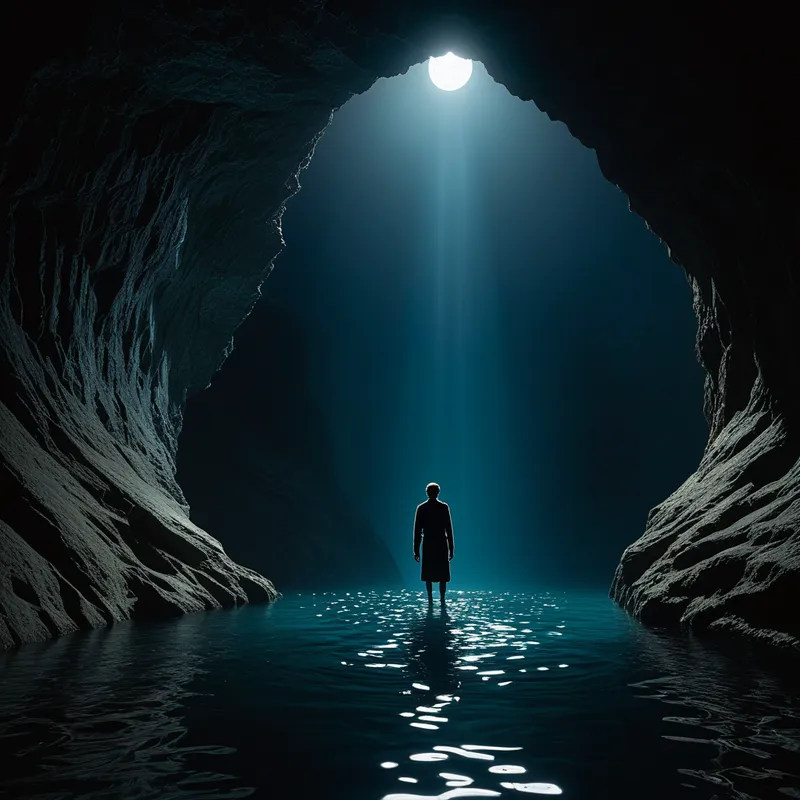
The sun-drenched garden symbolizes the conscious personality—ordered, acceptable, and often sterile in its perfection. The well, the cave, the mirror-lake are all symbols of the threshold to the unconscious. The act of projection—seeing one’s own Shadow in others—is a central drama of the myth, illustrating how we externalize inner conflict. The final confrontation and recognition symbolize the end of projection and the beginning of integration, where psychic energy trapped in self-deception is liberated.
Wholeness is not achieved by cutting off one’s shadow, but by learning to dance with it in the full light of consciousness.

The Dreamer’s Resonance
When this myth stirs in the modern dreamer, it announces a critical phase of psychic pressure. To dream of being chased by a monstrous figure, often of one’s own gender, is a classic Shadow motif. The monster’s relentless pursuit is the psyche’s insistence that disowned content must be faced. Dreams of encountering a mysterious, often threatening double or twin speak directly to the Shadow’s role as the “dark brother” or “sister.”
The psychological process is one of recognition and reclamation. Somatic signs may include a feeling of dread upon waking, a racing heart frozen in the dream, or a profound sense of uncanny familiarity with the dream antagonist. The dream is not a warning to run, but a summons to turn and ask, “What part of me are you?” The emotional charge of the dream—the fear, the rage, even the attraction—is a direct measure of the vital psychic energy bound up in the repressed complex. The dream presents the Shadow not to destroy the dreamer, but to force an expansion of identity.
Alchemical Translation
The myth of The Shadow is the foundational opus of psychic alchemy. It models the first and most perilous stage of individuation: Nigredo, the blackening. The conscious personality must descend into its own darkness, its certainties dissolved in the solvent of self-doubt and confrontation.
The Ego’s journey from repression to projection to confrontation mirrors the alchemical process of solve et coagula—dissolve and coagulate. First, the solid, gold-plated identity of the Ego must be dissolved by the acid of Shadow-awareness. The “base metal” of our crude, instinctual, and rejected selves is brought to the surface. This is a painful, mortificatio-like experience, a death of the innocent self-image.
The gold we seek is not found by polishing the persona, but by mining the lead of the Shadow.
Then comes the coagula, the reconstitution. The retrieved Shadow content is not simply added to the Ego; it is integrated, transmuted. The rage becomes assertive boundary-setting. The cunning becomes discernment. The primal energy becomes life force. The once-monstrous Shadow becomes a source of depth, resilience, and authenticity. The individual is no longer a one-sided creature of light, but a fully dimensional being capable of holding paradox. They achieve what Jung called “the transcendent function”—the capacity to hold the tension of opposites until a third, reconciling perspective emerges. The triumph is not a victory of light over dark, but the birth of a consciousness that can contain both, and in doing so, becomes truly human.
Associated Symbols
Explore related symbols from the CaleaDream lexicon: