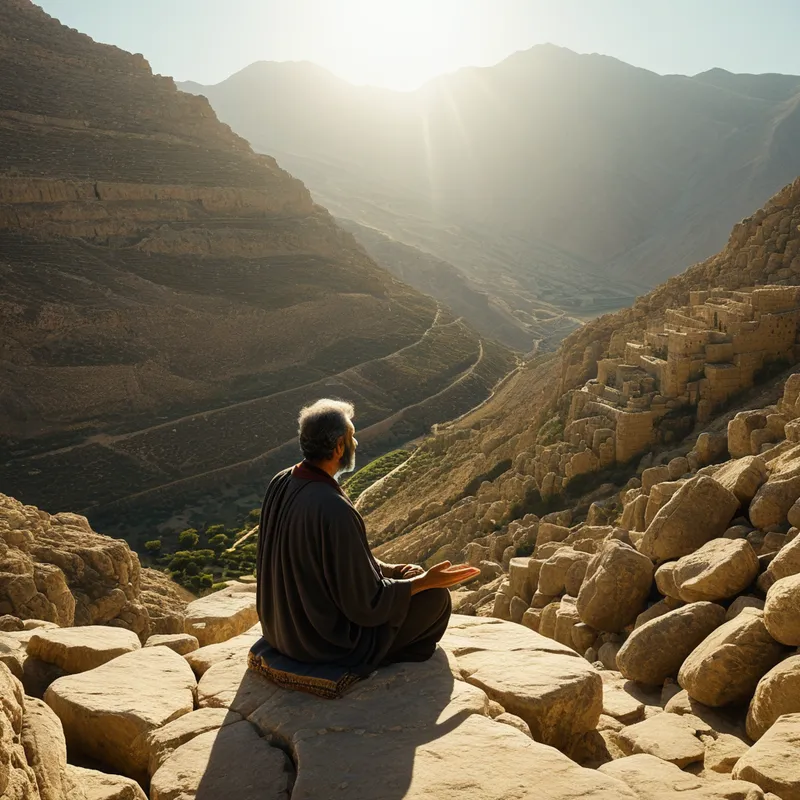
The Sermon on the Mount Myth Meaning & Symbolism
A teacher ascends a mountain to deliver a revolutionary code, blessing the humble and unveiling a kingdom hidden within the human heart.
The Tale of The Sermon on the Mount
The world was heavy. It was a weight you carried in your shoulders, in the coin purse at your belt, in the silent calculation behind every glance. It was the weight of Rome’s eagle, of the temple’s unmeetable law, of the dust that clung to your sandals no matter how far you walked. Hope was a rumor, a whisper traded in market corners and fishing boats: a man was speaking, and the words were not like other words.
They came from the lakeside, from the plains, a river of the weary, the curious, the desperate. They followed him up the path, a serpent of humanity coiling its way up the flank of the mountain. The air grew thin and clear. Below, the sea of Galilee lay like a polished shield; above, the sky was a bowl of hard, brilliant blue.
He did not stand on a platform. He did not shout. He found a place where the rock formed a natural seat, and he sat. The crowd settled on the slope before him like a great, living tapestry—fishermen smelling of salt and nets, farmers with earth under their nails, mothers with children on their hips, scholars with skepticism in their folded arms. The wind, the only sound, hushed.
And he opened his mouth. What came forth was not a argument, but an unveiling.
“Blessed,” he said, and the word hung in the air, strange and sweet. “Blessed are the poor in spirit, for theirs is the kingdom of heaven.” A ripple of confusion. Blessed are the hollow? The ones with nothing to offer?
He continued, each statement a stone dropped into the still pond of their understanding, the concentric rings disrupting everything. Blessed are those who mourn. Blessed are the meek, the merciful, the pure in heart. Blessed are the peacemakers. He called them children of God. He spoke of a salt that must not lose its taste, of a light not to be hidden under a basket, but set on a hill for all to see.
Then, the great reversal. “You have heard it said… but I say to you.” The law of old, carved in stone, was now being written on the pulsing muscle of the heart. Do not murder? Do not even nurse the anger. Do not commit adultery? Do not even let the seed of lust take root. Love your neighbor? Love also the one who curses you, the soldier who forces you to carry his pack a mile. Carry it two.
He spoke of prayer not as a public performance, but as a secret conversation in a closed room. He spoke of treasure that moths and rust could not touch, stored in a realm beyond the reach of thieves. “Do not worry about your life,” he said, his gaze sweeping over their anxious faces. “Look at the birds of the air… See how the lilies of the field grow.” His words painted a world held in a benevolent hand, where seeking a divine kingdom and its righteousness made all earthly scrambling fall into a new, peaceful order.
He ended with a story, of two builders. One wise, who dug deep and set his house on the unshakable bedrock of these words. One foolish, who built on the shifting, appealing sand. The crowd sat in a silence more profound than noise. The sermon was over. No thunderclap, no miraculous sign. Just a man, a mountain, and words that had quietly turned the world inside out, revealing its luminous, hidden lining. They descended, carrying a new weight—not of burden, but of a bewildering, terrifying possibility.

Cultural Origins & Context
This narrative is embedded within the Biblical tradition, specifically the Gospel of Matthew. Its “Global/Universal” claim rests not on its geographical ubiquity at its origin, but on the profound, archetypal architecture of its message, which has transcended its specific Jewish and early Christian context to become a foundational ethical and psychological document for much of the world.
Historically, it is presented as a discourse by Jesus of Nazareth, delivered to his disciples and a larger crowd. Scholars debate its exact historicity as a single event versus a literary compilation of teachings, but its cultural power is undeniable. It was passed down orally before being codified in text, functioning as a radical manifesto for a nascent community defining itself against both Roman imperial power and certain rigid interpretations of religious law. Societally, it served to invert prevailing values of honor, strength, and ritual purity, offering a new social blueprint centered on interior virtue, radical forgiveness, and an imminent, participatory kingdom of God.
Symbolic Architecture
The mountain is the first and primary symbol. It is the axis mundi, the meeting point of heaven and earth, the elevated space where the veil between realms grows thin. To ascend is to seek revelation. The sermon itself is the revealed code, not of a new civilization, but of a new consciousness.
The mountain is not a place to escape the world, but a vantage point from which to see it truly. The ascent is the difficult journey to a perspective where worldly logic is reversed.
The central symbolic act is the Beatitudes, a series of pronouncements that perform a sacred alchemy on human suffering. Poverty, mourning, and persecution are not cursed states to be escaped, but are mysteriously transformed into gateways (“blessed are…”). This represents the ultimate psychological insight: that our wounds, our vulnerabilities, our very limitations are the precise sites where transformation can begin, if we relate to them consciously.
The teachings on anger, lust, and love enact an internalization of the law. The commandment moves from the external act (“do not murder”) to the internal seed (“do not harbor hatred”). This shifts the moral and psychological battleground from the courtroom to the human soul. The “kingdom of heaven” is thus symbolically located within (“the kingdom of God is within you”).

The Dreamer’s Resonance
To dream of listening to the Sermon on the Mount is to dream of receiving a foundational, life-altering truth. The dreamer is often in a state of transition or crisis, where old values and strategies have failed. The mountain in the dream may be a literal slope, a staircase, or simply a feeling of elevated attention.
Somatically, one might feel a profound stillness, a hush in the dream-body, a focusing of all senses on the voice or the presence of the teacher. This reflects a moment of ego-relaxation, where the constant chatter of the personal mind subsides to allow a deeper, archetypal wisdom to speak. The crowd represents other parts of the psyche—the neglected, the meek, the mourning aspects of the self—all being addressed and validated.
Conversely, dreaming of giving the sermon indicates the dreamer is integrating this wisdom and is ready to articulate their own hard-won, authentic code of being, often after a period of intense inner work.

Alchemical Translation
The myth models the alchemical process of individuation—the journey toward psychological wholeness—with stunning clarity. The initial state is the “worldly mind,” identified with external validation, material security, and reactive emotion (anger, lust, anxiety). This is the “sand” foundation.
The alchemical fire is the searing, uncomfortable truth of the Beatitudes, which begins the nigredo, the blackening. It forces a confrontation with all that is “poor in spirit,” all that mourns and hungers within us.
The ascent of the mountain is the separatio, the conscious decision to step back from the collective trance of conventional values. The listening is the solutio, a dissolving of old, rigid structures of belief in the waters of a new perspective.
The core alchemical operation is the inversion. The base metals of the psyche—our vulnerability, our pain, our humility—are not discarded but are revealed as the prima materia, the essential raw material for creating gold. The “kingdom of heaven” is the lapis philosophorum, the Philosopher’s Stone: the achieved state of inner unity and value, where one acts from an integrated center rather than reacting to external pressures. To love one’s enemy is the ultimate coniunctio oppositorum (union of opposites), integrating the shadow.
Finally, the parable of the two builders presents the choice that concludes the work: to build the conscious personality (the ego) on the transient sands of persona and collective approval, or to dig painfully deep to anchor it on the bedrock of the Self, the inner kingdom. The sermon is the map for that excavation.
Associated Symbols
Explore related symbols from the CaleaDream lexicon: