The Serapeum Myth Meaning & Symbolism
The sacred bull Apis, a living god, dies to be ritually transformed into Osiris-Apis, entombed in the Serapeum's eternal darkness to ensure cosmic renewal.
The Tale of The Serapeum
Hear now the tale not carved in temple walls for all to see, but whispered in the dark passages beneath the sand, in the place where [the earth](/myths/the-earth “Myth from Hindu culture.”/) holds its breath. It begins not with a man, but with a god who walks as a beast.
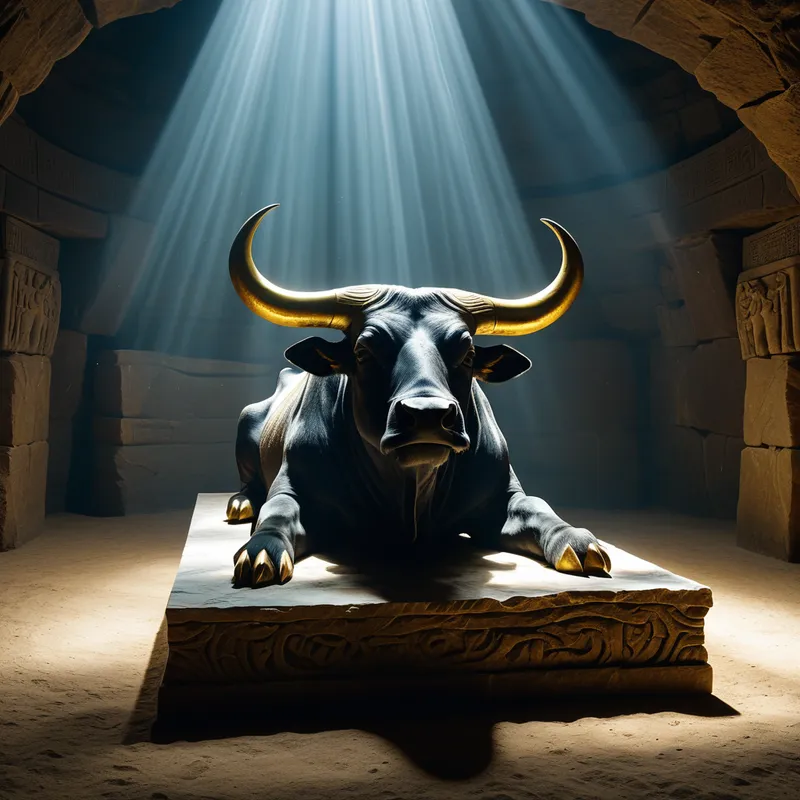
In the sun-baked city of Memphis, a ripple of awe passes through the crowd. The new Apis has been found. He is no ordinary bull. His hide is the black of the fertile Nile silt after the inundation, a single white diamond blazes on his forehead, and upon his back, the wings of a vulture are traced in white hair. His eyes hold the deep, knowing stillness of the Duat. For twenty-five years, he lives as a living god in his own palace, a conduit of [ma’at](/myths/maat “Myth from Egyptian culture.”/)</ab- br>. Priesters read the future in his movements; the people feel the kingdom’s vitality pulse through his strong flanks.
But a god in flesh is bound to time. A shadow falls, subtle at first—a slowing of his majestic step, a clouding in those profound eyes. The priests, keepers of the great rhythm, know. The living Apis must die so that the cosmic Apis may be reborn. The day comes. In a ceremony of profound silence and sorrowful reverence, the great bull is led not to a pasture, but to a sacred chamber. His death is not an end, but a solemn, necessary unlocking.
Then begins the great labor of love and terror. For seventy days, the master embalmers work in secret, performing the rites of Anubis. The massive body is transformed into an eternal vessel, packed with natron and linen, anointed with oils more precious than gold. He is no longer just Apis. In death, he achieves his ultimate unification: he becomes [Osiris](/myths/osiris “Myth from Global/Universal culture.”/)-Apis, the lord of resurrection wearing the form of divine potency.
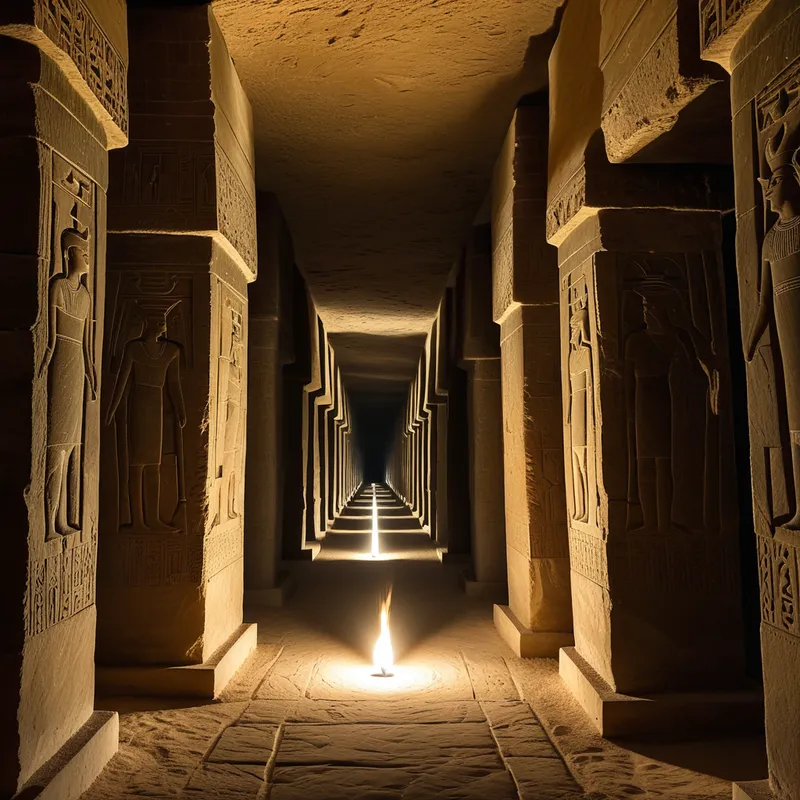
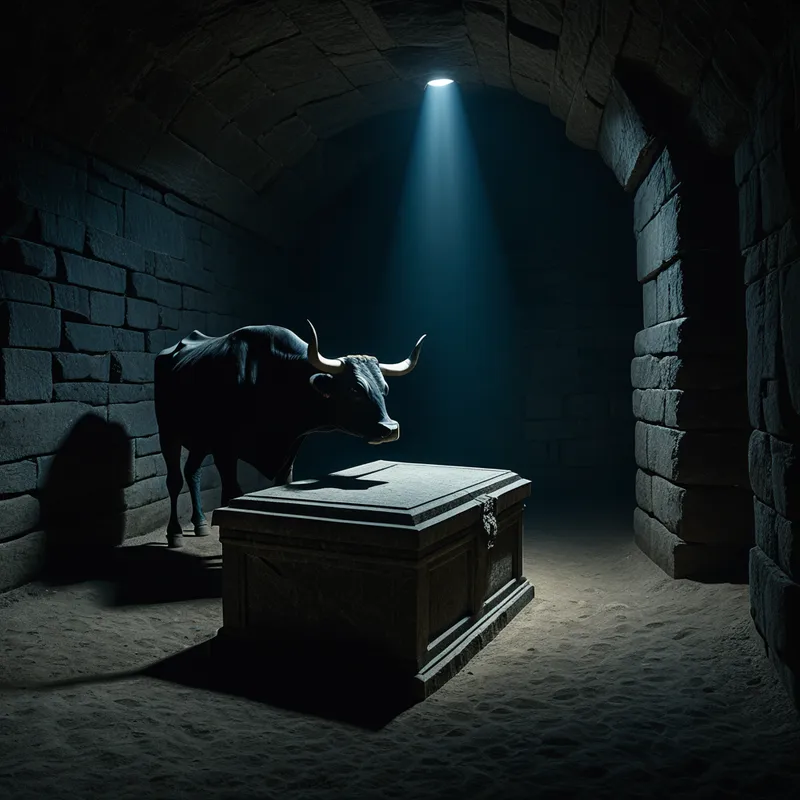
Now, under the cloak of deepest night, the procession descends. Priests chant the hymns of opening the mouth. The colossal sarcophagus, hewn from a single block of granite that took generations to drag from the quarries, waits in the absolute dark. The mummified bull-god is lowered into his eternal house within the Serapeum. The stone lid, weighing a mountain’s heart, is sealed. Torches are extinguished. The last priest withdraws, scraping the sand to obscure the entrance.
In that perfect, silent dark, the miracle occurs. The sacrificed vitality of the land, now entombed, becomes a seed. From this point of concentrated death, a field of force radiates. It nourishes the roots of [the world](/myths/the-world “Myth from Tarot culture.”/), ensures the Nile will rise again, the sun will conquer the night, and [the pharaoh](/myths/the-pharaoh “Myth from Egyptian culture.”/), the living [Horus](/myths/horus “Myth from Egyptian culture.”/), will rule with the justified power of Osiris. The Serapeum is not a tomb; it is a battery for eternity, a dark womb where [the world](/myths/the-world “Myth from Tarot culture.”/)‘s soul is perpetually recharged.
Cultural Origins & Context
The mythos of the Serapeum is not a single narrative but a ritual technology, born from the convergence of profound theological ideas in the Late Period. Its practice centered at Saqqara, the vast necropolis of Memphis, the administrative heart of Old Kingdom Egypt. The cult of the Apis bull was ancient, possibly predating the dynastic era, originally linking the bull’s raw generative power to the creator god Ptah.
The critical evolution came with the identification of the dead Apis with Osiris, the murdered and reconstituted king. This created the composite deity Osiris-Apis (which, in its Hellenized form, became Serapis). The Serapeum, as an architectural entity, served as the physical anchor for this belief. It was a national project; the death of an Apis was a moment of national significance, and its burial involved the entire priestly and administrative machinery. The myth was “told” through this extravagant, decades-long ritual cycle—from the jubilant search for the new calf to the somber, elaborate burial—making every citizen a participant in a story of death and guaranteed renewal.
Symbolic Architecture
At its core, the Serapeum myth is a masterclass in the [symbolism](/symbols/symbolism “Symbol: The use of symbols to represent ideas or qualities, often conveying deeper meanings beyond literal interpretation. In dreams, it’s the language of the unconscious.”/) of containment and transformative sacrifice. The Apis [bull](/symbols/bull “Symbol: The bull often symbolizes strength, power, and determination in many cultures.”/) represents incarnate divine power, the neter (god-force) made immediately, physically present in the world. He is the embodied [spirit](/symbols/spirit “Symbol: Spirit symbolizes the essence of life, vitality, and the spiritual journey of the individual.”/) of the land, its [fertility](/symbols/fertility “Symbol: Symbolizes creation, growth, and abundance, often representing new beginnings, potential, and life force.”/), its kingly [strength](/symbols/strength “Symbol: ‘Strength’ symbolizes resilience, courage, and the ability to overcome challenges.”/), and its cyclical [nature](/symbols/nature “Symbol: Nature symbolizes growth, connectivity, and the primal forces of existence.”/).
The most potent life must consent to the deepest dark to fuel the great cycle. The ego, in all its glorious particularity, must be entombed to feed the soul.
His [death](/symbols/death “Symbol: Symbolizes transformation, endings, and new beginnings; often associated with fear of the unknown.”/) is not a tragedy but the necessary precondition for a higher [integration](/symbols/integration “Symbol: The process of unifying disparate parts of the self or experience into a cohesive whole, often representing psychological wholeness or resolution of internal conflict.”/). By becoming Osiris-Apis, the animal vitality (Apis) is wedded to the [consciousness](/symbols/consciousness “Symbol: Consciousness represents the state of awareness and perception, encompassing thoughts, feelings, and experiences.”/) of [death](/symbols/death “Symbol: Symbolizes transformation, endings, and new beginnings; often associated with fear of the unknown.”/) and resurrection (Osiris). The Serapeum itself is the [symbol](/symbols/symbol “Symbol: A symbol can represent an idea, concept, or belief, serving as a powerful tool for communication and understanding.”/) of the [vas hermeticum](/myths/vas-hermeticum “Myth from Alchemical culture.”/), the sealed [vessel](/symbols/vessel “Symbol: A container or structure that holds, transports, or protects something essential, representing the self, emotions, or life journey.”/) of [alchemy](/symbols/alchemy “Symbol: A transformative process of purification and creation, often symbolizing personal or spiritual evolution through difficult stages.”/) where [dissolution](/symbols/dissolution “Symbol: The process of breaking down, dispersing, or losing form, often representing transformation, release, or the end of a state of being.”/) and [coagulation](/symbols/coagulation “Symbol: The spiritual process of transformation from fluid potential into solid reality, representing the moment of creation, manifestation, or spiritual birth.”/) occur. Its impenetrable darkness is not void but a [fertile ground](/symbols/fertile-ground “Symbol: Fertile ground symbolizes potential, growth, and the promise of new beginnings, reflecting a state where life can thrive.”/). The monolithic sarcophagus is the ultimate container, holding the concentrated essence of [life](/symbols/life “Symbol: The symbol of ‘Life’ represents a journey of growth, interconnectedness, and existential meaning, encompassing both the joys and challenges that define human experience.”/)-in-[death](/symbols/death “Symbol: Symbolizes transformation, endings, and new beginnings; often associated with fear of the unknown.”/), preventing its [dissipation](/symbols/dissipation “Symbol: The gradual fading, scattering, or wasting away of energy, substance, or focus. Often represents loss of vitality or purpose.”/), allowing its power to transmute and radiate in a subtler, more universal form.
The Dreamer’s Resonance
To dream of the Serapeum is to encounter the [psyche](/myths/psyche “Myth from Greek culture.”/)‘s own necropolis for sacred contents. One may dream of endless underground corridors, of finding a hidden basement filled with sealed stone boxes, or of a powerful, silent animal being led into a deep pit.
Such dreams often surface during life transitions that require a “death” of a former identity: the end of a career, the closing of a life chapter, the conscious sacrifice of a potent talent or a long-held role. The somatic feeling is one of profound gravity, of being drawn into a silent, weighty depth. Psychologically, this is the process of en-tomb-ment—not as punishment, but as a sacred necessity. The dreamer is being shown that a part of their spirit, something that once was a vibrant, living “god” in their personal [pantheon](/myths/pantheon “Myth from Roman culture.”/) (a skill, a relationship, a self-image), must now be ritually honored, released, and sealed away in the dark earth of the unconscious. The dream confirms this is not loss, but the beginning of a mysterious incubation.
Alchemical Translation
The individuation journey modeled by the Serapeum is the opus contra naturam—the work against nature’s tendency toward decay. Our instinct is to cling to the living Apis, to keep our vital energies visible, active, and celebrated in the sunlit world of [the ego](/myths/the-ego “Myth from Jungian culture.”/). The myth demands the opposite: to consciously choose the descent, the ritual killing, and the entombment.
[The first stage](/myths/the-first-stage “Myth from Alchemical culture.”/) is Identification of the Sacred Bull: Recognizing what in us is the “Apis”—the natural, God-given potency that has served us well. The second is the Ritual Sacrifice: The conscious, willing decision to “kill” its current form, to cease exploiting it for earthly glory or comfort. This is an act of supreme spiritual will. The third is the Embalming and Transformation: The careful, patient work of introspection (the 70 days), preserving the essence of that potency through understanding and reflection, anointing it with the oils of meaning, until it is no longer just raw talent (Apis) but soul-wisdom (Osiris-Apis).
The final stage is Entombment and Radiation: Sealing this transformed essence in the inner sanctum, the temenos of the soul. We do not dig it up for display. We let it rest in the dark. From that silent, sealed center, it begins to radiate not as personal power, but as a grounding, renewing force that sustains the entire inner kingdom. The ego no longer is the bull; it becomes the priest who tends the underground temple, ensuring the sacred, buried source continues to water the roots of being. The individual becomes, like the Serapeum itself, a stable vessel for the eternal process of death and renewal.
Associated Symbols
Explore related symbols from the CaleaDream lexicon: