The Sephirot Myth Meaning & Symbolism
A sacred map of ten divine emanations, the Sephirot charts the descent of infinite light into creation and the soul's arduous return to its source.
The Tale of The Sephirot
In the beginning, before beginning, there was only Ein Sof—the No-[Thing](/myths/thing “Myth from Norse culture.”/), the endless, nameless light. It was a light so pure, so absolute, it had no vessel to hold it, no form to give it shape. It simply was, a silent, boundless sea of potential.
But within that perfect stillness, a desire stirred—not a need, but a profound will to know itself, to be known. And so, from the heart of the endless, a single point of concentrated intention emerged. This was the first contraction, the [Tzimtzum](/myths/tzimtzum “Myth from Kabbalistic culture.”/). The infinite light drew back, creating a hollow, a womb of sacred darkness.
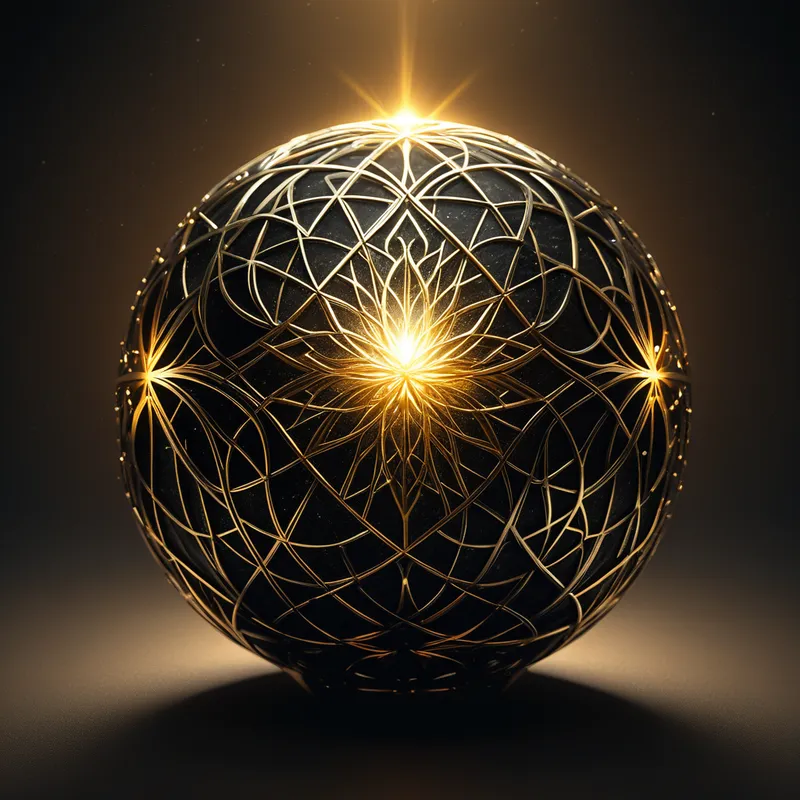
Into that primordial void, a ray of that original light descended. It was a ray of pure, undifferentiated mercy, and it sought to fill [the vessel](/myths/the-vessel “Myth from Alchemical culture.”/). But the vessel, newly formed from the absence, was too frail, too defined. It could not bear the intensity. With a soundless, cosmic shattering, the vessel broke. Sparks of that holy light scattered, falling through the emerging layers of reality like glittering stars cast into a deepening well. This was the Shevirat HaKelim, the great breaking. [The world](/myths/the-world “Myth from Tarot culture.”/) was born from a catastrophe of divine love.
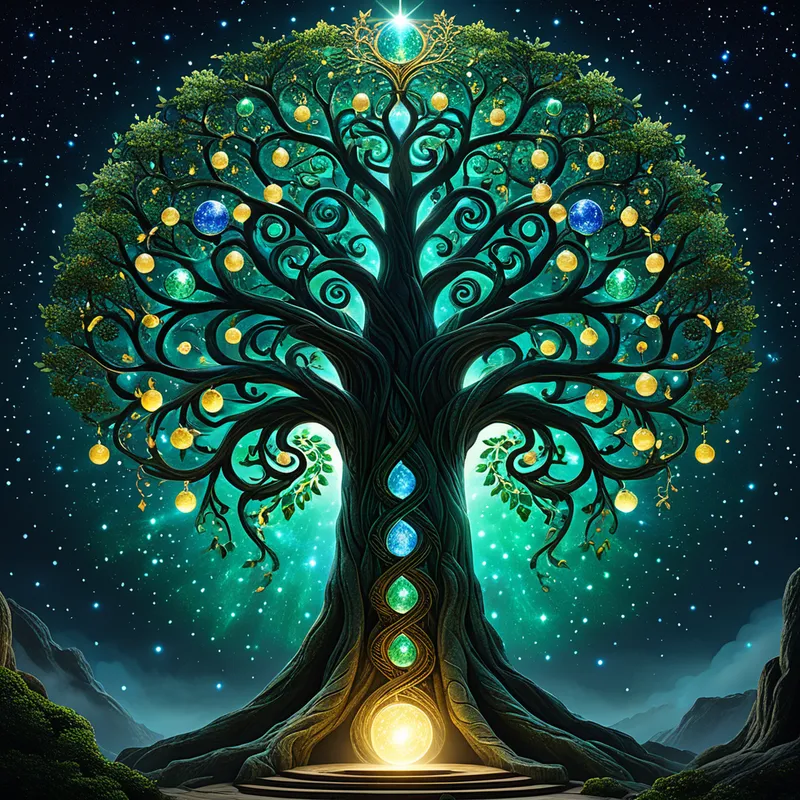
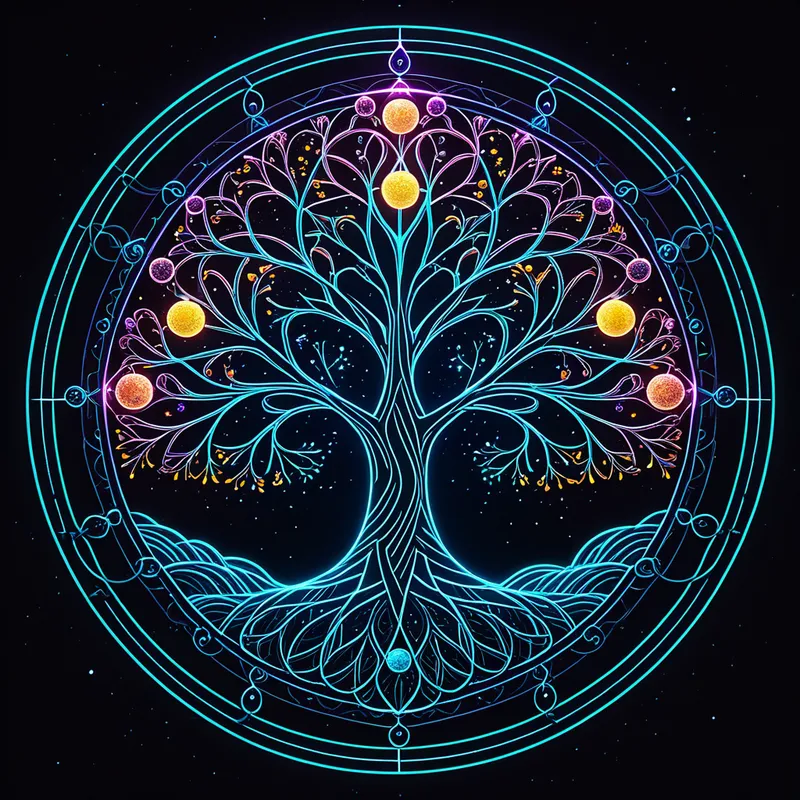
Yet, the ray did not cease. From the heart of the brokenness, a new structure began to form. Not a single vessel, but ten. Ten spheres of graduated light, each a unique facet of the divine, each a filter to temper the infinite into the finite. They arranged themselves not in a line, but in a pattern—a tree, a man, a map. This was the Etz Chaim.
The highest sphere, Keter, touched the edge of the infinite, a crown of pure, ineffable thought. From it flowed Chokhmah and Binah, father and mother, [the flash of insight](/myths/the-flash-of-insight “Myth from Alchemical culture.”/) and [the womb](/myths/the-womb “Myth from Various culture.”/) that gives it shape. Their child was Chesed, a great, flowing river of grace, balanced by the pillar of Gevurah, the necessary boundary, the sword that defines. From their tension was born Tiferet, the radiant heart of the tree, the sun around which all turns.
Below the heart, the journey into manifestation continued. Netzach and Hod, the hips and legs, the enduring drive and the clarifying form, supported the foundation, Yesod, [the moon](/myths/the-moon “Myth from Tarot culture.”/) that gathers all the lights above and projects them into the final sphere: Malkhut. She is the queen, [the earth](/myths/the-earth “Myth from Hindu culture.”/), the dense, beautiful, and fragmented world we inhabit, filled with the scattered sparks of that first, broken light.
And connecting these ten luminous spheres are twenty-two paths, the letters of the sacred alphabet, the vibrations that sing creation into being. The light now flows down this tree in a cascade of blessing, and the soul’s great work is to learn the paths, to gather the sparks, and to make the return journey upward, healing the break, letter by letter, sphere by sphere, until the vessel is whole and the light can shine within it, unbroken.
Cultural Origins & Context
The myth of the [Sephirot](/myths/sephirot “Myth from Kabbalistic culture.”/) is the heart of the Jewish mystical tradition known as Kabbalah. Its seminal text, the Zohar, emerged in 13th-century Spain, attributed to Rabbi Shimon bar Yochai, though it is understood to convey far older, oral teachings. This was not a myth for the populace but a guarded, esoteric doctrine transmitted from master to initiated disciple. Its societal function was dual: to provide a metaphysical map of God’s relationship with creation, and to offer a precise, contemplative technology for [the adept](/myths/the-adept “Myth from Alchemical culture.”/)’s spiritual ascent. It was a myth lived, not merely told, through meditation, prayer, and ethical action (Tikkun Olam), with the goal of unifying the divine presence ([Shekhinah](/myths/shekhinah “Myth from Jewish Mysticism culture.”/), associated with Malkhut) with her source.
Symbolic Architecture
The Etz Chaim is not a [story](/symbols/story “Symbol: The symbol of ‘Story’ represents the narrative woven through our lives, embodying experiences, lessons, and emotions that shape our identities.”/) about distant gods, but a symbolic [architecture](/symbols/architecture “Symbol: Architecture in dreams often signifies structure, stability, and the framing of personal identity or life’s journey.”/) of [consciousness](/symbols/consciousness “Symbol: Consciousness represents the state of awareness and perception, encompassing thoughts, feelings, and experiences.”/) itself. It is a [blueprint](/symbols/blueprint “Symbol: A blueprint represents the foundational plan or design for something, often symbolizing potential, structure, and the mapping of one’s inner self or future.”/) of the [psyche](/myths/psyche “Myth from Greek culture.”/), charting the [journey](/symbols/journey “Symbol: A journey in dreams typically signifies adventure, growth, or a significant life transition.”/) from unconscious unity (Keter) to conscious complexity and back again.
The Sephirot are the grammar of the soul, the syntax by which the infinite sentence of being is parsed into the poetry of a life.
The central [drama](/symbols/drama “Symbol: Drama signifies narratives, emotional expression, and the exploration of human experiences.”/) of the Shevirah symbolizes the necessary [fragmentation](/symbols/fragmentation “Symbol: The experience of breaking apart, losing cohesion, or being separated into pieces. Often represents disintegration of self, relationships, or reality.”/) that accompanies incarnation. Wholeness (the single ray) cannot enter experience without [differentiation](/symbols/differentiation “Symbol: The process of distinguishing or separating parts of the self, emotions, or identity from a whole, often marking a developmental or psychological milestone.”/) (the ten spheres). The “breaking” is the [trauma](/symbols/trauma “Symbol: A deeply distressing or disturbing experience that overwhelms the psyche, often manifesting in dreams as unresolved emotional wounds or psychological injury.”/) of [birth](/symbols/birth “Symbol: Birth symbolizes new beginnings, transformation, and the potential for growth and development.”/) into individuality, the scattering of our primordial unity into the diverse faculties of mind, [heart](/symbols/heart “Symbol: The heart symbolizes love, emotion, and the core of one’s existence, representing deep connections with others and self.”/), and [body](/symbols/body “Symbol: The body in dreams often symbolizes the dreamer’s self-identity, personal health, and the relationship they have with their physical existence.”/). Each Sephirah represents a psychological faculty: Chokhmah is intuitive flash, [Binah](/symbols/binah “Symbol: In Kabbalah, the third Sephirah representing divine understanding, the feminine principle, and the womb of creation.”/) is analytical comprehension, Chesed is expansive love, Gevurah is focused discipline. The paths are the connective processes—thoughts, feelings, actions—that link these inner states.
The entire [structure](/symbols/structure “Symbol: Structure in dreams often symbolizes stability, organization, and the framework of one’s life, reflecting how one perceives their environment and personal life.”/) is held in dynamic balance by three pillars: the right pillar of mercy (Chesed, [Netzach](/symbols/netzach “Symbol: The seventh Sephirah on the Kabbalistic Tree of Life, representing eternal victory, endurance, and the emotional drive of nature.”/)), the left [pillar of severity](/myths/pillar-of-severity “Myth from Kabbalistic culture.”/) (Gevurah, Hod), and the central pillar of mildness that reconciles them. This symbolizes the psyche’s constant work of integrating [expansion](/symbols/expansion “Symbol: A symbol of growth, increase, or extension beyond current boundaries, often representing personal development, opportunity, or overwhelming change.”/) and [contraction](/symbols/contraction “Symbol: A symbolic process of compression, reduction, or inward movement, often representing preparation, transition, or the tension between opposing forces.”/), grace and limit, to arrive at the compassionate center (Tiferet).
The Dreamer’s Resonance
When this myth stirs in the modern unconscious, it often manifests not as a literal tree, but as architectures of integration and collapse. One might dream of a complex machine with critical nodes failing, or a network of lights where one bulb flickers, threatening a cascade. These are dreams of Shevirah—the felt sense of a personal or professional structure breaking under a pressure it was not designed to hold (an influx of “too much light,” like sudden success or trauma).
Conversely, dreams of climbing a luminous lattice, solving an intricate puzzle that reveals a larger shape, or carefully reassembling a shattered, glowing artifact speak to the process of Tikkun. The somatic experience is often one of tension between centers in the body—a knot in the chest (Tiferet blocked) versus a flowing warmth—or a profound sense of alignment when a long-separated insight (Chokhmah) finally finds its emotional understanding (Binah).
Alchemical Translation
The Sephirot’s map is a guide for psychic alchemy—the individuation process. It begins with the acknowledgement of our inherent fragmentation (living in Malkhut). Our work is not to reject this world, but to see it as the palace of the queen, filled with divine sparks hidden in our daily struggles, relationships, and creative acts.
Individuation is the conscious undertaking of the Tzimtzum: creating a sacred space within by withdrawing identification from chaotic impulses, so that a focused ray of Self can descend and build stable vessels.
The journey upward requires balancing the inner pillars. We must temper boundless compassion (Chesed) with the necessary “no” of self-definition (Gevurah) to forge a genuine, resilient identity (Tiferet). We integrate our enduring drives (Netzach) with our analytical self-presentation (Hod) to form a stable foundation (Yesod) from which to act in the world. Each reconciled duality heals a fragment of the original break.
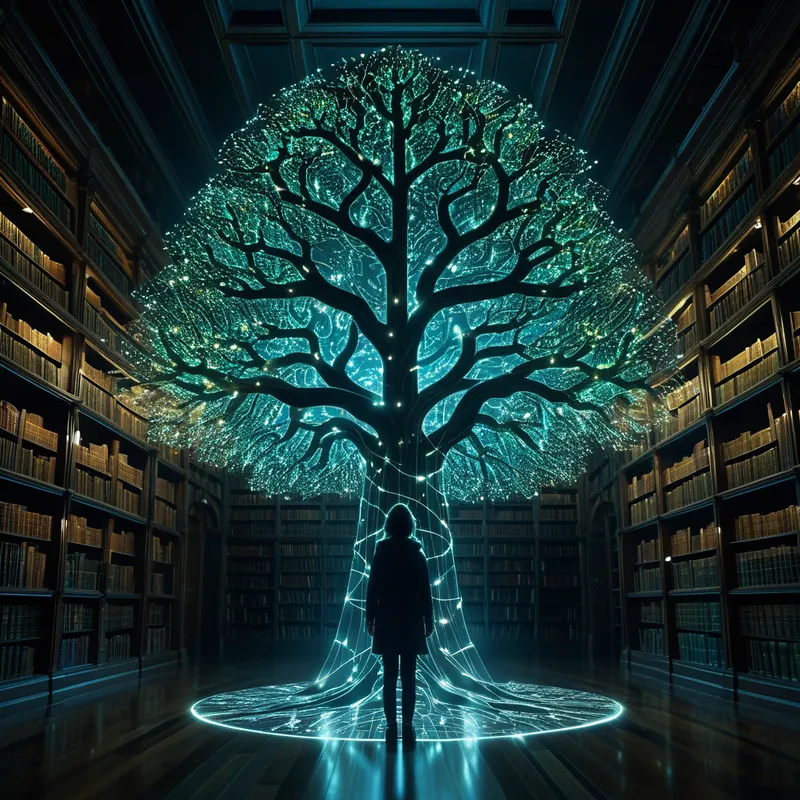
The ultimate alchemical goal is not to abandon the lower spheres for the highest, but to integrate the entire tree. To bring [the crown](/myths/the-crown “Myth from Various culture.”/) (Keter) into the kingdom (Malkhut), so that the infinite is fully incarnate in the finite individual. One becomes a walking, living [Tree of Life](/myths/tree-of-life “Myth from Kabbalistic culture.”/), where every thought, feeling, and action is a conscious pathway for the light to flow, unbroken. The myth ends where it began—in unity—but a unity that has known and incorporated the profound, beautiful lesson of the break.
Associated Symbols
Explore related symbols from the CaleaDream lexicon: