The Separation of Rangi and Papa Myth Meaning & Symbolism
The primal parents, Sky Father and Earth Mother, are separated by their children, creating the world of light, space, and differentiated life.
The Tale of The Separation of Rangi and Papa
In the beginning, there was no light, only a profound and clinging closeness. There was Rangi-nui, the Sky Father, and Papa-tū-ā-nuku, the Earth Mother. They lay in a tight, eternal embrace, their bodies pressed so close that no wind could stir, no space could breathe. Between them, in that warm, dark, and suffocating womb of potential, their children were born.
These were the atua, the gods: Tāne-mahuta, Tangaroa, Rongo-mā-tāne, Haumia-tiketike, Tū-matauenga, and Tāwhiri-mātea. They existed in perpetual twilight, curled and cramped, their forms pressed against the sinew of their father and the flesh of their mother. They knew only the sound of each other's breath and the steady, heavy heartbeat of the cosmos held too tight.
This closeness became a prison. The children longed for room to stretch, for light to see by, for a world in which to become who they were meant to be. One by one, they debated what must be done. Tū-matauenga, fierce and direct, argued for slaying their parents to make space. But the others recoiled. How could they destroy the source of their own being?
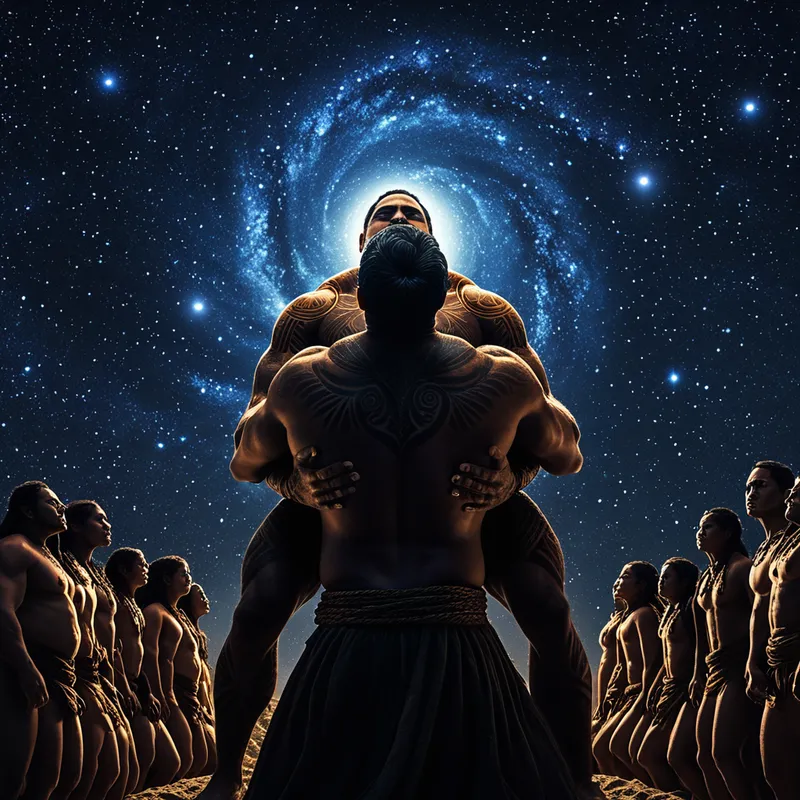
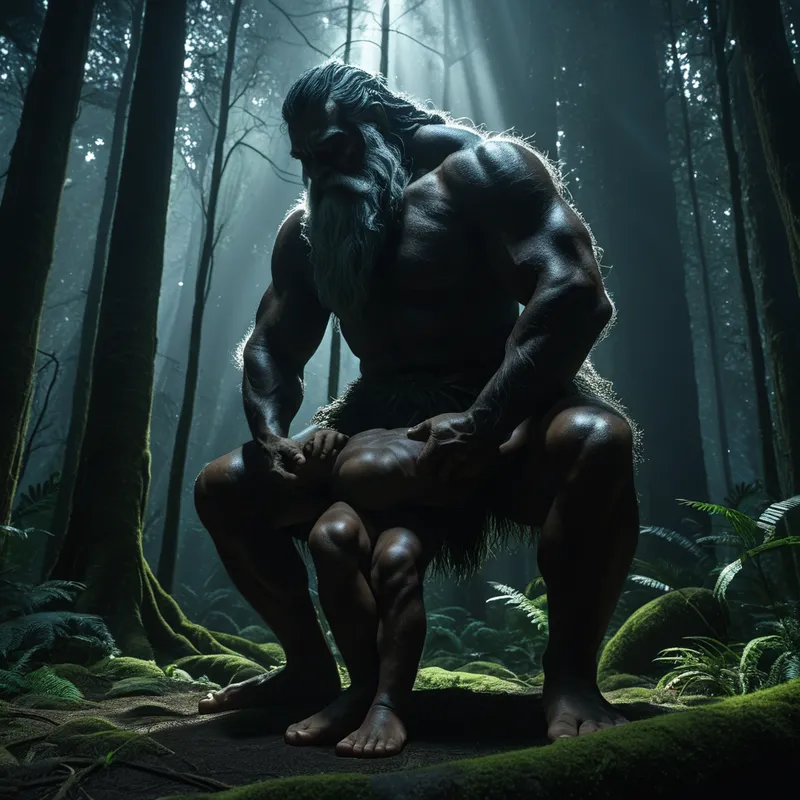
Then, Tāne-mahuta proposed a different path. Not destruction, but separation. He would force them apart. The others agreed. Tāne-mahuta laid himself down, planting his strong feet firmly upon the chest of Papa, his mother. He placed his shoulders against the vast, starless belly of Rangi, his father. He breathed deep of the stale, shared air, and began to push.
The strain was cosmic. The silence of the ages was filled with the groan of straining earth and the creak of protesting sky. He pushed, and pushed, muscles of divine will knotting and burning. For an eternity, nothing yielded. Then, a sound—a tearing, a rending, deep and fundamental. A sliver of unimaginable, piercing light speared the darkness. Rangi cried out in anguish, a sound of tearing love. Papa shuddered with a moan of profound loss.
Tāne-mahuta pushed harder. The crack widened. The light flooded in, cold and brilliant and terrifying. Rangi was forced upward, weeping, his tears becoming the first rain and dew. Papa was pressed downward, her body now exposed, becoming the land. Between them, Te Ao Mārama, the World of Light, was born. Space yawned open. Wind, Tāwhiri-mātea, rushed into the void with a howl of fury at his siblings' act. The children, now gods of a proper domain, tumbled into the new world, blinking in the dazzling, painful, glorious light.
Cultural Origins & Context
This cosmogonic narrative is the foundational myth of the Māori people, the indigenous Polynesian inhabitants of Aotearoa (New Zealand). It was not a mere story but the central pillar of their worldview, transmitted orally through generations by tohunga (priests and scholars) and master storytellers. Its recitation was a sacred act, often performed during significant rituals, at the opening of new meeting houses (wharenui), or to establish the deep genealogical (whakapapa) connection of all people and things back to these primal parents.
The myth functioned as a cosmological map and a social charter. It explained the origin of the natural world—why the sky is distant, why rain falls, why forests grow from the earth. More profoundly, it established the fundamental Māori concept that the universe is a vast, interconnected family. Every mountain, river, tree, and person is a descendant of Rangi and Papa, imbuing the natural world with sacredness and kinship. The act of separation was not framed as a violent rebellion but as a necessary, though painful, step in the unfolding of life and order.
Symbolic Architecture
At its heart, the myth is a profound allegory for the birth of consciousness from the unconscious, and of differentiation from unity.
The primal unity of Rangi and Papa is the unconscious state—a state of potential, containing all things, but where nothing is distinct or realized. It is the womb, the dreamless sleep, the undifferentiated psyche.
The children represent the emergent forces of the psyche—instincts, drives, and archetypal potentials—struggling to be born into manifestation. Their cramped condition symbolizes the frustration and tension that builds when potential is trapped without expression. Tāne-mahuta's act is the archetypal act of consciousness itself: the force that distinguishes, names, and creates space for life to unfold. The separation is not an attack but a necessary differentiation, creating the "space" (Te Ao Mārama) where experience, relationship, and identity become possible.
The grief of the parents is crucial. It signifies that creation is always accompanied by loss. The perfect, closed circuit of the unconscious is broken forever. The resulting world is one of distance, longing (symbolized by Rangi's weeping rain), and sometimes violent weather (the wrath of Tāwhiri-mātea). Yet, it is only in this separated state that love, as conscious relationship across a distance, can exist.
The Dreamer's Resonance
When this mythic pattern stirs in the modern dreamer, it often manifests as dreams of immense pressure, of being trapped in small, dark spaces, or of struggling to separate from an engulfing presence (a house, a relationship, a parent, a job). The somatic feeling is one of constriction in the chest, a need to push, to break free, to breathe.
Psychologically, this signals a critical stage of individuation. The dreamer is outgrowing an old, unconscious unity—perhaps with a family system, a cultural identity, or a dormant aspect of the self. The "children" in the dreamer are the nascent talents, truths, or identities clamoring for light and space. The act of separation in the dream, however frightening or fraught with guilt (hearing the parental cry), is the psyche's own Tāne-mahuta working to create internal space for a more conscious life. The ensuing "storm" of emotion—anxiety, grief, anger—is the expected Tāwhiri-mātea, the chaotic emotional backlash to this necessary psychic reorganization.
Alchemical Translation
The myth provides a flawless model for psychic transmutation. The prima materia is the undifferentiated, unconscious state (Rangi and Papa's embrace). The first, crucial operation is separatio—not destruction, but the careful, forceful creation of distinction.
The alchemist, like Tāne, must place their feet on the solid ground of reality (Papa) and push against the boundless, potential-filled sky of the unconscious (Rangi). The goal is not to reject either, but to create the vas, the sacred vessel of the conscious self, in the space between.
This process is always an ordeal. It requires the strength of the Tāne archetype—the will to grow upward toward the light, to structure chaos into form (forests). The "tears" of rain that follow are the necessary solvents of grief and emotion that water the new psychic landscape. The wrathful storms are the purifying fires that test the new structure's integrity.
Ultimately, the transmutation leads to Te Ao Mārama—the illuminated mind. Here, the once-cramped potentials become differentiated faculties: the warrior (Tū), the cultivator (Rongo), the nurturer (Haumia), the explorer (Tangaroa). The individual is no longer a trapped child in a parental unconscious, but a sovereign being in a world of their own conscious making, forever connected to, but distinct from, their source.
Associated Symbols
Explore related symbols from the CaleaDream lexicon:
- Separation — The fundamental, painful, and necessary act that creates the space for consciousness, relationship, and the manifest world to exist.
- Sky — The masculine principle of potential, spirit, and distant consciousness; the father who must be pushed away to allow for life below.
- Earth — The feminine principle of substance, body, and nurturing ground; the mother who provides the foundation from which to push.
- Forest — The symbol of structured growth and life that emerges from the act of separation, representing the ordered mind and realized potential.
- Rain — The tears of the process, the emotional release and nourishing grief that follows a necessary severance or loss.
- Wind — The chaotic emotional and psychic backlash that occurs when an old, stable unity is disrupted by the forces of change.
- Light — The dawn of consciousness, awareness, and clarity that is the ultimate gift and goal of the separating act.
- Mother — The archetypal container, the source of all substance and grounding, from which one must differentiate to become an individual.
- Father — The archetypal spirit and law, the source of order and potential, whose distance creates the space for autonomous life.
- Child — The emergent self, the new potential or identity that is cramped and unformed until it takes action to create its own world.
- Mountain — The symbolic representation of Tāne's effort; the immense, steady, upward striving required to achieve separation and consciousness.
- Grief — The essential, sacred emotion that acknowledges the cost of creation and transformation, watering the new world with understanding.