The Separatio Process Myth Meaning & Symbolism
A primordial myth of the alchemical vessel shattering, dividing the One into the Many, initiating the long journey of return to the perfected Self.
The Tale of The Separatio Process
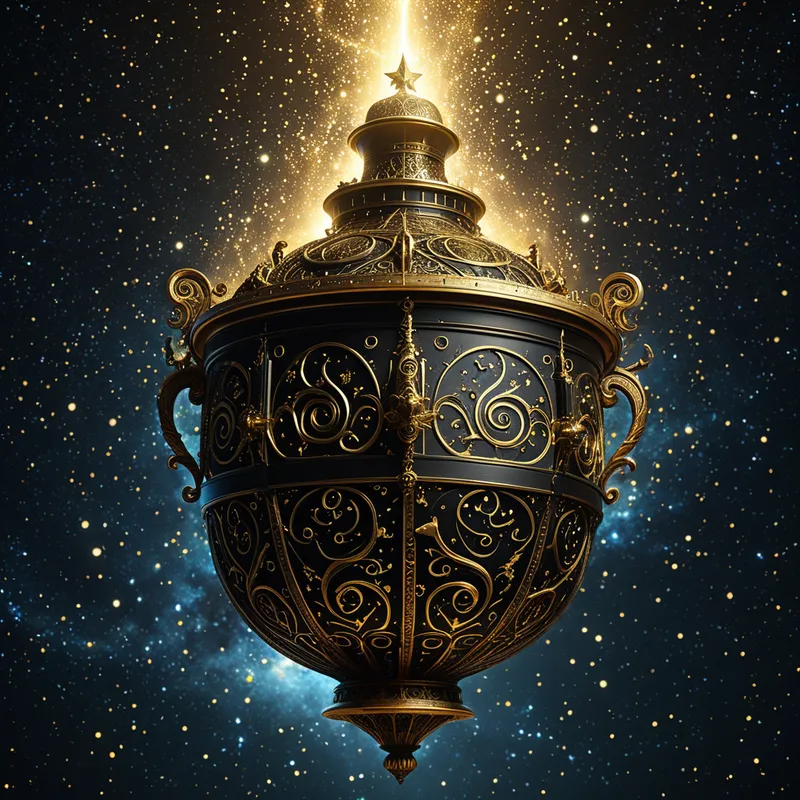
In the beginning, before time was counted, there was [the Vessel](/myths/the-vessel “Myth from Alchemical culture.”/). It was not a [thing](/myths/thing “Myth from Norse culture.”/) of clay or glass, but a living orb of silent potential, a perfect, self-contained [Unus Mundus](/myths/unus-mundus “Myth from Alchemical culture.”/). Within its seamless skin swirled the Chaos in harmonious slumber—fire danced with [water](/myths/water “Myth from Chinese culture.”/), earth embraced air, spirit was indistinguishable from matter. This was the [Rebis](/myths/rebis “Myth from Alchemical culture.”/) in its infancy, a cosmic egg dreaming of a world.
The Opifex, the Great Artificer, beheld this perfection and knew it was not enough. A song cannot be sung by a single, eternal note. A story cannot be told without separation into words. A longing stirred in the heart of the One—a longing for experience, for relationship, for the agonizing beauty of becoming.
And so, with a will born of both love and necessity, the Opifex did not add to the Vessel, but withdrew. A sacred absence was created. In that void of relation, the harmony within strained. The elements, once lovers in a seamless dance, began to sense their own nature. Fire knew its heat as distinct from Water’s coolness. Earth felt its solid weight against Air’s insubstantial flight. Spirit yearned for a body, and matter ached for a soul.
The tension grew, a silent scream within the perfect sphere. Then, a soundless crack, finer than a hair, appeared on its golden surface. Not a flaw of making, but a seam of destiny. From that crack poured not destruction, but a terrible, magnificent differentiation. Light separated from darkness. Hot rose from cold. The bitter quarreled with the sweet. The Unus Mundus was shattered into the ten thousand things—stars, stones, rivers, and the breath of living creatures. The Vessel lay in fragments, its once-contained chaos now sprawled across the raw canvas of creation.
The Opifex looked upon the catastrophic beauty of this [Separatio](/myths/separatio “Myth from Alchemical culture.”/) and did not weep for the lost whole. Instead, they gathered the shards, not to rebuild the old Vessel, but to begin [the Great Work](/myths/the-great-work “Myth from Alchemical culture.”/). For now, with the opposites born and set apart, the long, slow labor of conscious reunion could truly begin.
Cultural Origins & Context
This myth does not belong to a single tribe or nation, but to the underground river of Alchemy that flowed beneath the surface of medieval and Renaissance Europe. It was never a public scripture but a whispered truth, passed in encoded language within illuminated manuscripts like the [Tabula Smaragdina](/myths/tabula-smaragdina “Myth from Alchemical/Hermetic culture.”/) and the cryptic images of the [Rosarium Philosophorum](/myths/rosarium-philosophorum “Myth from Alchemical culture.”/). It was told in the silent laboratories of adepts, not with words, but through the very process of their art: the heating and cooling, the dissolving and precipitating, the relentless dividing of compounds to their essential natures.
Its societal function was esoteric and psychological. For the culture of [the alchemist](/myths/the-alchemist “Myth from Various culture.”/), the myth of Separatio served as a sacred map for inner transformation. It justified the necessary agony of analysis, the breaking down of the personality’s false unity. It taught that before one could become more, one must first become less—that the conscious mind must be separated from the unconscious, the spirit from the blind drives of the body. It was a myth for those brave enough to disassemble their own soul in the hope of finding its genuine gold.
Symbolic Architecture
The myth’s power lies in its stark [symbolism](/symbols/symbolism “Symbol: The use of symbols to represent ideas or qualities, often conveying deeper meanings beyond literal interpretation. In dreams, it’s the language of the unconscious.”/) of a necessary catastrophe. The perfect Unus Mundus represents the original, unconscious state of wholeness—the blissful ignorance of [infancy](/symbols/infancy “Symbol: A symbol of beginnings, vulnerability, and foundational development, often representing a return to origins or a state of pure potential.”/) or the unexamined [life](/symbols/life “Symbol: The symbol of ‘Life’ represents a journey of growth, interconnectedness, and existential meaning, encompassing both the joys and challenges that define human experience.”/). It is comfortable, but it is [static](/symbols/static “Symbol: Static represents interference, disruption, and the breakdown of clear communication or signal, often evoking feelings of frustration and disconnection.”/). It contains all possibilities but realizes [none](/symbols/none “Symbol: The absence represented by ‘none’ can signify emptiness, potential, or a yearning for substance.”/).
The first act of creation is not union, but division. To know love, one must first know solitude. To forge strength, one must first experience fragmentation.
The Separatio itself symbolizes the inevitable and painful [dawn](/symbols/dawn “Symbol: The first light of day, symbolizing new beginnings, hope, and the transition from darkness to illumination.”/) of [consciousness](/symbols/consciousness “Symbol: Consciousness represents the state of awareness and perception, encompassing thoughts, feelings, and experiences.”/). It is the [moment](/symbols/moment “Symbol: The symbol of a ‘moment’ embodies the significance of transient experiences that encapsulate emotional depth or pivotal transformations in life.”/) we realize we are separate from our [mother](/symbols/mother “Symbol: The symbol of ‘Mother’ represents nurturing, protection, and the foundational aspect of one’s emotional being, often associated with comfort and unconditional love.”/), from [nature](/symbols/nature “Symbol: Nature symbolizes growth, connectivity, and the primal forces of existence.”/), from the divine. It is the analytical mind taking things apart to understand them. Psychologically, it is the process of discrimination: distinguishing [the ego](/myths/the-ego “Myth from Jungian culture.”/) from the [shadow](/symbols/shadow “Symbol: The ‘shadow’ embodies the unconscious, repressed aspects of the self and often represents fears or hidden emotions.”/), the [persona](/symbols/persona “Symbol: The social mask or outward identity one presents to the world, often concealing the true self.”/) from the true self, our noble aspirations from our base instincts. The shattering [Vessel](/symbols/vessel “Symbol: A container or structure that holds, transports, or protects something essential, representing the self, emotions, or life journey.”/) is the necessary [death](/symbols/death “Symbol: Symbolizes transformation, endings, and new beginnings; often associated with fear of the unknown.”/) of naive [innocence](/symbols/innocence “Symbol: A state of purity, naivety, and freedom from guilt or corruption, often associated with childhood and moral simplicity.”/), without which conscious, earned integrity is impossible.
The Opifex is the guiding principle of [the Self](/myths/the-self “Myth from Jungian culture.”/), the inner [archetype](/symbols/archetype “Symbol: A universal, primordial pattern or prototype in the collective unconscious that shapes human experience, behavior, and creative expression.”/) of wholeness that paradoxically instigates the fracture. It represents the part of us that knows we must fall apart to come together correctly. It is not a cruel god, but a severe mentor, applying the heat of [crisis](/symbols/crisis “Symbol: A crisis symbolizes turmoil, urgent challenges, and the need for immediate resolution or change.”/) and the solvent of [analysis](/symbols/analysis “Symbol: The process of examining something methodically to understand its components or meaning. In dreams, it represents the mind’s attempt to break down complex experiences.”/) to our compounded being.

The Dreamer’s Resonance
When this myth stirs in the modern [psyche](/myths/psyche “Myth from Greek culture.”/), it manifests in dreams of rupture and sorting. You may dream of a beloved home crumbling, of a mirror breaking, of a treasured object splitting in two. You may find yourself in endless warehouses, cataloging strange artifacts, or on shores sorting stones from shells. These are the somatic echoes of Separatio.
The psychological process at work is a deep, often unsettling, differentiation. The dreamer is in a life phase where a previously cohesive identity—a relationship, a career, a belief system—is being taken apart. The feeling is one of loss, anxiety, and chaotic scattering. Yet, beneath the distress, the dreams often carry a curious, clinical detail: the careful observation of the fragments. This is the psyche beginning its alchemical work. It is not merely destroying; it is analyzing. The dreamer is being compelled to distinguish what is truly theirs from what was inherited, what is gold from what is dross, what is spirit from what is merely habit.

Alchemical Translation
For the modern individual seeking individuation, the myth of Separatio models the first, non-negotiable stage of psychic transmutation. We cannot integrate what we have not first distinguished.
The process begins with the application of the Aqua Fortis of honest self-reflection. This is the heat of therapy, the solvent of journaling, the crisis that forces us to examine the compounds of our personality. We must separate our own desires from our parents’ expectations, our authentic feelings from our conditioned reactions, our adult values from our childish wounds.
The goal is not to remain in pieces, but to sort the pieces with conscious hands. The shattered Vessel is not the end; it is the precondition for the Purificatio and the Coniunctio to come.
This is the labor of the orphan archetype. We feel cast out from the warm, unconscious whole. Yet, this very separation grants us agency. By holding the shard of our anger apart from the shard of our grief, we can understand each. By distinguishing our inner king from our inner beggar, we can eventually broker a peace between them. The myth assures us that this painful, analytical separation is not a sin against wholeness, but its sacred and necessary prelude. We break the egg to hatch the bird. We dissolve the ore to extract the metal. We endure the Separatio to ultimately achieve a reunion that is conscious, chosen, and infinitely more resilient than the original, unconscious unity.
Associated Symbols
Explore related symbols from the CaleaDream lexicon: