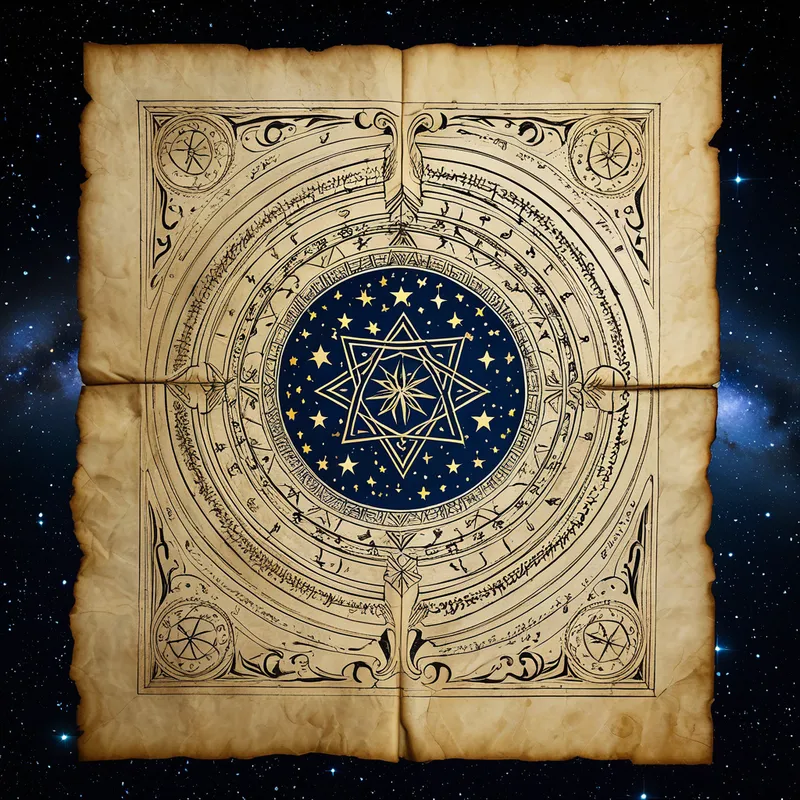
The Sefer Yetzirah Myth Meaning & Symbolism
An ancient text revealing the universe's creation through 32 secret paths: the 10 divine numbers and the 22 foundational Hebrew letters.
The Tale of The Sefer Yetzirah
Before [the world](/myths/the-world “Myth from Tarot culture.”/) was world, there was a whisper in the boundless dark. It was not a sound, but a potential for sound. It was the breath of the Infinite, the Ein Sof, drawing in upon itself. And in that contraction, a space was carved—not a place, but a possibility. Into this pregnant void, the Holy One, blessed be He, engraved thirty-two wondrous paths of wisdom.
These were not roads of stone or dust, but channels of divine intent. Ten were numbers, Sefirot, vessels of limitless light. They emerged from the Nothing: one, the Breath of the Living God; two, the Breath from Breath, carving air from spirit; three, the [Water](/myths/water “Myth from Chinese culture.”/), condensed from [the mist](/myths/the-mist “Myth from Celtic culture.”/) of air; four, the Fire, born from the friction of [water](/myths/water “Myth from Chinese culture.”/) and spirit. And from these primal elements, the six directions of space were sealed—Depth, Height, East, West, North, South—a cosmic cube of divine measurement.
Then came the twenty-two foundations: the letters of the holy tongue. They were not mere shapes, but living forces, the bones and sinews of creation. With three Mother Letters—Aleph, Mem, Shin—He established the triune world of soul, time, and cosmos. With seven Double Letters, He forged the seven planets and the seven days, each letter a pendulum swinging between life and death, peace and calamity. And with the twelve Simple Letters, He sculpted the twelve constellations, the twelve months, and the twelve human faculties—sight, hearing, speech, thought, and more.
The Holy One combined them, permuted them, weighed them, and swapped them. He carved the universe with the letter Bet and formed [the earth](/myths/the-earth “Myth from Hindu culture.”/). He spoke life with the letter Hei. He sealed [the abyss](/myths/the-abyss “Myth from Kabbalistic culture.”/) with Mem and kindled the firmament with Shin. Each combination was a divine experiment, a cosmic equation whose solution was a star, a thought, a blade of grass. And finally, He formed the Human, a microcosm, a mirror of the whole—a being whose very soul was a permutation of letters, whose body was a map of the Sefirot, standing in the center of the six directions, binding all creation together through breath and speech. The book of formation was complete, a blueprint hidden in the very fabric of being, waiting to be read by those who dare to listen to the silence between the letters.
Cultural Origins & Context
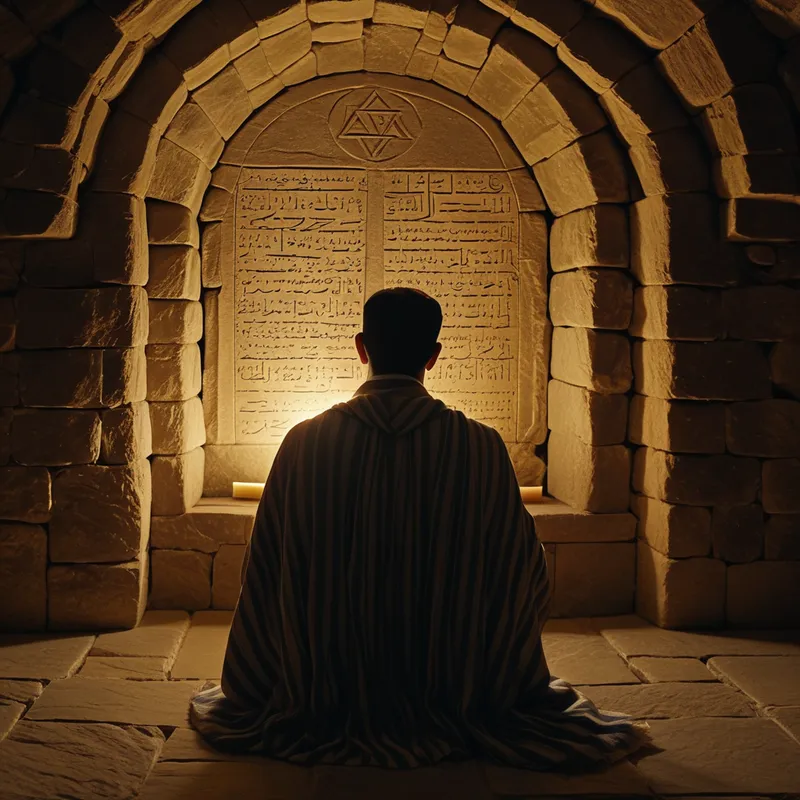
The [Sefer Yetzirah](/myths/sefer-yetzirah “Myth from Jewish culture.”/) is a slender, enigmatic text, its origins shrouded in the mists of antiquity. Traditionally attributed to the patriarch Abraham, it is more likely a product of the Talmudic or early post-Talmudic era (between the 3rd and 6th centuries CE), a time of intense mystical speculation. It was not a text for the multitude, but for the solitary adept, the yodea chein—the “one who knows grace.” Passed down in whispers, copied in secret, it was [the cornerstone](/myths/the-cornerstone “Myth from Biblical culture.”/) of Kabbalah.
Its societal function was dual. Exoterically, it was a meditation on the majesty of God’s creation through language, affirming the profound holiness of Hebrew as the substrate of reality. Esoterically, it was a manual of power and transformation. To know the combinations (tzirufim) of the letters was to participate in the ongoing act of creation, to heal, to prophesy, and, according to legend, to animate a [Golem](/myths/golem “Myth from Jewish folklore culture.”/). It provided a sacred cosmology that ordered a chaotic world, offering a map where every element—from the furthest star to the deepest human emotion—was connected in a divine, linguistic matrix.
Symbolic Architecture
At its [heart](/symbols/heart “Symbol: The heart symbolizes love, emotion, and the core of one’s existence, representing deep connections with others and self.”/), the Sefer Yetzirah is a myth of structured [emanation](/symbols/emanation “Symbol: A spiritual or divine energy flowing outward from a source, often representing creation, influence, or the manifestation of the sacred into the material world.”/). The [universe](/symbols/universe “Symbol: The universe symbolizes vastness, interconnectedness, and the mysteries of existence beyond the individual self.”/) is not born from [chaos](/symbols/chaos “Symbol: In Arts & Music, chaos represents raw creative potential, uncontrolled expression, and the breakdown of order to forge new artistic forms.”/) or violent struggle, but from the orderly, intellectual emanation of divine attributes ([Sefirot](/symbols/sefirot “Symbol: The ten divine emanations in Kabbalah representing aspects of God and the structure of creation.”/)) and the combinatorial play of foundational elements (the letters).
The myth teaches that creation is an act of divine linguistics; reality is a text waiting to be decoded, and consciousness is the reader.
Psychologically, the ten Sefirot represent the archetypal stages of any process of manifestation, from the first spark of [intention](/symbols/intention “Symbol: Intention represents the clarity of purpose and direction in one’s life and can symbolize motivation and commitment within a dream context.”/) (Keter) to its final realization in a tangible form (Malkhut). They are the internal [architecture](/symbols/architecture “Symbol: Architecture in dreams often signifies structure, stability, and the framing of personal identity or life’s journey.”/) of the [psyche](/myths/psyche “Myth from Greek culture.”/) itself. The twenty-two letters symbolize the raw, psychoid [material](/symbols/material “Symbol: Material signifies the tangible aspects of life, often representing physical resources, desires, and the physical world’s influence on our existence.”/) of experience—the sounds, images, and primal feelings that must be combined to form coherent thoughts, emotions, and ultimately, a stable sense of self. The [Human](/symbols/human “Symbol: The symbol of a human represents individuality, complexity of emotions, and social relationships.”/), as the [microcosm](/symbols/microcosm “Symbol: A small, self-contained system that mirrors or represents a larger, more complex whole, often reflecting the universe within an individual.”/), represents [the ego](/myths/the-ego “Myth from Jungian culture.”/)-[consciousness](/symbols/consciousness “Symbol: Consciousness represents the state of awareness and perception, encompassing thoughts, feelings, and experiences.”/) tasked with the sacred duty of integrating these inner forces, of becoming the conscious author of one’s own [life](/symbols/life “Symbol: The symbol of ‘Life’ represents a journey of growth, interconnectedness, and existential meaning, encompassing both the joys and challenges that define human experience.”/).
The Dreamer’s Resonance
When this myth stirs in the modern unconscious, it often manifests not as a narrative dream, but as a dream of pattern. One might dream of endlessly rearranging blocks with strange symbols, of hearing a forgotten language whose grammar feels intuitively known, or of discovering a hidden code in the architecture of one’s own home. These are dreams of the psyche attempting to re-order itself, to find the foundational “letters” and “numbers” of one’s own being.
Somatically, this can feel like a process of deep re-wiring—a tingling in the spine (the central column of the [Tree of Life](/myths/tree-of-life “Myth from Kabbalistic culture.”/)), a pressure in the forehead (the seat of the Keter), or a sense of the body as a literal map. The psychological process is one of analysis followed by synthesis. The dreamer is breaking down a complex life situation or identity crisis into its constituent parts (the letters) and seeking the divine rule-set (the 32 paths) by which to reassemble them into something whole, functional, and holy.
Alchemical Translation
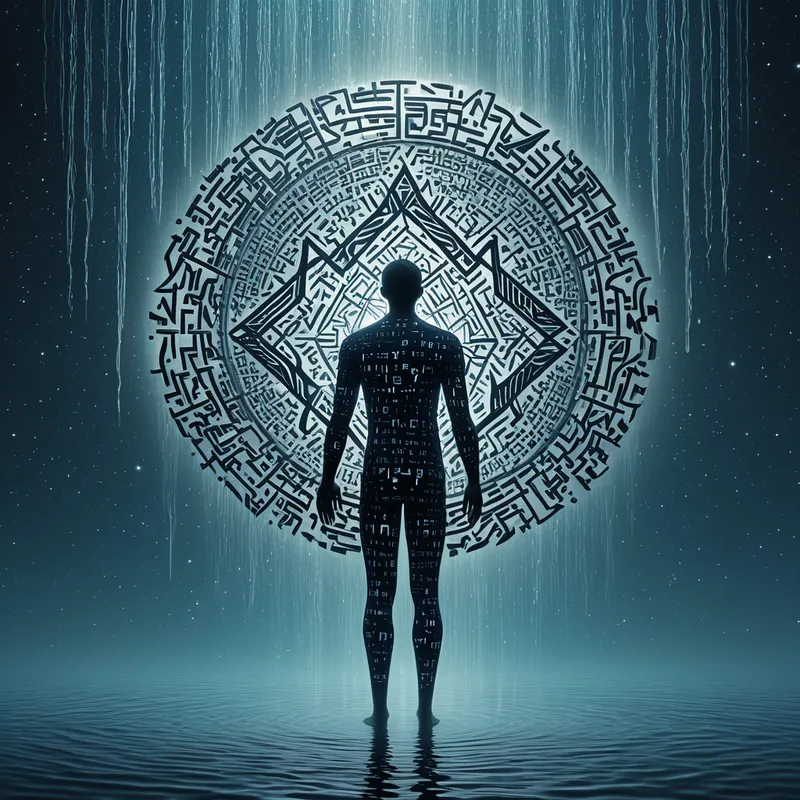
The alchemical journey modeled by the Sefer Yetzirah is the transmutation of chaotic personal experience into conscious, creative order—the process of Individuation. The [prima materia](/myths/prima-materia “Myth from Alchemical culture.”/) is the raw, undifferentiated stuff of one’s psyche and life events. The solve stage is the analytical work of distinguishing the “ten Sefirot” within: What is my true will (Keter)? What is my wisdom (Chokhmah) and understanding (Binah)? How do my emotions (Tiferet) clash with my judgments (Gevurah)?
The ultimate alchemical gold is the realized Self, the Tikkun—the being who has repaired their inner world by consciously speaking it into coherent, compassionate existence.
The coagula stage is the active permutation of the “twenty-two letters.” This is the creative act of taking those analyzed elements—a memory, a trauma, a talent, a relationship—and consciously recombining them through narrative (writing, therapy, art), through changed behavior, and through sacred speech (affirmations, prayer, honest communication). One becomes the Yotzer, the “Former,” of one’s own soul. The goal is not to escape the world but to become its conscious center, the Human who stands in the six directions, integrating all aspects of experience, thereby performing the ultimate act of <abbr title=“Hebrew for “repair of the world,” the concept of healing the divine fragmentation through human ethical and mystical action”>Tikkun Olam—the repair of one’s own microcosm, which echoes into the macrocosm.
Associated Symbols
Explore related symbols from the CaleaDream lexicon: