The Second Noble Truth Myth Meaning & Symbolism
The Buddha's revelation beneath the Bodhi tree that the root of all suffering is craving, a diagnosis for the human condition.
The Tale of The Second Noble Truth
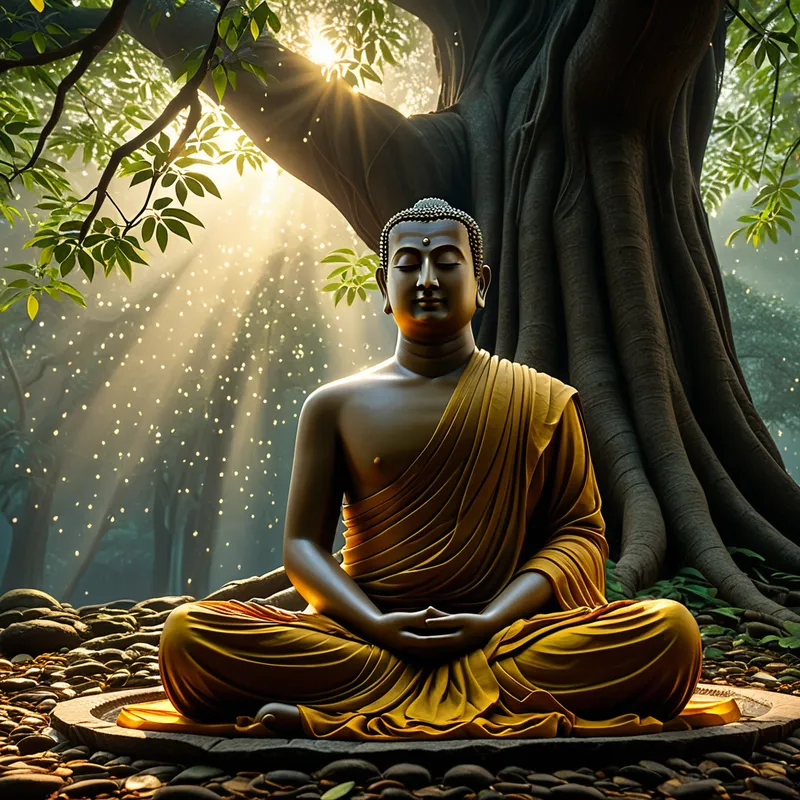
The night was not yet done. Beneath the ancient, sheltering arms of the Bodhi tree, a prince-turned-ascetic sat unmoving. [The earth](/myths/the-earth “Myth from Hindu culture.”/) itself seemed to hold its breath. [Siddhartha Gautama](/myths/siddhartha-gautama “Myth from Buddhist culture.”/) had turned his back on armies of temptation, on the seductive whispers of the demon Mara. He had faced the specters of his own fear and desire, and now he descended, like a diver into the deepest ocean, into the caverns of his own mind.
He did not seek a god. He sought a cause.
In the silent theater of his meditation, [the world](/myths/the-world “Myth from Tarot culture.”/) played out its endless drama. He saw the newborn’s cry, the lover’s clinging embrace, the merchant’s anxious tally, the old man’s trembling sigh. He saw the glittering parade of kingdoms rising and falling, of beauty fading to dust, of health succumbing to decay. A great river of sorrow flowed through it all, a current of dukkha—unsatisfactoriness, suffering. He had named this river in his first great seeing. But from what spring did this bitter [water](/myths/water “Myth from Chinese culture.”/) flow?
He followed the current upstream, past the obvious rocks of pain and loss. Past the surface ripples of sickness and old age. He journeyed into subtler territories: the quiet ache of having what is pleasant, knowing it will change; the sharper pang of being separated from what is loved; the dull, grinding frustration of not getting what one wants. [The river](/myths/the-river “Myth from Buddhist culture.”/) was fed by a thousand such streams.
Deeper still he went, into the very bedrock of experience. And there, in the dark, fertile soil of the human heart, he found the source. It was not a single [thing](/myths/thing “Myth from Norse culture.”/), but a process—a grasping, a thirst, a burning. Tanhā. It manifested in three voices, a whispering chorus: “This, I want more of!” (kāma-taṇhā). “This, I want to be!” (bhava-taṇhā). “This, I want to be rid of!” (vibhava-taṇhā).
He saw it clearly, as one sees the spark that starts the wildfire. The pleasant sensation arises, and with it, the clutch of craving, the mental fist tightening around the experience, demanding it stay. The unpleasant sensation arises, and with it, the frantic push of aversion, the mental arm thrusting it away. The neutral sensation arises, and with it, the fog of ignorance, a dullness that seeks stimulation or escape. This was it. This was the origin, the genesis, the second truth.
It was not a condemnation, but a diagnosis. A revelation as precise as a surgeon’s insight. The cause of the sickness was not the world itself, but the heart’s addicted relationship to it. As the first light of dawn touched the leaves of [the Bodhi tree](/myths/the-bodhi-tree “Myth from Buddhist culture.”/), it touched a mind that had seen to the very root. The truth stood revealed, stark and liberating in its clarity: “Now this, bhikkhus, is the noble truth of the origin of suffering: it is this craving which leads to renewed existence, accompanied by delight and lust, seeking delight here and there; that is, craving for sensual pleasures, craving for existence, craving for extermination.”
The search was over. The cause was found.
Cultural Origins & Context
This is not a myth of gods and monsters, but a myth of insight. Its setting is historical—the 5th century BCE in the Gangetic plains of India—yet its narrative is psychological. It was not sung by bards but spoken by a teacher, the Buddha, in his first discourse, the Dhammacakkappavattana Sutta.
The societal function was revolutionary. In a culture deeply engaged with rituals for pleasing gods and theories about the eternal self (ātman), [the Buddha](/myths/the-buddha “Myth from Buddhist culture.”/) presented a pragmatic, empirical teaching. The Second Noble Truth was the critical second step in a fourfold medical protocol: identify the symptom (First Truth: there is suffering), diagnose the cause (Second Truth: the cause is craving), determine the prognosis (Third Truth: cessation is possible), and prescribe the treatment (Fourth Truth: the path). It was passed down orally for centuries within the [Sangha](/myths/sangha “Myth from Buddhist culture.”/), a vital piece of analytical wisdom meant not for belief, but for verification through one’s own experience.
Symbolic Architecture
The myth of the Second [Truth](/symbols/truth “Symbol: Truth represents authenticity, honesty, and the quest for knowledge beyond mere appearances.”/) architecturally maps the [interior](/symbols/interior “Symbol: The interior symbolizes one’s inner self, thoughts, and emotions, often reflecting personal growth, vulnerabilities, and secrets.”/) of [human](/symbols/human “Symbol: The symbol of a human represents individuality, complexity of emotions, and social relationships.”/) bondage. The [Bodhi tree](/symbols/bodhi-tree “Symbol: The sacred fig tree under which Siddhartha Gautama attained enlightenment, symbolizing awakening, wisdom, and the interconnectedness of all life.”/) is the [axis](/symbols/axis “Symbol: A central line or principle around which things revolve, representing stability, orientation, and the fundamental structure of reality or consciousness.”/) mundi, the place where the vertical plunge into the [psyche](/myths/psyche “Myth from Greek culture.”/) meets the horizontal [truth](/symbols/truth “Symbol: Truth represents authenticity, honesty, and the quest for knowledge beyond mere appearances.”/) of the world. Mara’s armies symbolize the personal and collective distractions that keep us from looking [inward](/symbols/inward “Symbol: A journey toward self-awareness, introspection, and the exploration of one’s inner world, thoughts, and unconscious mind.”/).
The root of the tree is also the root of the fire.
Tanhā itself is the core [symbol](/symbols/symbol “Symbol: A symbol can represent an idea, concept, or belief, serving as a powerful tool for communication and understanding.”/)—not a [demon](/symbols/demon “Symbol: Demons often symbolize inner fears, repressed emotions, or negative aspects of oneself that the dreamer is struggling to confront.”/) to be slain, but a process to be understood. Its three forms are a complete taxonomy of psychological clinging:
- Craving for Sensual Pleasure (kāma-taṇhā): The [hunger](/symbols/hunger “Symbol: A primal bodily sensation symbolizing unmet needs, desires, or emotional voids. It represents craving for fulfillment beyond physical nourishment.”/) for more pleasant sights, sounds, tastes, touches, thoughts, and emotions. It is the [child](/symbols/child “Symbol: The child symbolizes innocence, vulnerability, and potential growth, often representing the dreamer’s inner child or unresolved issues from childhood.”/) reaching for another sweet, the addict seeking the next fix, the collector needing one more [piece](/symbols/piece “Symbol: A ‘piece’ in dreams often symbolizes a fragment of the self or a situation that requires integration, reflection, or understanding.”/).
- Craving for Existence (bhava-taṇhā): The desire to be solid, permanent, and defined. It is the attachment to [identity](/symbols/identity “Symbol: Identity represents the sense of self, encompassing personal beliefs, cultural background, and social roles.”/), [status](/symbols/status “Symbol: Represents one’s social position, rank, or standing within a group, often tied to achievement, power, or recognition.”/), ideology, or the hope for an eternal self. It is the fear of annihilation made into a project of building a [fortress](/symbols/fortress “Symbol: A fortress symbolizes security and protection, representing both physical and psychological safety from external threats.”/) of “me.”
- Craving for Non-Existence (vibhava-taṇhā): The desire to escape, to annihilate unpleasant experiences, to blot out parts of [the self](/myths/the-self “Myth from Jungian culture.”/) deemed unacceptable. It is not [peace](/symbols/peace “Symbol: Peace represents a state of tranquility and harmony, both internally and externally, often reflecting a desire for resolution and serenity in one’s life.”/), but a violent [rejection](/symbols/rejection “Symbol: The experience of being refused, excluded, or dismissed by others, often representing fears of inadequacy or social belonging.”/) of what is.
Psychologically, this represents [the ego](/myths/the-ego “Myth from Jungian culture.”/)’s fundamental [activity](/symbols/activity “Symbol: Activity in dreams often represents the dynamic aspects of life and can indicate movement, progress, and engagement with personal or societal responsibilities.”/): to create a stable, pleasurable “self” out of the flowing stream of experience, and to violently defend it. The “[hero](/symbols/hero “Symbol: A hero embodies strength, courage, and the ability to overcome significant challenges.”/)” of this myth is not a conqueror, but a diagnostician. The [triumph](/myths/triumph “Myth from Roman culture.”/) is not in killing the [dragon](/symbols/dragon “Symbol: Dragons are potent symbols of power, wisdom, and transformation, often embodying the duality of creation and destruction.”/), but in turning the light of [awareness](/symbols/awareness “Symbol: Conscious perception of self, surroundings, or internal states. Often signifies awakening, insight, or heightened sensitivity.”/) upon its very [nature](/symbols/nature “Symbol: Nature symbolizes growth, connectivity, and the primal forces of existence.”/).
The Dreamer’s Resonance
When this myth stirs in the modern dreamer, it rarely appears as a Buddha under a tree. It manifests as the somatic texture of craving itself.
You may dream of wandering through infinite shopping malls, filling a cart with items that turn to leaves or dust. You may dream of frantically building a sandcastle as the tide comes in, or of trying to scrub a stain from your skin that only spreads. You may dream of a loved one’s face melting when you try to hold it, or of a door you desperately need to open being forever locked. These are dreams of Tanhā in action.
The psychological process is one of recognition. The dream ego is experiencing the frustration and anxiety inherent in the grasping mind. The dream is not solving the problem; it is showing you the problem in real-time. The resonance is in the feeling—the ache of wanting, the burn of aversion, the numb fog of indifference. To wake from such a dream with the question “What was I so desperately seeking?” is to begin the work of the Second Truth.

Alchemical Translation
The alchemical process modeled here is not one of adding a philosopher’s stone, but of applying the heat of inquiry to the base metal of our automatic reactions. It is the transmutation of ignorance into insight, of compulsive craving into conscious relationship.
The fire that burns is also the fire that purifies.
The first step is Mortificatio: the “killing” of the illusion that happiness lies in the next acquisition, the next achievement, or the next escape. The Second Truth performs this by bluntly identifying craving as the cause of suffering, not its cure. This is a necessary dark night, a disillusionment.
This leads to [Solutio](/myths/solutio “Myth from Alchemical culture.”/): the dissolving of the solid, craving self into its component parts. By observing craving without acting on it—seeing the wanting as a mere phenomenon that arises and passes—the ego’s identification with that craving begins to soften. “I am a person who wants that” becomes “There is a wanting.”
Finally, there is [Separatio](/myths/separatio “Myth from Alchemical culture.”/): the clear distinguishing between the raw experience (a pleasant feeling) and the added layer of craving (the clutch to keep it). This discrimination is the birth of inner freedom. The psychic energy once bound up in chasing and fleeing is liberated. It becomes available for the work of Metta, for creativity, for presence.
The individuation journey here is towards becoming the sage—not one who has no desires, but one who sees the arising and passing of desire with clarity and compassion. The goal is not to arrive at a state of wantlessness, but to cease being organized by wanting. The myth of the Second Noble Truth provides the precise map for this most profound of interior revolutions: to find the source of the world’s sorrow in the palm of your own hand, and in that finding, to begin to loosen your grip.
Associated Symbols
Explore related symbols from the CaleaDream lexicon: