The Scholar's Incense Myth Meaning & Symbolism
A tale of a poor scholar whose profound sacrifice of his last possession, a precious incense stick, leads to divine intervention and ultimate success.
The Tale of The Scholar’s Incense
In the twilight of the Ming dynasty, when the empire’s heart beat with the rhythm of the imperial examinations, there lived a scholar named Li. His world was one of ink-stained fingers and threadbare robes, a small, cold room where the only warmth came from the flicker of a single oil lamp. For years, he had poured his soul into the classics, memorizing the Four Books and Five Classics until the characters danced behind his eyelids in the dark. Yet, success remained a distant star, obscured by the fog of poverty and obscurity.
His sole inheritance from his father, a man of modest learning but great heart, was a small, exquisitely carved sandalwood box. Inside, wrapped in faded yellow silk, lay three sticks of the finest incense. “For the most important moment,” his father had whispered on his deathbed. “When your spirit needs to speak to heaven itself.” Li guarded them as he guarded his hope.
The day of the provincial examination arrived, a tempest of anxiety and ambition. Li, his stomach hollow with hunger, joined the river of candidates flowing towards the examination hall. But at the gate, a cold dread seized him. In his frantic preparations, he had forgotten the most crucial item: the examination fee. The stern official barred his way, a stone wall of bureaucracy. Pleads were useless; the rules were iron. Despair, colder than the winter wind, wrapped around his heart. He turned away, the dream of a lifetime crumbling to dust at his feet.
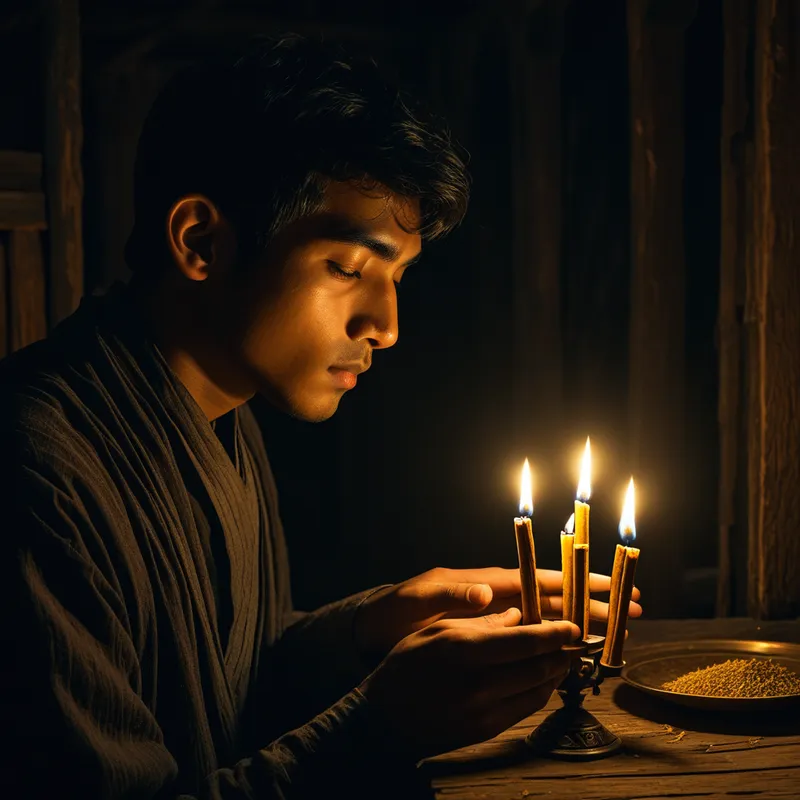
That night, in his desolate room, the world felt utterly silent. The future was a blank page. He opened the sandalwood box. Two incense sticks remained. In a moment of pure, unadorned grief, he did not think of strategy or prayer. He thought only of honor—honor for his father’s sacrifice, honor for the years of study, honor for the very act of striving itself. He would offer his devotion, not for gain, but as a final, beautiful farewell to the path.
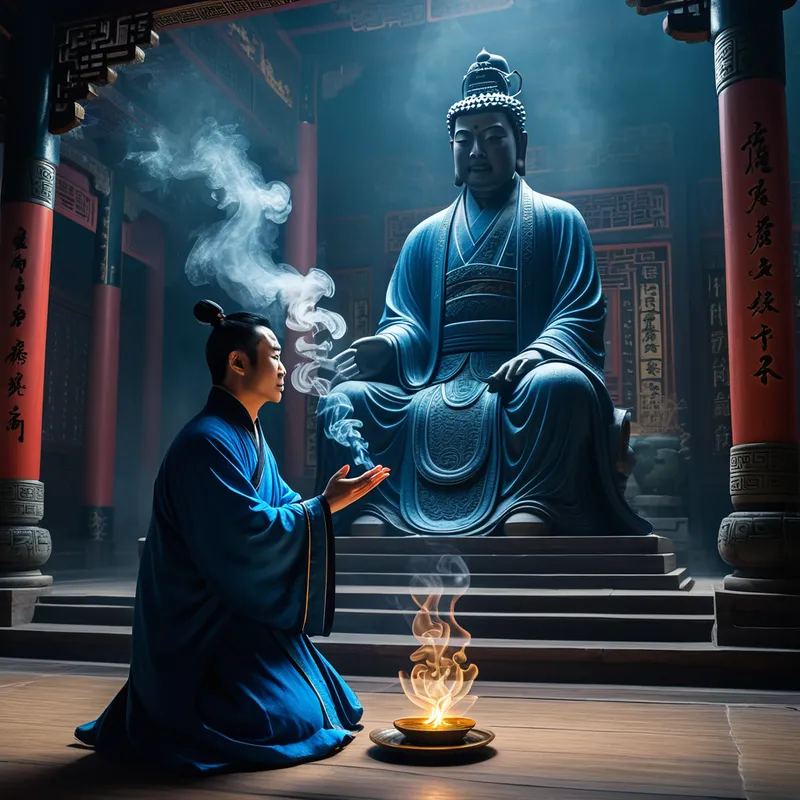
He took the precious stick to the humble shrine of Wenchang Dijun, the God of Literature. The temple was empty. Lighting the incense, he placed it in the burner with hands that did not tremble. “Great Star Lord,” he said, his voice clear in the quiet. “I have nothing left to give but this, the last treasure of my house. I offer it not for success, for that chance is gone, but in gratitude for the wisdom your teachings have brought me, and in honor of my father’s wish.” The fragrant smoke curled upward, a silent, elegant script written on the air.
He returned home, emptied yet peaceful, and fell into a deep sleep. In his dream, Wenchang Dijun appeared, not in terrifying majesty, but with the serene bearing of a grand chancellor. His voice was like the rustle of ancient scrolls. “Your incense was the truest essay I have ever received. It was written not with ink, but with your heart’s blood. A scholar’s worth is not in his wealth, but in his devotion to the Way.” The deity touched Li’s forehead with a brush that glowed with celestial light.
Li awoke at dawn, the dream vivid, a strange certainty in his chest. At his door stood a messenger from the examination hall. There had been, he was told, a most unusual error. A candidate with a name similar to his had paid a double fee. The surplus was now rightfully his. Stunned, Li rushed to the hall and was admitted just as the gates were closing.
When the results were posted, his name was at the very top. His examination papers were said to be masterpieces, flowing with a clarity and depth that astonished the graders. He had lit a single stick of incense, and in return, the heavens had lit a path for his entire life.
Cultural Origins & Context
This myth, in its many variations, is woven into the fabric of late imperial Chinese scholar-official culture. It emerged not from a single canonical text, but from a rich oral tradition of xianhua (inspiring tales) and gushi (stories) told by examination candidates, tutors, and within local communities. It functioned as a vital piece of psychological and spiritual technology within the immense pressure cooker of the Keju system.
The story was a balm for collective anxiety. For every successful candidate, thousands faced repeated, crushing failure. The myth provided a narrative framework that transcended mere meritocracy. It suggested that the celestial bureaucracy, mirroring the earthly one, valued virtues beyond rote memorization: sincerity, filial piety, and selfless devotion. It was often recounted on the eve of exams, not as a guarantee, but as a reminder to cultivate the inner disposition of a true scholar—one whose relationship to knowledge was sacred. The incense itself was a tangible link to this spiritual economy, a medium for communicating with Shenxian who presided over human fortunes.
Symbolic Architecture
At its core, the myth is an alchemical parable of value and transformation. The scholar’s journey maps a profound psychic shift from external ambition to internal integrity.
The final, most precious resource is not spent on the self, but surrendered to the symbolic source of meaning. In that act of non-attachment, the self is re-made.
The Incense is the pivotal symbol. It is condensed heritage (the father’s gift), material wealth (the last item of value), and spiritual currency. Burning it is not a request; it is a total offering. It represents the sublimation of the ego’s desire into a pure act of devotion. The smoke is the vehicle—the intention made visible, ascending to the divine realm.
Wenchang Dijun is the archetypal Self figure, the embodiment of the ultimate goal of the intellectual and spiritual journey. He does not reward hard work alone, but the quality of the heart behind the work. His intervention signifies a moment of grace, where the inner alignment of the individual resonates with the ordering principle of the cosmos.
The Forgotten Fee symbolizes the unavoidable, often absurd, material obstacles of life—the brutal realities that seem to invalidate years of inner preparation. It is the test before the test, forcing a crisis that separates worldly strategy from transcendent sincerity.
The Dreamer’s Resonance
When this myth stirs in the modern unconscious, it often surfaces in dreams of profound sacrifice before a crucial threshold. You may dream of burning a beloved book to stay warm, or offering your last coin at a deserted shrine. The setting is often one of stark preparation—a sterile exam hall, a bare studio before a big audition, an empty office the night before a pivotal presentation.
Somatically, this dream pattern accompanies a felt sense of having given everything, of being at a zero point. There is a deep anxiety, yes, but underneath it, if one listens closely, a strange, hollow peace. The psychological process is the dissolution of the transactional ego. The dream-ego is being forced to relinquish the mindset of “I do this to get that.” The anguish of the “forgotten fee” is the death throes of the old bargain with life. The act of offering the “incense”—whatever unique form it takes in the dream—is the psyche’s ritual enactment of surrender to a process larger than conscious will. The dreamer is not failing; they are being prepared to receive in a new way.
Alchemical Translation
The individuation journey modeled here is not one of heroic conquest, but of humble, transformative sacrifice. The modern “scholar” is anyone devoted to a craft, a calling, or a deep learning—the artist, the therapist, the entrepreneur, the seeker.
The first stage is The Accumulation of the Ink: the long, often lonely years of study, practice, and inner development. This builds the prima materia, the raw substance of the soul.
The crisis is The Missing Fee: the moment when the world seems to refuse you, when external validation is withheld, when the bridge between your inner world and outer success collapses. This is not a mistake, but a necessary humiliation of the ego. It destroys the illusion that the outer reward is the goal.
The alchemical fire is not ambition’s blaze, but the slow, complete burn of offering what you thought you needed to keep.
The Alchemical Offering is the core of the work. It is the conscious, painful decision to dedicate your deepest effort—your “incense”—not to the goal of fame, wealth, or approval, but to the essence of the work itself. To write for the sake of truth, to heal for the sake of healing, to create for the sake of beauty. This is the sublimatio: the vaporization of personal desire into a devotional act.
The return, the Celestial Intervention, is the emergence of the Self. It is not a deity acting from outside, but the latent wholeness within, activated by the sacrifice. It manifests as unexpected help, a sudden clarity, or a capacity you didn’t know you possessed. Your work gains an authentic authority because it now flows from the center, not the periphery, of your being. You have, at last, become a vessel for the very thing you sought. The incense of your devotion has called forth the god within.
Associated Symbols
Explore related symbols from the CaleaDream lexicon: