The Scapegoat Ritual Myth Meaning & Symbolism
On the holiest day, the High Priest transfers the sins of a nation onto a goat, which is then driven into the desolate wilderness, bearing the burden away.
The Tale of The Scapegoat Ritual
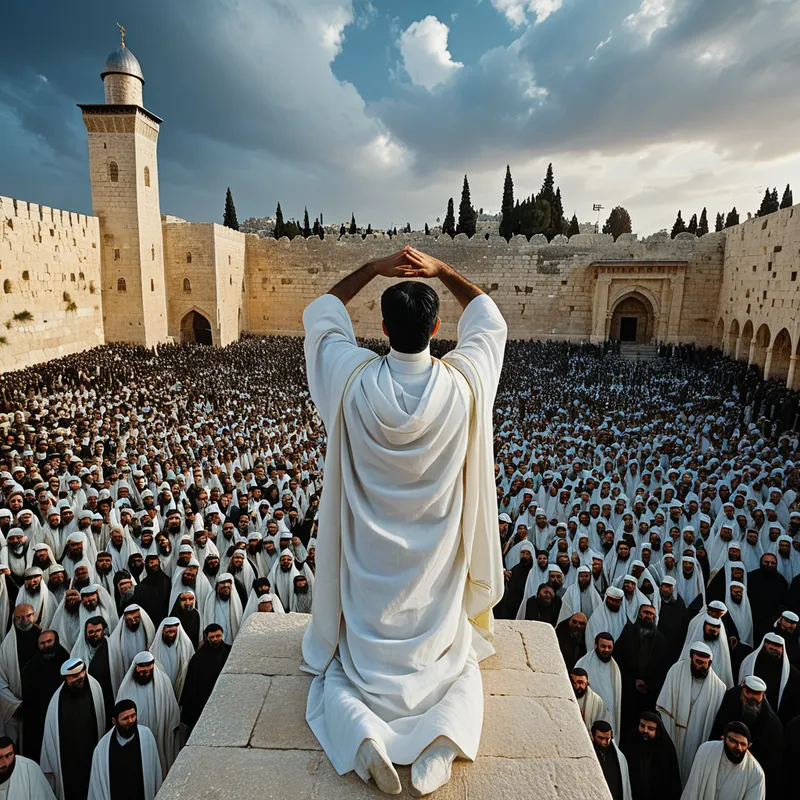
The air in [Jerusalem](/myths/jerusalem “Myth from Biblical culture.”/) hung thick, not with desert heat, but with a collective, unspoken weight. It was the tenth day of the seventh month, the Day of Atonement, Yom Kippur. A silence deeper than mere quiet had settled over the people, a stillness born of profound reckoning. All labors had ceased. All appetites were denied. The nation stood, breath held, before the memory of its own transgressions.
At the center of this suspended world stood one man: the High Priest. Stripped of his usual golden splendor, he was clad only in simple, holy linen, white as a sun-bleached bone. His purity was not for glory, but for a perilous journey. Today, he would pass through [the veil](/myths/the-veil “Myth from Various culture.”/) not of cloth, but of mortality itself, entering the Holy of Holies, the dwelling place of the [Tetragrammaton](/myths/tetragrammaton “Myth from Kabbalistic culture.”/). The scent of incense meant to cloud his vision from overwhelming glory clung to his robes.
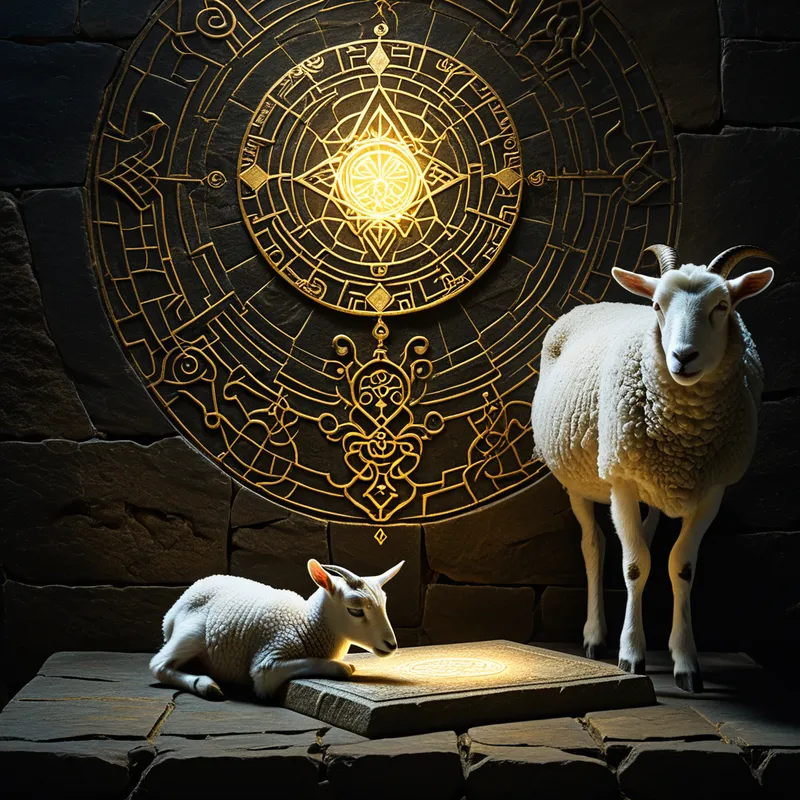
Outside [the Temple](/myths/the-temple “Myth from Jewish culture.”/), the people waited. And with them waited two goats, chosen by sacred lot. They were twins in form, a mirror of fate. Their coats, one perhaps lighter, one darker, were irrelevant. Their destiny was written by the trembling hand of chance. The lot was cast—clattering stones inscribed with “For YHWH” and “For Azazel.” One goat was designated for sacrifice, its blood to be sprinkled in the most sacred place, a covenant renewed in crimson. The other was set apart, alive.
This second goat stood, unaware. The High Priest emerged from the cloud of the Holy Place, his face etched with the terror and awe of his encounter. He approached the living goat. The crowd’s silence intensified into a palpable force. He laid both his hands upon the animal’s head, and in a voice that carried the gravity of [the world](/myths/the-world “Myth from Tarot culture.”/), he confessed. He poured into the goat’s twitching ears not his own sins, but the iniquities, the rebellions, the failings of the entire people of Israel. Word by word, sin by sin, the intangible guilt of a nation was transferred, laid upon the hairy back of the beast.
Then, a designated man, one chosen for this grim task, took the rope. The goat, now a living container of sacred contamination, was led away. Not with ceremony, but with urgency. Through the city gates, past the staring eyes of the people, and out into the unforgiving wilderness. They journeyed to a place of cutting off, a land of Gezera. No altar awaited here, only desolation. The attendant, his duty one of expulsion, not sacrifice, pushed the goat over a precipice or sent it stumbling into the barren wastes. It carried everything away—the quarrels, the betrayals, the hidden shames. The people, watching the speck disappear into the haze of [the desert](/myths/the-desert “Myth from Biblical culture.”/), felt not joy, but a profound, clean emptiness. The weight was gone. Borne away into [the wilderness](/myths/the-wilderness “Myth from Biblical culture.”/), to Azazel. The atonement was complete.

Cultural Origins & Context
This ritual, meticulously prescribed in the Book of Leviticus (Chapter 16), was [the cornerstone](/myths/the-cornerstone “Myth from Biblical culture.”/) of the most sacred day in the Jewish liturgical year. It was not a folktale told by bards, but a precise, priestly technology of the sacred, performed annually to maintain the cosmic and social order. Its transmission was formal, embedded in the Torah, and its execution was the sole responsibility of the Aaronid priesthood.
Societally, its function was paramount. Ancient Israelite religion understood sin not merely as a personal moral failing, but as a tangible miasma, a contaminating force that could pollute [the Tabernacle](/myths/the-tabernacle “Myth from Biblical culture.”/) (and later, the Temple) itself, jeopardizing the entire community’s relationship with the divine. The ritual served as a collective psychic hygiene. The sacrifice of the first goat (for YHWH) dealt with sanctity, purifying the holy place. The expulsion of the second (for Azazel) dealt with impurity, removing the accrued corruption from the communal body. It was a drama of division and removal, ensuring that holiness and profanity, the sacred and the polluted, were kept in their proper, separate realms for the community’s survival.
Symbolic Architecture
The myth’s power lies in its stark, binary [symbolism](/symbols/symbolism “Symbol: The use of symbols to represent ideas or qualities, often conveying deeper meanings beyond literal interpretation. In dreams, it’s the language of the unconscious.”/). The two goats represent a fundamental psychic split: the part of [the self](/myths/the-self “Myth from Jungian culture.”/) that can be redeemed through sacrifice and [integration](/symbols/integration “Symbol: The process of unifying disparate parts of the self or experience into a cohesive whole, often representing psychological wholeness or resolution of internal conflict.”/) (the [goat](/symbols/goat “Symbol: The goat symbolizes independence, resilience, and various traits associated with adaptability across diverse cultures.”/) for YHWH), and the part that must be consciously, ritually expelled (the [goat](/symbols/goat “Symbol: The goat symbolizes independence, resilience, and various traits associated with adaptability across diverse cultures.”/) for Azazel).
The scapegoat is not evil incarnate, but the conscious carrier of acknowledged shadow. It is the designated vessel for what the community knows, yet cannot integrate.
The Kohen Gadol acts as the mediating [consciousness](/symbols/consciousness “Symbol: Consciousness represents the state of awareness and perception, encompassing thoughts, feelings, and experiences.”/), [the ego](/myths/the-ego “Myth from Jungian culture.”/) that must interface between the collective and the numinous. His [confession](/symbols/confession “Symbol: The act of revealing hidden truths, secrets, or wrongdoings, often to relieve guilt, seek forgiveness, or achieve psychological liberation.”/) with hands upon the goat is an act of profound psychological transference—making the unconscious conscious by projecting it onto a concrete, expendable form. The [wilderness](/symbols/wilderness “Symbol: Wilderness often symbolizes the untamed aspects of the self and the unconscious mind, representing a space for personal exploration and discovery.”/), Azazel’s domain, symbolizes the unconscious itself: the trackless, amoral psychic [space](/symbols/space “Symbol: Dreaming of ‘Space’ often symbolizes the vastness of potential, personal freedom, or feelings of isolation and exploration in one’s life.”/) where that which we disown is banished. The [ritual](/symbols/ritual “Symbol: Rituals signify structured, meaningful actions carried out regularly, reflecting cultural beliefs and emotional needs.”/) does not destroy the [shadow](/symbols/shadow “Symbol: The ‘shadow’ embodies the unconscious, repressed aspects of the self and often represents fears or hidden emotions.”/); it relocates it, creating a temporary, sacred cleanliness by drawing a clear [boundary](/symbols/boundary “Symbol: A conceptual or physical limit defining separation, protection, or identity between entities, spaces, or states of being.”/) between “us” and “it.”
The Dreamer’s Resonance
When this myth stirs in modern dreams, it rarely appears as biblical pageantry. Instead, one may dream of frantically packing a suitcase with rotten, shameful objects and leaving it at a distant train station. One may dream of a pet or a familiar animal turning away, burdened with the dreamer’s sadness, and walking into a fog. One may dream of scrubbing a house clean only to find a single, filthy room that must be sealed off forever.
These are somatic dreams of expulsion. The dreamer is undergoing a process of psychic sorting, where some emotional content—a resentment, a guilt, a trait deemed unacceptable—has reached a critical mass. The [psyche](/myths/psyche “Myth from Greek culture.”/), in its ancient wisdom, is attempting its own Yom Kippur. The feeling upon waking is often one of relief mixed with unease: a burden has been named and removed, but the dream highlights the cost of that removal. The process is not one of healing through integration, but of survival through excision. It signals a [psyche](/myths/psyche “Myth from Greek culture.”/) temporarily opting for the cleanliness of separation over the difficult work of reconciliation.

Alchemical Translation
For the modern individual seeking individuation, [the Scapegoat](/myths/the-scapegoat “Myth from Christian culture.”/) Ritual presents a critical early stage, not an end goal. The alchemical work begins with the ritual’s first, honest step: the confession. This is the [nigredo](/myths/nigredo “Myth from Alchemical culture.”/), the blackening, where one must consciously lay hands upon one’s own “goat”—the repressed anger, the narcissistic wound, the childish greed—and name it aloud to oneself.
The true alchemy begins when we stop driving the goat into the wilderness and instead dare to follow it, to meet Azazel in his own domain.
The primitive ritual ends with expulsion for the sake of communal purity. The alchemical translation, however, requires a second, more perilous journey. One must later venture into that personal wilderness—the felt sense of depression, rage, or shame—not to banish the goat, but to retrieve it. This is the albedo, the whitening. The goal is not to reintegrate the raw, destructive impulse, but to extract the latent energy and purpose trapped within it. The rage may hold a core of righteous self-protection. The shame may guard a profound sensitivity. The “sin” cast out often contains a disowned power. By bringing the symbol of the [scapegoat](/myths/scapegoat “Myth from Biblical culture.”/) back from the demonized wilderness and sacrificing it on the inner altar of conscious understanding, its essence is transmuted. The burden becomes a lesson; the expelled fragment returns as strength. The ritual of separation thus becomes the first, necessary step in the longer, more sacred work of paradoxical reunion.
Associated Symbols
Explore related symbols from the CaleaDream lexicon: