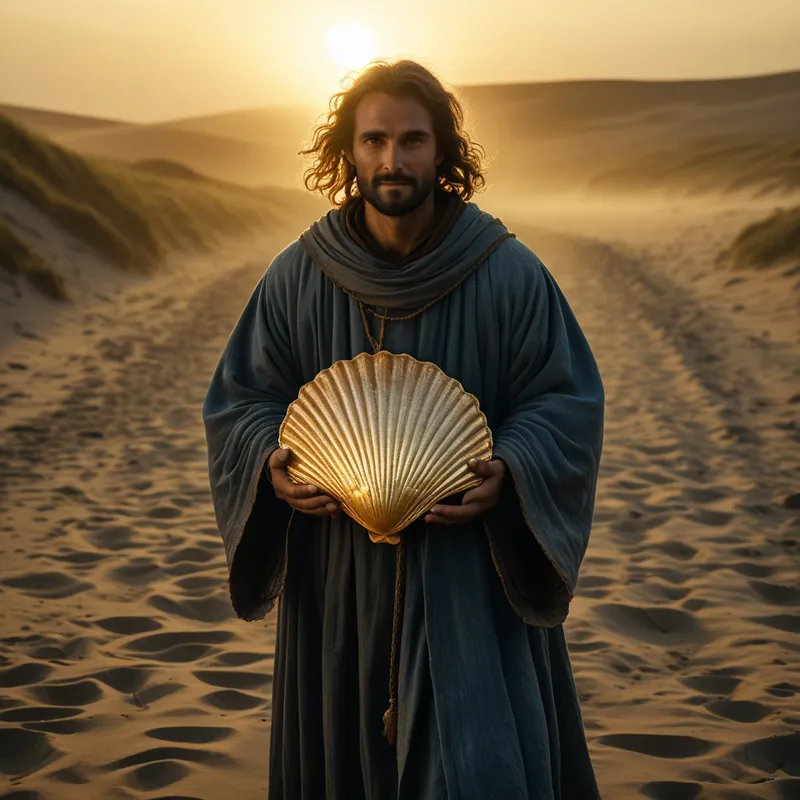
The Scallop Pilgrim Badge Myth Meaning & Symbolism
A myth of a pilgrim, a shell, and the sacred journey that transforms the wanderer into a vessel of divine grace.
The Tale of The Scallop Pilgrim Badge
Listen, and hear a tale not of kings or dragons, but of dust and longing.
Once, there was a soul who was not lost, but was profoundly away. They dwelt in the comfortable shadows of their own valley, where the sun was familiar and the paths were well-trodden. Yet, in the quiet of the night, a strange wind would whisper—a wind that carried the scent of salt and distant stone. It spoke of a place where the sun died gloriously into [the sea](/myths/the-sea “Myth from Greek culture.”/), at the very edge of the known world, where the bones of a saint lay dreaming. This whisper became an ache, a thorn in the spirit. [The world](/myths/the-world “Myth from Tarot culture.”/) of home grew thin, translucent, and the call from beyond its borders grew into a roar they could no longer ignore.
And so, they became a pilgrim. They left without fanfare, exchanging their fine cloak for one of coarse wool, their sturdy shoes for sandals that would know a thousand leagues. The road was not a single path but a unraveling of all paths—through dark forests where the trees seemed to watch, over mountains that scraped [the sky](/myths/the-sky “Myth from Persian culture.”/) with teeth of granite, across plains where [the wind](/myths/the-wind “Myth from Various culture.”/) was the only companion. Hunger was their spice, thirst their wine, and blisters their unwanted jewels.
They met others on [the way](/myths/the-way “Myth from Taoist culture.”/), each bearing the same hollow look and the same fierce light in the eyes. They shared black bread and stories in the firelight, their tongues loosened by shared hardship. Some fell to sickness, or to bandits, or to the deeper sickness of despair, their journey ending in a ditch by the roadside, a silent testament. [The pilgrim](/myths/the-pilgrim “Myth from Christian culture.”/) walked on, their heart a heavy stone.
Then, one evening, as the sky bled purple over a final, relentless hill, they saw it: the endless silver sheet of the ocean. And where the land frayed into the waves, a city of spires and bells—Santiago de Compostela. The journey’s end. A sob, half relief, half grief, escaped them. At the great cathedral, amidst the incense and the chanting, they completed their rites. But the true gift was given not in the echoing nave, but afterwards, by the shore.
An old keeper, his face a map of sea and salt, pressed a simple scallop shell into their hand. It was cool and solid, its grooves fanning out like rays of stone. “Take this,” he said, his voice like shifting shingle. “It is your proof. But more, it is your reminder. The grooves that meet at a single point—they are the many roads that led you here. The shell that once housed life in the deep—it is what you have become. You are no longer just a person from a valley. You are a vessel that has carried a sacred thirst across the world, and has been filled.”
The pilgrim tied the shell to their pack. The long road home awaited, but they were different. The shell tapped gently against their side with every step, a quiet, rhythmic music. It was no longer a badge of arrival, but a compass for the soul. They had walked to the end of [the earth](/myths/the-earth “Myth from Hindu culture.”/), and had found, in a shell, the map to their own center.
Cultural Origins & Context
This is not a myth confined to a single parchment, but one etched into the landscape of Europe itself—[the Camino de Santiago](/myths/the-camino-de-santiago “Myth from Christian culture.”/). Emerging in the 9th century after the purported discovery of the tomb of Saint James the Apostle in northwestern Spain, the pilgrimage became one of the three great pilgrimages of Christendom, alongside Rome and [Jerusalem](/myths/jerusalem “Myth from Biblical culture.”/). The myth of the scallop badge is woven into the very fabric of this historical phenomenon.
It was passed down not by bards in halls, but by thousands upon thousands of anonymous feet. It was told in hospice refuges, at crossroads, and in the silent language of shared blisters and donated bread. Its primary tellers were the pilgrims themselves and the communities that sprang up to support them. The scallop shell (Pecten), abundant on the Galician coast, became the universal, pre-literate symbol of this journey. It functioned as a practical badge of honor and safe passage, identifying the pilgrim to receive charity and shelter. Societally, it reinforced a powerful cultural narrative: that transformative grace is earned not through stationary prayer alone, but through the sacred, somatic act of journeying—of literally walking one’s faith into being.
Symbolic Architecture
The [shell](/symbols/shell “Symbol: Shells are often seen as symbols of protection, transition, and the journey of personal growth.”/) is a perfect symbolic [vessel](/symbols/vessel “Symbol: A container or structure that holds, transports, or protects something essential, representing the self, emotions, or life journey.”/), containing multitudes within its simple form.
The pilgrim’s path is an outward journey that mirrors the inward descent; each step on the dusty road is a step deeper into the self.
Firstly, it is a [symbol](/symbols/symbol “Symbol: A symbol can represent an idea, concept, or belief, serving as a powerful tool for communication and understanding.”/) of the [journey](/symbols/journey “Symbol: A journey in dreams typically signifies adventure, growth, or a significant life transition.”/) itself. Its grooves, converging at a single [hinge](/symbols/hinge “Symbol: A jointed device allowing movement between two fixed parts, symbolizing transition, connection, and flexibility in life’s architecture.”/), mirror the many disparate paths—the [French](/symbols/french “Symbol: The term ‘French’ often evokes notions of romance, sophistication, and cultural richness, suggesting aspirations or appreciation of beauty and elegance in life.”/) Way, the Northern Way, the Portuguese Way—all leading to one sacred point. It represents the unification of multiplicity into purposeful [direction](/symbols/direction “Symbol: Direction in dreams often relates to life choices, guidance, and the path one is following, emphasizing the importance of navigation in personal journeys.”/). Psychologically, this speaks to the [integration](/symbols/integration “Symbol: The process of unifying disparate parts of the self or experience into a cohesive whole, often representing psychological wholeness or resolution of internal conflict.”/) of the [personality](/symbols/personality “Symbol: Personality in dreams often symbolizes the traits and characteristics of the dreamer, reflecting how they perceive themselves and how they believe they are perceived by others.”/)’s scattered fragments (the complex, the disparate desires, the conflicting impulses) toward a central, organizing principle—[the Self](/myths/the-self “Myth from Jungian culture.”/).
Secondly, it is an [emblem](/symbols/emblem “Symbol: A symbolic design representing identity, authority, or ideals, often used in heraldry, logos, or artistic expression.”/) of [vulnerability](/symbols/vulnerability “Symbol: A state of emotional or physical exposure, often involving risk of harm, that reveals authentic self beneath protective layers.”/) and sustenance. The empty shell, once the home of a soft [creature](/symbols/creature “Symbol: Creatures in dreams often symbolize instincts, primal urges, and the unknown aspects of the psyche.”/), is open. Pilgrims used it as a crude cup to drink from streams or to receive alms of [food](/symbols/food “Symbol: Food in dreams often symbolizes nourishment, both physical and emotional, representing the fulfillment of basic needs as well as deeper desires for connection or growth.”/). This represents the necessary state of the [seeker](/symbols/seeker “Symbol: A person actively searching for meaning, truth, or a higher purpose, often representing the dreamer’s own quest for identity or fulfillment.”/): one must become hollow, open, and dependent to receive. It is the [death](/symbols/death “Symbol: Symbolizes transformation, endings, and new beginnings; often associated with fear of the unknown.”/) of the armored, self-sufficient ego, making [room](/symbols/room “Symbol: A room in a dream often symbolizes the self, representing personal space, mental state, or aspects of one’s identity.”/) for the grace of the world (and the transcendent) to enter.
Finally, it is an ancient symbol of [birth](/symbols/birth “Symbol: Birth symbolizes new beginnings, transformation, and the potential for growth and development.”/) and resurrection. Visually, it echoes the setting sun dipping into the sea at Finisterre, and by association, the promise of a new [dawn](/symbols/dawn “Symbol: The first light of day, symbolizing new beginnings, hope, and the transition from darkness to illumination.”/). It is also linked to the myth of [Venus](/myths/venus “Myth from Alchemical culture.”/) born from the sea-[foam](/symbols/foam “Symbol: Foam represents ephemeral boundaries, cleansing processes, and the tension between substance and emptiness. It symbolizes what appears solid but dissolves easily.”/), transmuted into a [Christian](/symbols/christian “Symbol: The symbol represents the faith, teachings, and cultural values associated with Christianity, including themes of love, salvation, and morality.”/) context as [rebirth](/symbols/rebirth “Symbol: A profound transformation where old aspects of self or life die, making way for new beginnings, growth, and renewal.”/) through baptismal waters. The pilgrim dies to their old [life](/symbols/life “Symbol: The symbol of ‘Life’ represents a journey of growth, interconnectedness, and existential meaning, encompassing both the joys and challenges that define human experience.”/) and is born anew on the road.
The Dreamer’s Resonance
When the symbol of the scallop pilgrim badge surfaces in modern dreams, it rarely appears as a historical artifact. It emerges as a feeling, an image, or a scenario soaked in the myth’s essence. One might dream of finding a strangely textured shell on a city sidewalk, of being compelled to walk a never-ending hallway, or of feeling a profound, aching need to travel to a place they cannot name.
These dreams signal a [psyche](/myths/psyche “Myth from Greek culture.”/) initiating a process of individuation</ab- br>. The somatic process is one of restlessness—a psychological itch that cannot be scratched in the current environment. The dream-ego is sensing that its growth has stagnated in the “valley” of familiar attitudes, relationships, or self-concepts. The pilgrimage in the dream represents the [psyche](/myths/psyche “Myth from Greek culture.”/)’s demand for a crucible, for an ordeal that will force a shedding of the outworn self. The anxiety in such dreams is not about danger, but about the monumental effort required and the fear of the unknown self that may be discovered. The shell, when it appears, is a reassuring sign from the unconscious: you are on the path, and you are protected by the very structure of the journey itself.
Alchemical Translation
The myth of the Scallop Pilgrim Badge is a precise alchemical manual for psychic transmutation. It outlines the opus ([the great work](/myths/the-great-work “Myth from Alchemical culture.”/)) of the soul in three distinct stages.
[The first stage](/myths/the-first-stage “Myth from Alchemical culture.”/), [Nigredo](/myths/nigredo “Myth from Alchemical culture.”/) (the blackening), is the initial call—the discontent, the thorn, the whisper that turns home into a prison. This is the necessary decay of the old, complacent identity. The pilgrim’s decision to leave is the first act of self-negation for a higher purpose.
The second stage, Albedo (the whitening), is the journey itself—the purification through ordeal. The wearing down of the body on the road is the wearing away of [the ego](/myths/the-ego “Myth from Jungian culture.”/)’s defenses. The shared suffering, the silence, the exposure to the elements: this is the soul being scoured clean, whitened like a sun-bleached shell on the shore. The meeting point of the many grooves is the nascent, emerging core Self coming into focus.
The badge is not earned at the destination, but forged in the walking. It is the psyche’s own seal, confirming the transformation has already occurred.
The final stage, [Rubedo](/myths/rubedo “Myth from Alchemical culture.”/) (the reddening), is not merely the arrival at the cathedral, but the acceptance of the shell and the return home. This is the integration. The gold of the completed work is not a material trophy, but the transformed consciousness. The pilgrim returns to their valley, but they are now [the stranger](/myths/the-stranger “Myth from Biblical culture.”/) who carries the world within them. The shell badge is the tangible proof of the completed cycle—the inert, base material of a former life has been transmuted into a sacred symbol, a permanent touchstone of the journey from seeking to becoming. For the modern individual, this myth teaches that wholeness is not a state to be achieved at a finish line, but a path to be walked, one step at a time, with an open heart and a shell tied to your pack.
Associated Symbols
Explore related symbols from the CaleaDream lexicon: