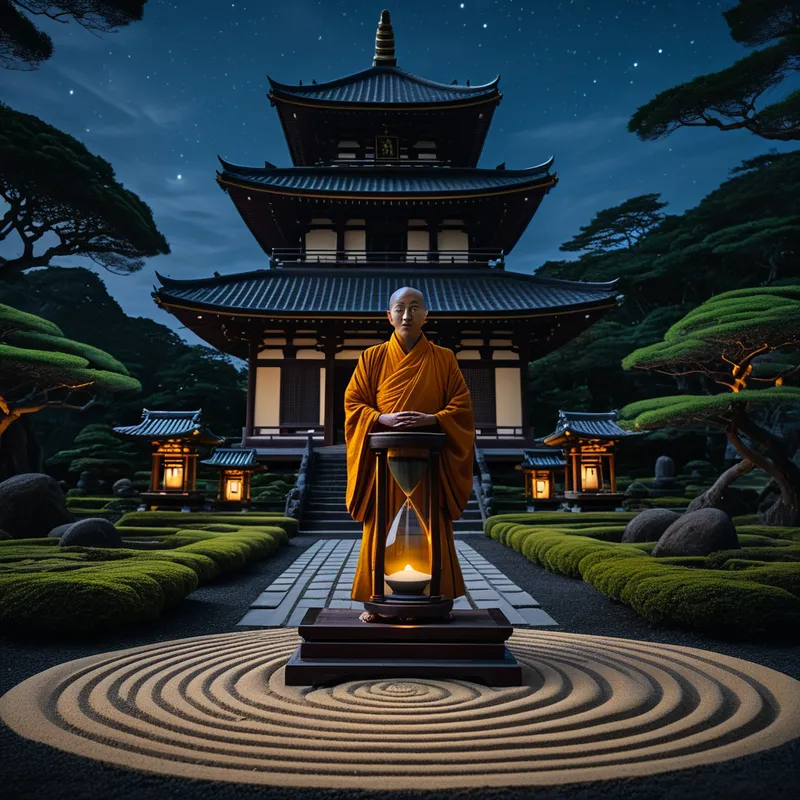
The Sands of Time in Buddhist imagery Myth Meaning & Symbolism
A tale of a monk confronting the cosmic hourglass, learning that enlightenment lies not in stopping time, but in flowing with its endless, sacred stream.
The Tale of The Sands of Time in Buddhist imagery
Listen. In the deep mountains, where mist clings to ancient cedars like a forgotten prayer, there was a temple known as Fumetsu no Toki-dera. Here lived a monk named Chie no Tsuki. He was a diligent seeker, mastering sutras, sitting in perfect zazen, yet a thorn of anguish festered in his heart. He saw the cherry blossoms fall, his teacher’s face grow lined, and the relentless decay of all things. He feared time—the great thief of moments.
One night, during the Higan observance, a dream-vision seized him. A path of silver moonlight, cold as a river, appeared on [the temple](/myths/the-temple “Myth from Jewish culture.”/)’s wooden veranda. Compelled, he followed it deep into the mountain’s heart, to a cavern he had never seen. The air hummed with a profound silence, the silence between heartbeats.
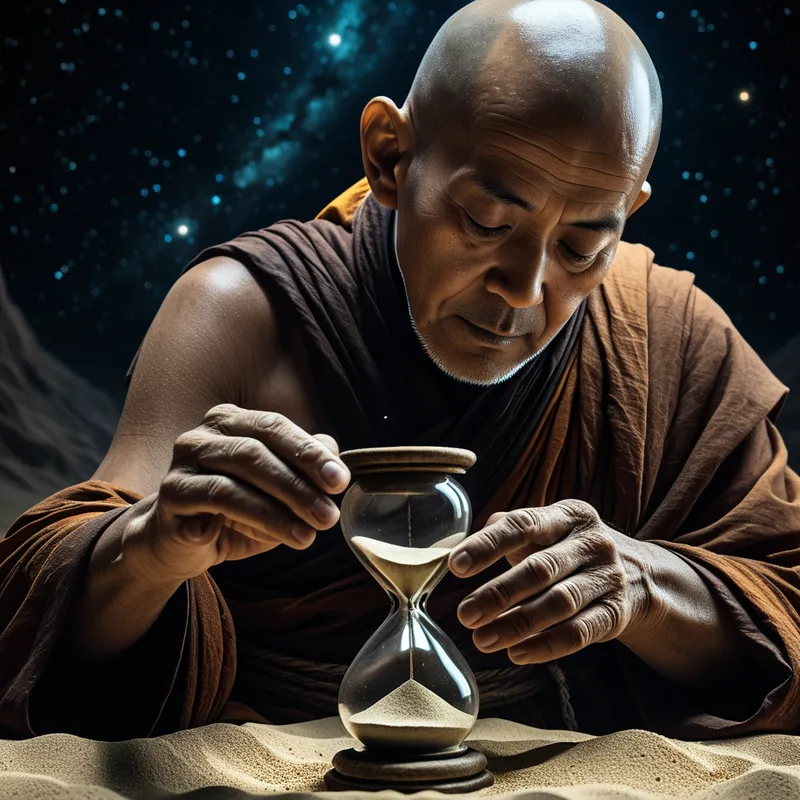
In the cavern’s center, floating in a shaft of ethereal light, was the Rinne no Sunadokei. It was colossal, its frames crafted from petrified sakaki wood, its glass spheres containing not mere sand, but swirling galaxies of infinitesimal moments—each grain a laugh, a tear, a falling leaf, a dying breath. The sands flowed from the upper chamber to the lower with a soft, eternal hiss, the very sound of existence passing.
Chie no Tsuki fell to his knees, overcome. Here was the engine of [samsara](/myths/samsara “Myth from Buddhist culture.”/) itself. His lifelong fear crystallized before him. In a surge of desperate compassion for all suffering beings, he cried out to [the void](/myths/the-void “Myth from Buddhist culture.”/), “Stop! Let this suffering cease!” He reached out, his fingers brushing the ancient wood. And it stopped.
The hissing ceased. The universe held its breath. For a moment, there was perfect, absolute stillness. No wind, no rustle, no pulse in his own throat. Then, the horror dawned. The cavern’s light froze. The dust motes in the air became jagged, crystalline prisons. The warmth fled from his own body. He saw, in the suspended sands, a billion moments trapped—a child’s unfulfilled smile, a healing wound halted mid-stitch, a song caught forever on a single note. This was not peace; it was a cosmic death, the end of becoming. He had not conquered time; he had murdered life.
Tears of true understanding, hot and alive, broke the spell of his own arrogance. He bowed his head to the floor, his prayer now one of utter surrender. “Forgive my foolishness. Let it flow. Let all things be as they must be.” As his tear touched the stone, a single grain of sand, glowing like a tiny sun, broke free from the mass and drifted onto his kneeling form. With a sound like a deep, cosmic sigh, the sands began to flow again. The hiss returned, sweeter now than any [temple bell](/myths/temple-bell “Myth from Buddhist culture.”/). He returned to his temple at dawn, not with a secret of how to stop time, but with the grace to hear its sacred, flowing song in the chant of his brothers and [the fall](/myths/the-fall “Myth from Biblical culture.”/) of the rain.
Cultural Origins & Context
This narrative is not a single, canonical scripture, but a hōgo—a teaching tale that crystallized within the rich soil of Japanese Zen Buddhism during the Kamakura and Muromachi periods. It is a folk-philosophical myth, passed down not by named authors but by rōshi and storytellers in temple courtyards and around hearths. Its function was deeply pedagogical, designed to illustrate the core Buddhist doctrine of mujō in a way that bypassed intellectual argument and struck directly at the heart’s anxiety.
The imagery synthesizes native Japanese aesthetic sensitivity to ephemerality—[mono no aware](/myths/mono-no-aware “Myth from Japanese culture.”/), often evoked by cherry blossoms and autumn leaves—with the sophisticated cosmological models of Mikkyō. [The hourglass](/myths/the-hourglass “Myth from Various culture.”/) itself is a distinctly non-Eastern object, suggesting a point of cultural exchange, but its filling with “moments” instead of inert sand transforms it into a perfect vessel for Buddhist thought. It served society as a narrative tool to reconcile the human terror of death with the spiritual imperative to embrace change, fostering a cultural attitude of mindful appreciation for the fleeting now.
Symbolic Architecture
The myth’s power lies in its stark symbolic [architecture](/symbols/architecture “Symbol: Architecture in dreams often signifies structure, stability, and the framing of personal identity or life’s journey.”/). The Rinne no Sunadokei is the ultimate [symbol](/symbols/symbol “Symbol: A symbol can represent an idea, concept, or belief, serving as a powerful tool for communication and understanding.”/) of mujō and engi. Each [grain](/symbols/grain “Symbol: Represents sustenance, growth cycles, and the foundation of civilization. Symbolizes life’s harvest, patience, and transformation from seed to nourishment.”/) is a [kshana](/myths/kshana “Myth from Hindu culture.”/), the indivisible [unit](/symbols/unit “Symbol: Represents wholeness or completeness within the dream narrative.”/) of temporal experience, yet each is interconnected, flowing to create the [river](/symbols/river “Symbol: A river often symbolizes the flow of emotions, the passage of time, and life’s journey, reflecting transitions and movement in one’s life.”/) of causality.
The hourglass does not measure time; it is time. To grasp it is to be crushed by the weight of a universe in motion.
The monk, Chie no Tsuki, represents the egoic mind, the part of [consciousness](/symbols/consciousness “Symbol: Consciousness represents the state of awareness and perception, encompassing thoughts, feelings, and experiences.”/) that seeks permanence, control, and an escape from suffering. His initial [quest](/symbols/quest “Symbol: A quest symbolizes a journey or search for purpose, fulfillment, or knowledge, often representing life’s challenges and adventures.”/) is noble—the end of suffering—but it is rooted in aversion, a fundamental misunderstanding of [reality](/symbols/reality “Symbol: Reality signifies the state of existence and perception, often reflecting one’s understanding of truth and life experiences.”/). His act of stopping the flow is the ultimate [expression](/symbols/expression “Symbol: Expression represents the act of conveying thoughts, emotions, and individuality, emphasizing personal communication and creativity.”/) of spiritual bypassing, attempting to achieve enlightenment by rejecting the very fabric of existence. The resulting frozen hellscape reveals the [truth](/symbols/truth “Symbol: Truth represents authenticity, honesty, and the quest for knowledge beyond mere appearances.”/): [life](/symbols/life “Symbol: The symbol of ‘Life’ represents a journey of growth, interconnectedness, and existential meaning, encompassing both the joys and challenges that define human experience.”/) is the flow. [Stasis](/symbols/stasis “Symbol: A state of inactivity, equilibrium, or suspension where no change or progress occurs, often representing psychological or existential paralysis.”/) is not [nirvana](/symbols/nirvana “Symbol: A state of ultimate liberation, enlightenment, and cessation of suffering, representing the end of the spiritual journey.”/); it is the antithesis of being.
The single, glowing grain that alights upon him is the gift of satori. It is not the cessation of experience, but a transformed [relationship](/symbols/relationship “Symbol: A representation of connections we have with others in our lives, often reflecting our emotional state.”/) to it. He becomes the conscious [vessel](/symbols/vessel “Symbol: A container or structure that holds, transports, or protects something essential, representing the self, emotions, or life journey.”/) for a single [moment](/symbols/moment “Symbol: The symbol of a ‘moment’ embodies the significance of transient experiences that encapsulate emotional depth or pivotal transformations in life.”/), fully accepting its [arrival](/symbols/arrival “Symbol: The act of reaching a destination, marking the end of a journey and the beginning of a new phase or state.”/) and its passing. This is the shift from [chronos](/symbols/chronos “Symbol: Ancient Greek personification of time as a destructive, all-devouring force, representing inevitable change, decay, and the cyclical nature of existence.”/) (quantitative, relentless time) to [kairos](/myths/kairos “Myth from Global/Universal culture.”/) (the qualitative, sacred right [moment](/symbols/moment “Symbol: The symbol of a ‘moment’ embodies the significance of transient experiences that encapsulate emotional depth or pivotal transformations in life.”/)).
The Dreamer’s Resonance
When this myth stirs in the modern dreamer’s [psyche](/myths/psyche “Myth from Greek culture.”/), it often manifests as dreams of frozen clocks, stuck elevators, or being trapped in glue or amber. The somatic experience is one of suffocation, paralysis, and profound anxiety. Psychologically, this indicates a confrontation with what we might call “Process Arrest.”
The dreamer is likely facing a life transition—an aging parent, a career change, the end of a relationship, or simply the terrifying pace of their own life—and the psyche’s instinct is to stop the process to avoid the impending pain or uncertainty. The dream is a dramatic enactment of [the ego](/myths/the-ego “Myth from Jungian culture.”/)’s futile attempt to control the uncontrollable. The resulting nightmare of frozen life is [the Self](/myths/the-self “Myth from Jungian culture.”/)’s corrective message: “Your attempt to avoid suffering by stopping time is creating a deeper, living death. The pain of flow is life; the peace of stasis is oblivion.”
Alchemical Translation
The myth models the alchemical opus of individuation not as a quest to obtain a golden stasis, but as the courage to submit to the transformative fire of time itself. The monk’s journey is a perfect map: [nigredo](/myths/nigredo “Myth from Alchemical culture.”/) (the blackening) is his initial anguish and fear of [impermanence](/myths/impermanence “Myth from Buddhist culture.”/). albedo (the whitening) is his illuminating, yet arrogant, vision of the cosmic mechanism—clarity without wisdom. His act of stopping the flow is a false [rubedo](/myths/rubedo “Myth from Alchemical culture.”/), a pseudo-transformation that leads not to the philosopher’s stone, but to the frozen, sterile crystal.
True gold is not forged in the arrest of process, but in the conscious, compassionate participation in it.
The real rubedo, the reddening or culmination, is his tearful surrender. This is the dissolution of the ego’s project of control. He does not become the master of time; he becomes its humble, awakened witness. The glowing grain is the [lapis philosophorum](/myths/lapis-philosophorum “Myth from Alchemical culture.”/)—the realized Self that understands its nature as both a transient grain and the entire, flowing stream. For the modern individual, the alchemical translation is this: healing and wholeness are found not in eliminating our wounds, anxieties, or aging, but in letting them flow through us, learning their lessons, and recognizing our identity as the spacious awareness that contains the entire, beautiful, painful, and ever-changing procession. We must, as the myth instructs, learn to hear the sacred hiss of the sands in our own breath.
Associated Symbols
Explore related symbols from the CaleaDream lexicon: