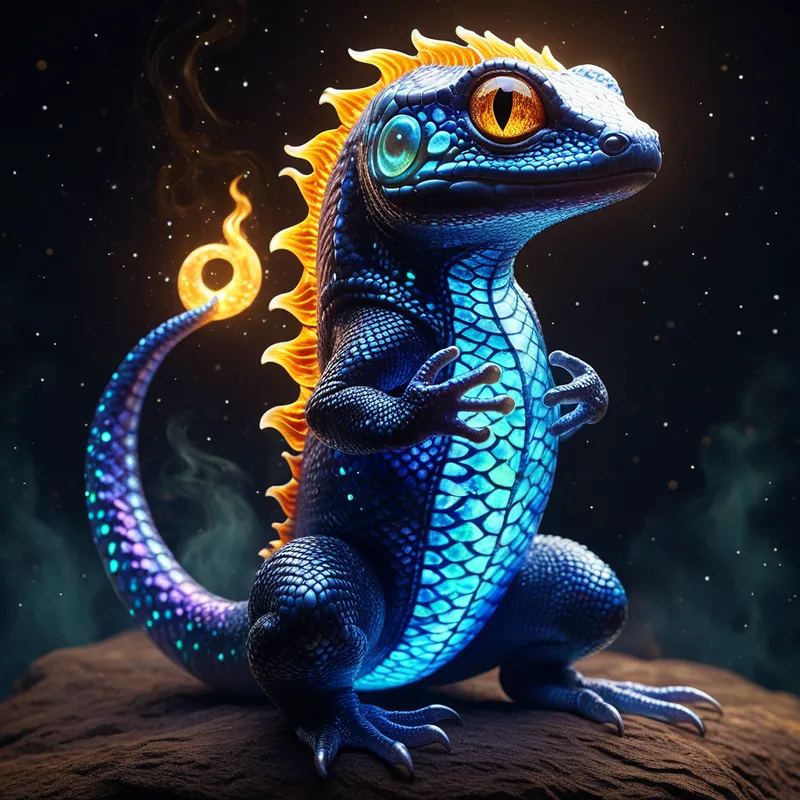
The Salamander Myth Meaning & Symbolism
A creature born in the furnace of the cosmos, the Salamander embodies the soul's ability to be purified and reborn in the crucible of its own inner fire.
The Tale of The Salamander
Listen, and hear the tale whispered not on [the wind](/myths/the-wind “Myth from Various culture.”/), but in the crackle of [the hearth](/myths/the-hearth “Myth from Norse culture.”/)-fire and the hiss of molten lead in [the crucible](/myths/the-crucible “Myth from Alchemical culture.”/). In the beginning, before the first philosopher’s stone was dreamed of, there was only [the Prima Materia](/myths/the-prima-materia “Myth from Alchemical culture.”/)—the chaotic, dark, and moist soul of [the world](/myths/the-world “Myth from Tarot culture.”/). And within that womb of potential slept a spark, a longing for form.
From the forge of the stars, the Ignis Aeternus descended. It did not strike [the earth](/myths/the-earth “Myth from Hindu culture.”/) as lightning, but seeped into it as a fever, heating the deep veins of ore and the secret waters under the mountains. The earth groaned in a labor of heat and pressure. And from this union of cosmic fire and telluric mud, in the absolute darkness of the world’s first furnace, a shape stirred.
It was not born; it was kindled.
It was the [Salamander](/myths/salamander “Myth from Alchemical culture.”/). Its skin was not scale nor flesh, but the very patina of flame given texture—a living ember, cool to its own touch but radiant with an inner sun. It did not crawl; it flowed, a rivulet of liquid gold through cracks in bedrock. It did not breathe air, but the exhalation of metals deep in the earth. Its home was not a forest or a stream, but the heart of the conflagration, the blinding white center of [the alchemist](/myths/the-alchemist “Myth from Various culture.”/)’s fire where all things are taken apart.
For eons, it slept in those subterranean fires, a secret guardian of the transformative principle. Then came the Seekers—those men and women with soot under their nails and stars in their eyes. They built their athanors and stirred their alembics, seeking to compel nature to reveal her secrets. They sought the Salamander, not as prey, but as witness and guide.
The greatest of them, a woman known only as Maria Practica, prepared her ultimate work. For seven years she purified, for seven years she combined, and for a final seven days and nights, she fed the furnace until the bricks glowed like a second sunset. Into the crucible went the final matter—the [prima materia](/myths/prima-materia “Myth from Alchemical culture.”/) of her own soul, all her doubt, fear, and longing made tangible.
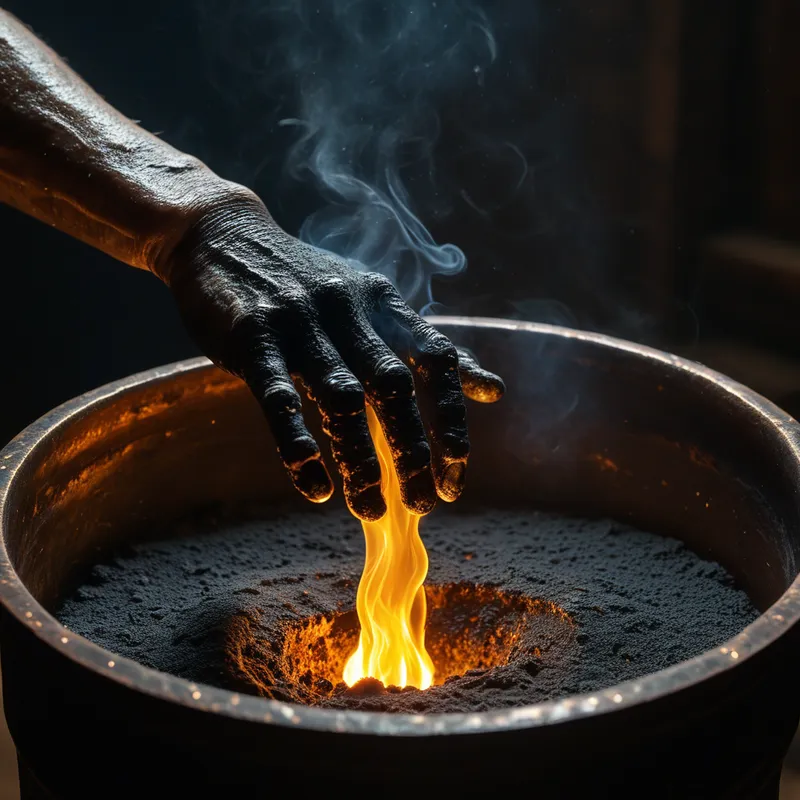
The fire roared, consuming the offering. The crucible became a tiny sun in her workshop. And as the metal within reached its peak, not melting but dissolving into a shimmering, mercurial essence, a shape moved within the light. From the very center of the liquefied gold, the Salamander emerged. It climbed the lip of the crucible, its feet leaving no burn, only a trail of cooling, perfect metal. It looked at Maria, its eyes holding the calm of the fire after the storm of burning. It did not speak, but in that look was transmitted the entire secret: the fire does not destroy; it reveals the true, incorruptible form hidden within. Then, its work as witness complete, it flowed back into the coals and was gone. Left behind in the crucible was not gold, but a seed of light—the first true glimpse of the [Lapis Philosophorum](/myths/lapis-philosophorum “Myth from Alchemical culture.”/). The Salamander had not given her the stone; it had shown her the nature of the flame necessary to create it.
Cultural Origins & Context
The myth of the Salamander is not a narrative with a single origin, but a persistent imaginal presence woven through the entire tapestry of Western alchemical tradition, from the Hellenistic texts of Alexandria to the lavish symbolic prints of the Renaissance. It was never a “story” told in taverns, but a theoria transmitted in cryptic manuscripts, such as those attributed to [Hermes Trismegistus](/myths/hermes-trismegistus “Myth from Greek culture.”/), or whispered between adepts in [the laboratory](/myths/the-laboratory “Myth from Alchemical culture.”/).
Its primary function was didactic and initiatory. For the alchemist, the laboratory (labora) was also an oratory (ora)—a place of work and prayer. The Salamander served as the living emblem of the central, paradoxical axiom of the art: the agent of destruction is also [the womb](/myths/the-womb “Myth from Various culture.”/) of rebirth. It taught the practitioner to see the fire not as a mere tool, but as a spiritual entity, a divine presence within the process. To “see the Salamander” was not a physical event but a psychological milestone, signifying the moment the alchemist’s consciousness had aligned with the transformative power of [the opus](/myths/the-opus “Myth from Alchemical culture.”/) itself. It was proof that the work was alive.
Symbolic Architecture
Psychologically, the [Salamander](/symbols/salamander “Symbol: Salamanders symbolize rebirth, transformation, and renewal.”/) is the archetypal embodiment of the [spirit](/symbols/spirit “Symbol: Spirit symbolizes the essence of life, vitality, and the spiritual journey of the individual.”/)’s [resilience](/symbols/resilience “Symbol: The capacity to recover quickly from difficulties, adapt to change, and maintain strength through adversity.”/) in the face of the transformative [crisis](/symbols/crisis “Symbol: A crisis symbolizes turmoil, urgent challenges, and the need for immediate resolution or change.”/). It represents the part of the [psyche](/myths/psyche “Myth from Greek culture.”/) that does not merely survive the fires of suffering, conflict, or intense [emotion](/symbols/emotion “Symbol: Emotion symbolizes our inner feelings and responses to experiences, often guiding our actions and choices.”/), but is constituted by them.
The Salamander is the soul that has made a covenant with its own dissolution, finding its identity not in fixed form, but in the capacity to be fluid within the flame.
It symbolizes the igneous spirit—the passionate, purifying, and ultimately spiritual [aspect](/symbols/aspect “Symbol: A distinct feature, quality, or perspective of something, often representing a partial view of a larger whole.”/) of the [life](/symbols/life “Symbol: The symbol of ‘Life’ represents a journey of growth, interconnectedness, and existential meaning, encompassing both the joys and challenges that define human experience.”/) force. In contrast to the undifferentiated waters of the unconscious (often symbolized by the Mercurial [Serpent](/symbols/serpent “Symbol: A powerful symbol of transformation, wisdom, and primal energy, often representing hidden knowledge, healing, or temptation.”/)), the Salamander is that same [energy](/symbols/energy “Symbol: Energy symbolizes vitality, motivation, and the drive that fuels actions and ambitions.”/) sublimated, refined, and directed by [consciousness](/symbols/consciousness “Symbol: Consciousness represents the state of awareness and perception, encompassing thoughts, feelings, and experiences.”/) (the fire). It is the libido that has been harnessed for the work of individuation.
Its dwelling in the [furnace](/symbols/furnace “Symbol: A furnace represents transformation through intense heat, purification, and the containment of powerful energy. It symbolizes both creative potential and destructive force.”/) symbolizes the necessity of the vas, the sealed [vessel](/symbols/vessel “Symbol: A container or structure that holds, transports, or protects something essential, representing the self, emotions, or life journey.”/) of the [opus](/symbols/opus “Symbol: A spiritual or alchemical term for a great work of creation, often representing the culmination of a life’s purpose or a transformative process.”/). This is the contained [space](/symbols/space “Symbol: Dreaming of ‘Space’ often symbolizes the vastness of potential, personal freedom, or feelings of isolation and exploration in one’s life.”/) of [analysis](/symbols/analysis “Symbol: The process of examining something methodically to understand its components or meaning. In dreams, it represents the mind’s attempt to break down complex experiences.”/), introspection, or any disciplined practice where the heat of confrontation is contained and focused, preventing a destructive psychic [explosion](/symbols/explosion “Symbol: An explosion symbolizes sudden change, unchecked emotions, or profound transformation, often reflecting repressed anger or anxiety that manifests destructively.”/) and allowing for a slow, cooked transformation.
The Dreamer’s Resonance
When the image of the Salamander arises in a modern dream, it signals a profound somatic and psychological process underway. It rarely appears during times of peace, but in the midst of a “trial by fire”—a period of intense stress, passionate upheaval, illness, or a crushing moral or emotional dilemma.
Somatically, the dreamer may report sensations of inner heat, feverish energy, or a feeling of being “forged” or “under pressure.” Psychologically, the dream marks the activation of the Magician archetype within. The dream-ego is often in a position analogous to the alchemist: facing a crucible (a relationship, a career decision, an internal conflict) that feels destructive. The appearance of the Salamander is the unconscious affirming that within this very crucible, a core, indestructible aspect of [the Self](/myths/the-self “Myth from Jungian culture.”/) is being tempered.
If the dreamer fears or attacks the Salamander, it reflects a resistance to this necessary, painful transformation. If they observe it with awe or feel its radiant warmth, it indicates a nascent, hard-won acceptance of the process—a recognition that the fire is not an enemy, but the medium of their own rebirth.

Alchemical Translation
For the modern individual seeking wholeness, the myth of the Salamander models the process of psychic transmutation in a direct and powerful way. The “base metal” of our neuroses, complexes, and unexamined life patterns must be subjected to the fire of honest self-confrontation.
The first step is the kindling of the furnace: committing to the often-uncomfortable work of self-examination, whether through therapy, journaling, meditation, or artistic expression. This creates the necessary heat.
The second is the creation of the sealed vessel: establishing a disciplined, regular, and protected space for this work—a time, a practice, a therapeutic relationship—that can contain the emotional volatility that arises.
The goal is not to exit the fire unscathed, but to discover, like the Salamander, that your true nature is of the fire itself—that you are the transformation you are undergoing.
The “Salamander moment” in individuation is that breakthrough where one stops identifying as the victim of life’s fires (“Why is this happening to me?”) and begins to identify with the transformative process itself (“This is happening for the forging of me”). The complex is not just analyzed; it is alchemized. Its intense energy is seen not as a problem to be eliminated, but as the very prima materia for the creation of a more resilient, authentic, and integrated consciousness. The reward is not immunity to suffering, but the discovery of the incorruptible, golden essence of the Self—the Lapis within—that the Salamander forever guards.
Associated Symbols
Explore related symbols from the CaleaDream lexicon: