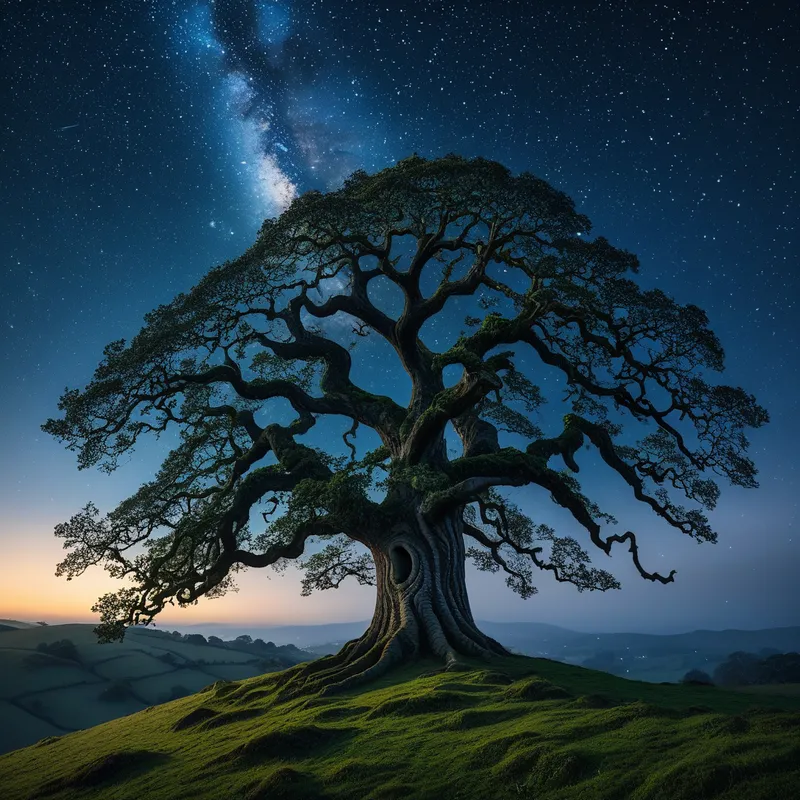
The Sacred Oak Myth Meaning & Symbolism
A druid king sacrifices his physical form to become the immortal Sacred Oak, uniting the land, the people, and the Otherworld in a single, eternal root.
The Tale of The Sacred Oak
Listen. [The wind](/myths/the-wind “Myth from Various culture.”/) does not just move through the branches; it speaks with the voice of the first king. Before the [stone circles](/myths/stone-circles “Myth from Celtic culture.”/) were raised, when [the world](/myths/the-world “Myth from Tarot culture.”/) was raw and the tribes were scattered like leaves before a storm, there was a king named Ard Rí. He was a ruler, yes, but more so a Druid, whose wisdom flowed from the deep wells of [the earth](/myths/the-earth “Myth from Hindu culture.”/) and the high paths of the stars.
His kingdom was not of walls and towers, but of forest and ford, of mound and meadow. Yet a sickness came upon the land. The rivers ran thin, the soil grew hard and cold, and a silence fell over the creatures. The people whispered that the pact between the human world and the [Sídhe](/myths/sdhe “Myth from Celtic / Irish culture.”/) was broken. The king consulted the omens, read the flight of [the crane](/myths/the-crane “Myth from Japanese culture.”/), and listened to the oldest stone. The answer came, not as a shout, but as a sigh from the very bones of the hill.
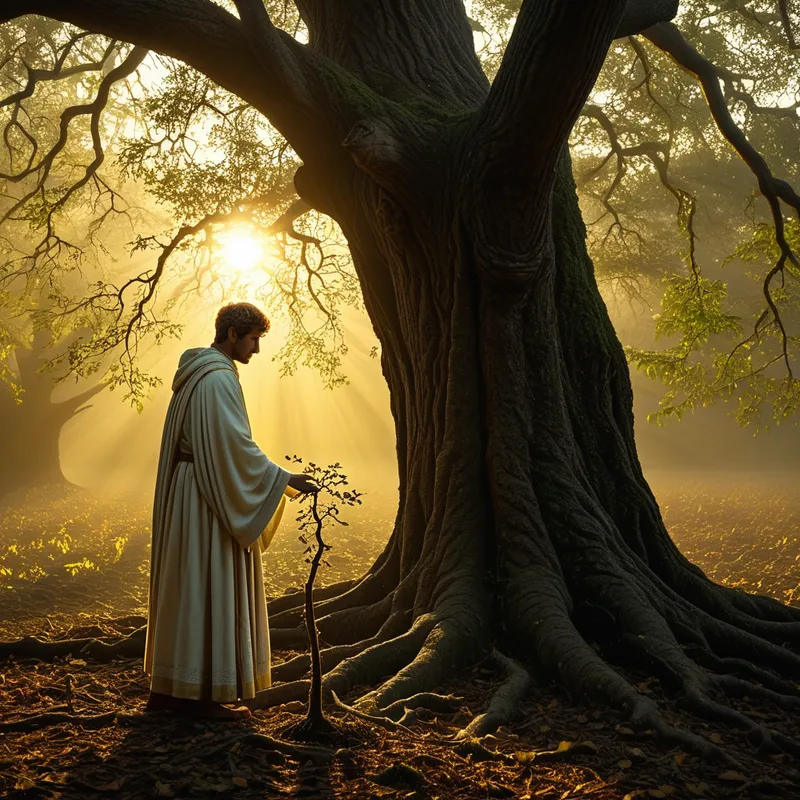
To heal the fracture, a bridge must be built—a living bridge of utter sacrifice. Not of blood upon an altar, but of sovereign consciousness poured into root and branch. On the night of the dark moon, Ard Rí climbed the central hill, the Sídhe mound at the heart of his realm. He carried no sword, no crown. In his hands was a single acorn, harvested from the last healthy oak in the northern wood.
He dug into the cold earth with his bare hands, feeling the pulse of the sleeping land. He planted the acorn. Then, he knelt, placing his palms flat upon the soil on either side of the tiny seed. He began to sing, a low, resonant chant that was not in the tongue of men, but in the language of stone and sap, of star-fall and groundwater. He sang of connection, of duty, of an unbreakable bond.
As he sang, a terrible and beautiful transformation began. His fingers lengthened, darkened, and split, diving into the earth as seeking roots. His back straightened and hardened, his skin becoming rugged bark. His hair and beard became not leaves, but the very first shoots of the sapling, which now grew at impossible speed, fed by the essence of the king. His eyes, the last to change, looked up at the emerging stars—and then they were not eyes, but knots in the wood, seeing in a way no mortal ever could.
Where the man had knelt, now stood a young, mighty oak. Its roots plunged deeper than any tree, drinking from [the underworld](/myths/the-underworld “Myth from Greek culture.”/) rivers. Its branches stretched higher than any before, brushing the pathways of the stars. The land shuddered—a gentle, healing shudder. Springs bubbled forth. The soil grew warm and rich. The people felt it in their sleep: a new presence, watchful, wise, and utterly steadfast. The king was gone. The Bile had been born. He had not died. He had become.
Cultural Origins & Context
The myth of the Sacred Oak, or the Bile, is not a single narrative from a single text. It is a thematic pillar reconstructed from archaeology, fragmentary early Irish and Welsh literature, and the meticulous records of Roman observers. The Celts held the oak in unparalleled esteem; the very word “Druid” is often linked to the Proto-Celtic “dru-wid-”, meaning “oak-knower” or “profound knowledge.”
These sacred trees were not merely worshipped. They were central to identity, law, and cosmology. A tribe’s Bile was its spiritual and political center. Under its branches, kings were inaugurated, treaties sworn, and judgments passed. The tree was [the axis mundi](/myths/the-axis-mundi “Myth from Chinese culture.”/), the connecting pillar between the three realms: the [Otherworld](/myths/otherworld “Myth from Celtic culture.”/) below (roots), the Middleworld of human habitation (trunk), and the Upperworld of celestial powers (branches). The myth of the king becoming the tree codifies this cosmology into a foundational story of sovereignty. The king’s sacrifice was not a loss, but the ultimate act of governance: a literal embodiment of the land he was sworn to protect.
Symbolic Architecture
At its core, the myth is a map of conscious [integration](/symbols/integration “Symbol: The process of unifying disparate parts of the self or experience into a cohesive whole, often representing psychological wholeness or resolution of internal conflict.”/). The [human](/symbols/human “Symbol: The symbol of a human represents individuality, complexity of emotions, and social relationships.”/) [king](/symbols/king “Symbol: A symbol of ultimate authority, leadership, and societal order, often representing the dreamer’s inner power or external control figures.”/) represents the individuated ego—aware, responsible, but ultimately separate and mortal. The sick land symbolizes a [psyche](/myths/psyche “Myth from Greek culture.”/) in a state of [dissociation](/symbols/dissociation “Symbol: A psychological separation from one’s thoughts, feelings, or identity, often experienced as a journey away from the self during trauma or stress.”/), where the conscious mind has lost its [connection](/symbols/connection “Symbol: Connection symbolizes relationships, communication, and bonds among individuals.”/) to the instinctual, ancestral [depths](/symbols/depths “Symbol: Represents the subconscious, hidden emotions, or foundational aspects of the self, often linked to primal fears or profound truths.”/) (the Otherworld) and the transpersonal, guiding [heights](/symbols/heights “Symbol: Represents ambition, fear, or spiritual elevation. Often symbolizes life challenges or a desire for perspective.”/) (the Upperworld).
The sacrifice is not an annihilation of self, but its radical expansion into a more durable and connected form of being.
The oak is the [symbol](/symbols/symbol “Symbol: A symbol can represent an idea, concept, or belief, serving as a powerful tool for communication and understanding.”/) of the Self—the total, integrated psyche. Its roots are the connection to the unconscious, the instincts, the personal and collective past. Its [trunk](/symbols/trunk “Symbol: The trunk in dreams typically denotes the core structure or foundation of one’s identity, values, or beliefs.”/) is the conscious [life](/symbols/life “Symbol: The symbol of ‘Life’ represents a journey of growth, interconnectedness, and existential meaning, encompassing both the joys and challenges that define human experience.”/) and [identity](/symbols/identity “Symbol: Identity represents the sense of self, encompassing personal beliefs, cultural background, and social roles.”/), grounded and sustained by what lies beneath. Its branches are the reach toward [spirit](/symbols/spirit “Symbol: Spirit symbolizes the essence of life, vitality, and the spiritual journey of the individual.”/), meaning, and the future. The king’s transformation is [the ego](/myths/the-ego “Myth from Jungian culture.”/)’s submission to the greater [pattern](/symbols/pattern “Symbol: A ‘Pattern’ in dreams often signifies the underlying structure of experiences and thoughts, representing both order and the repetitiveness of life’s situations.”/) of the Self. He ceases to rule over the land and begins to exist as the land’s living core.
The Dreamer’s Resonance
When this myth stirs in the modern unconscious, it often manifests in dreams of profound rootedness or its terrifying opposite. One might dream of becoming a tree, feeling roots grow from one’s feet into deep, nourishing earth—a somatic expression of seeking grounding during life transitions, or a healing from burnout. Conversely, dreams of a withered, lightning-struck oak, or of trying desperately to [water](/myths/water “Myth from Chinese culture.”/) a dying tree, point to a perceived rupture between conscious life and inner sustenance.
The somatic process is one of centering. The dream-ego is being called away from peripheral concerns and social personas (the scattered kingdom) back to its central, axial truth. There is often a feeling of immense, slow power, of weathering storms through stillness rather than fight. Psychologically, it is the process of moving from a state of “having” a psyche to “inhabiting” it fully, of shifting identity from the fleeting contents of consciousness to the enduring structure that contains it.
Alchemical Translation
The alchemical process mirrored here is the opus contra naturam—the work against nature, which is ultimately a work for a higher, integrated nature. The king’s initial state is one of differentiated, human consciousness (lead). The crisis is the recognition of its isolation and fragility. The sacrifice is the [nigredo](/myths/nigredo “Myth from Alchemical culture.”/), the darkening and dissolution of the old form. The planting of the acorn is the seeding of the new, hidden potential.
The transformation itself is the albedo and citrinitas—the whitening and yellowing, where the spiritual essence is purified and given solar quality. The final emergence of the Bile is the [rubedo](/myths/rubedo “Myth from Alchemical culture.”/), the reddening, the creation of the philosophical tree, the arbor philosophica.
Individuation is not about becoming more uniquely human, but about becoming fully natural in the grandest sense—mineral, vegetative, animal, and conscious, all at once.
For the modern individual, the myth models the ultimate act of psychological sovereignty. It asks: What in you must cease to be a separate, ruling “king” and instead become the living, connective tissue of your entire being? What worn-out identity must you allow to be dissolved so that your consciousness can become structural, supportive, and life-giving? The [triumph](/myths/triumph “Myth from Roman culture.”/) is not conquest, but a seamless, steadfast presence—a consciousness that has become ecosystem, enduring, wise, and deeply, unshakably rooted in the truth of its own existence.
Associated Symbols
Explore related symbols from the CaleaDream lexicon: