The Rusalka Myth Meaning & Symbolism
A myth of the restless, drowned maiden, the Rusalka, who lures the living into the deep, embodying the psyche's untamed grief and the call to remember what was lost.
The Tale of The Rusalka
Listen, and let the whisper of the willow guide you to the water’s edge, where the light fractures and the world grows deep. It begins not with a birth, but with a drowning.
In the time when the world was thick with forest and the rivers sang their own old songs, there lived a maiden. She was fair, with laughter like spring rain and a heart open as a meadow. But fate is a crooked path. Perhaps she was betrayed by a lover’s false oath, cast into the water by cruel hands. Perhaps she slipped from a shaky log bridge, her cry swallowed by the current. Or perhaps, in the deepest winter of her soul, she walked into the river’s embrace of her own will, seeking an end to a sorrow too heavy for land.
The water took her. It filled her lungs with cold silence and wound her hair with dark weeds. But her story did not end. It transformed. On the third day after her drowning, or the seventh, or at the turning of the spring equinox—when life stirs most powerfully—she rose. Not as a corpse, but as a Rusalka.
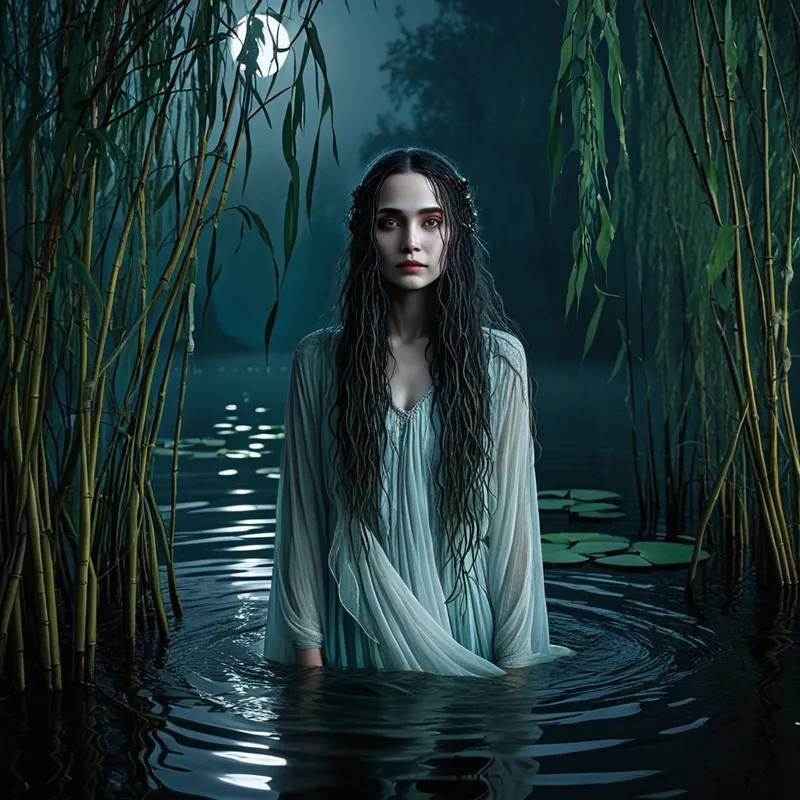
No longer a daughter of the village, she became a daughter of the deep. Her skin took on the pallor of the moon on water. Her eyes held the chill of the riverbed. Her hair, once braided with ribbons, now flowed like the currents themselves, tangled with pearls of river foam. She made her home in the deepest pools of the forest, in the silent bends of the river, under the weeping canopy of the willow.
By day, she might be silent, a mere ripple. But come the twilight, especially in the week of the Rusalnaya Week, she would emerge. She would climb the gnarled branches of the willow or the oak, and sit, combing her long hair with a bone comb, singing a song without words—a melody of such profound, aching beauty that it stilled the night birds. This song was a net cast upon the soul of any man who wandered near.
Hearing it, he would be drawn. He would see not a spirit, but the maiden she once was, beckoning him with eyes full of promised love. He would wade into the water, entranced, reaching for her cool hand. And she would take it. With a strength born of the deep, she would pull him down, into the cold, green silence. There, in her watery bower, she would embrace him, and dance with him—a frantic, endless whirl—until the last bubble of his life escaped his lips and he stayed with her forever. Or, in some tellings, she would simply tickle him to death, a final, cruel parody of laughter. Her embrace was not love, but a compulsion to share her state, to have company in her eternal, restless exile.
Cultural Origins & Context
The Rusalka is not a singular, standardized figure, but a fluid archetype that pooled in the collective consciousness of the Eastern and Southern Slavic peoples. Her stories were not penned in illuminated manuscripts but breathed into life around hearthfires, passed from grandmother to grandchild, and woven into the seasonal rituals of agrarian life. She belongs to the vast and animistic stratum of pre-Christian Slavic belief, where every forest, stream, and field possessed its own spirit, its own genius loci.
Her most potent time was Rusalnaya Week, following the Christian Pentecost (Green Week). This period reveals her deep connection to the cult of the dead and the fecund, dangerous power of nature in full spring surge. During this week, rituals were performed to both appease and harness the spirit of the Rusalki. Villagers would leave offerings of cloth, bread, and garlands at the water’s edge or in trees. In some regions, a ritual called “the escorting of the Rusalka” involved symbolically guiding her spirit back to the water with song and dance, ensuring she would not haunt the fields and dry places. This practice highlights her dual nature: she was a force to be respected, placated, and carefully returned to her proper domain, lest her untamed energy blight the crops or ensnare the living.
Symbolic Architecture
The Rusalka is a master symbol of the psyche’s unfinished business. She is not merely a ghost, but a specific kind of soul—one whose transition was violated, whose story was cut short not by natural completion, but by trauma, betrayal, or sudden rupture.
She is the embodied cry of the part of us that was not allowed to grieve, to rage, or to say a proper goodbye.
Her domain is the boundary: the riverbank, the surface of the water, the edge of the forest. She exists in the liminal space between life and death, memory and oblivion, the conscious world and the unconscious depths. Her beautiful, haunting song represents the irresistible pull of unresolved pain—a siren call that promises solace (a return to love, to wholeness) but delivers dissolution. The men she drowns are not victims of an external monster, but of their own unconscious attraction to this unresolved feminine energy, a desire to “solve the mystery” or “save the maiden” without understanding the depth of her wound, which is ultimately a reflection of their own.
Her connection to willow trees and water plants roots her in symbolism of immense grief (the weeping willow) and tenacious life that thrives in saturated, emotional ground. She is the psyche’s truth: what is repressed does not disappear; it gains a life of its own, becomes autonomous, and seeks expression, often in destructive or captivating ways.
The Dreamer’s Resonance
When the Rusalka pattern surfaces in modern dreams, she rarely appears as a literal folklore entity. She manifests as the atmosphere of the dream. It is the dream of being irresistibly drawn to a beautiful, yet eerily still, body of water in a familiar-yet-alien landscape. It is the figure of a woman seen from behind, her hair obscuring her face, standing at the end of a pier or in a flooded basement. It is the sensation of being held underwater in an embrace that feels both loving and suffocating.
Somatically, the dreamer may awaken with a feeling of damp chill, a tightness in the chest, or a profound, unnamable sadness. Psychologically, this signals an encounter with a complex—a cluster of emotions, memories, and energies that have been “drowned” in the unconscious. This could be a past trauma, an abandoned creative potential, a stifled expression of grief or rage, or a relational betrayal that was never processed. The Rusalka calls from the deep, not to destroy, but to be acknowledged. Her haunting is an invitation, however terrifying, to look into the water and finally see what lies beneath the surface of one’s own history.

Alchemical Translation
The journey of individuation, the alchemy of the soul, requires not only building up the conscious personality but also reclaiming the lost, drowned, and exiled parts of the self. The Rusalka myth models this perilous, essential work.
The first stage is Recognizing the Call—hearing that haunting melody in our compulsions, our melancholies, our repetitive attractions to unresolved situations. We must resist the naive “heroic” impulse to jump in and rescue or destroy the spirit. That leads only to drowning, to being overwhelmed by the complex.
The second stage is Appeasement and Witnessing. This is the cultural ritual of leaving an offering. Psychologically, it means approaching the pain with respect, offering it the “cloth” of our attentive presence and the “bread” of our compassion. We sit on the bank, and instead of being lured in, we witness her. We ask: “What story was cut short? What grief was not allowed?”
The final, alchemical act is not to banish the Rusalka, but to help her complete her transition. To give her story an ending.
This is the “escorting” ritual. It involves retrieving the memory, feeling the frozen emotion, speaking the unsaid words, or performing the symbolic act of mourning that was stolen by circumstance. When this is done, the Rusalka’s form may change in the inner vision. The vengeful spirit may transform back into the maiden, who then, at peace, can finally fade into the depths or transform into a benign guardian of that inner space. The energy that was bound in restless haunting is released, becoming a source of depth, empathy, and intuitive connection rather than a force of entrapment. The waters of the unconscious, once feared for their drowning embrace, become a wellspring. We learn that to be whole, we must sometimes venture to the willow-shaded bank, listen to the old, sad songs, and perform the rituals of remembrance for all that we, and our ancestors, have left unfinished.
Associated Symbols
Explore related symbols from the CaleaDream lexicon: