The Runes of Odin Myth Meaning & Symbolism
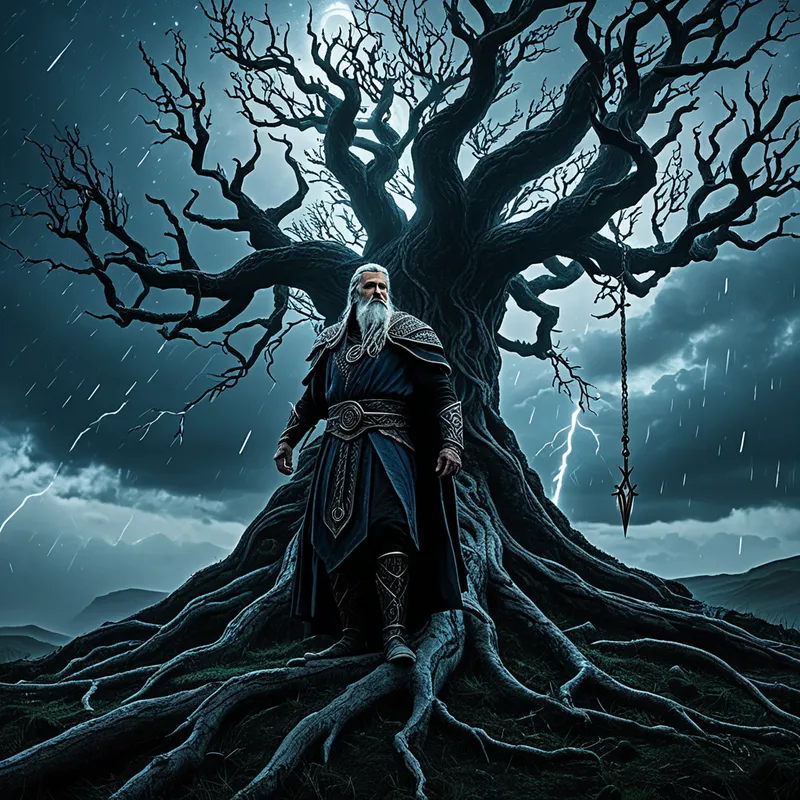
The Allfather hangs himself on the World Tree for nine nights, pierced by a spear, to seize the secret of the runes from the abyss.
The Tale of The Runes of Odin
Listen. The wind does not whisper here; it keens. It cuts through the high, lonely branches of Yggdrasil, the great ash that holds all the worlds in its grasp. At its heart, in a place that is no place, a god prepares to die.
He is Odin, the Allfather, the Hooded One. He has traded an eye for a drink from Mímisbrunnr, but the deep, humming secrets of the universe still slip through his fingers like mist. He knows of a power older than the gods, a primal alphabet etched into the bones of creation itself: the runes. They are not mere letters. They are the hidden laws, the true names of things. To wield them is to shape destiny. But they are not given. They must be taken, and the price is everything.
With a resolve that chills the very air, Odin takes up his own spear, Gungnir. He drives it deep into his own side. The pain is a white-hot star, but it is only the beginning. He casts a rope over a mighty, lightning-scarred limb of Yggdrasil. He hangs himself, a willing offering to himself. For nine nights and nine days, he hangs between the worlds. The cold seeps into his bones, a cold deeper than any winter in Jötunheimr. The wound in his side weeps. He is given no water, no morsel of food. The great tree groans with his weight.
He stares down into the churning, root-choked darkness below, the well of Urðr. He stares up at the unreachable stars. He is the sacrifice and the priest, the question and the answer waiting to be born. On the final, desperate edge of consciousness, as his single eye begins to dim, he lets go. Not of the rope, but of himself. The god-king, the ruler of Asgard, dissolves. Odin the entity dies.
And in that shattering silence of non-being, they come. From the depths of the well, from the sap of the tree, from the void between his own thoughts, shapes of fire and ice flare into his perception. They are angular, stark, undeniable: ᚠ Fehu, ᚢ Uruz, ᚦ Thurisaz. The runes. They blaze their meanings directly into his soul—cattle and wealth, the wild aurox and primal strength, the thorn and destructive force. He sees them all, the entire Elder Futhark. He does not learn them; he remembers them, for they were always there, waiting for one who would pay the price to see.
With a gasp that is both a death rattle and a first breath, Odin is returned. He falls from the tree, reborn. The knowledge is now part of him, etched into his spirit more permanently than any scar. He takes up the runes, screaming with the power of them, and from that moment, he is truly the god of magic, of poetry, of the hidden paths. He has bought wisdom with his own pain, and the universe has yielded its secrets.
Cultural Origins & Context
This myth is preserved primarily in the Old Norse poem Hávamál (“The Sayings of the High One”), stanzas 138-145, within the Poetic Edda. It is Odin himself who recounts the tale in the first person, a rare and powerful autobiographical fragment from a god. This was not a story for children at the hearth; it was esoteric knowledge, passed among skalds (poets), seers, and those initiated into the mysteries of seiðr and runic magic.
Its societal function was multifaceted. For the warrior culture, it modeled the ultimate sacrifice: the surrender of the self for a greater, strategic power. For the poet, it was the archetype of inspiration won through suffering and ecstasy. For the rune-master, it was the sacred origin story of their art, a stern warning that true power demands a total exchange. The myth established that wisdom (wod, from which Odin’s name may derive) is not a passive acquisition but an active, violent retrieval from the edge of oblivion. It framed knowledge as a hard-won trophy from a battle fought not against giants, but against the limits of one’s own being.
Symbolic Architecture
At its core, the myth is not about acquiring a tool, but about undergoing a metamorphosis of consciousness. Odin begins as a seeker, but to find, he must first become lost. The spear, Gungnir, is the instrument of will, turned inward. The act of hanging is a symbolic crucifixion, a suspension of the ego in the liminal space where opposites meet: life and death, heaven and hell (the heights and roots of Yggdrasil), knowing and not-knowing.
The runes are the archetypal patterns of reality, the psychic DNA of the cosmos. To gain them, one must first offer one’s familiar identity as fuel for the transformation.
The nine nights echo the nine months of gestation, a period of dark incubation necessary for a new birth. Odin does not simply add rune-lore to his repertoire; he is unmade and remade. His missing eye is crucial here—he sacrificed conventional, surface perception for inner sight. Now, hanging, he sacrifices the very platform of the perceiver. The runes flood in only when the vessel of the old self is shattered. This is the ultimate symbolic truth: profound knowledge rewires the knower. You cannot hold the pattern of everything and remain the same limited thing.
The Dreamer’s Resonance
When this myth stirs in the modern psyche, it often manifests in dreams of suspension, paralysis, or painful initiation. You may dream of hanging from a great height, not in terror, but in a strange, expectant agony. You might be pinned by a beam, or lying wounded and immobile on a symbolic battlefield. These are not nightmares of helplessness, but somatic metaphors for the ego’s necessary crucifixion.
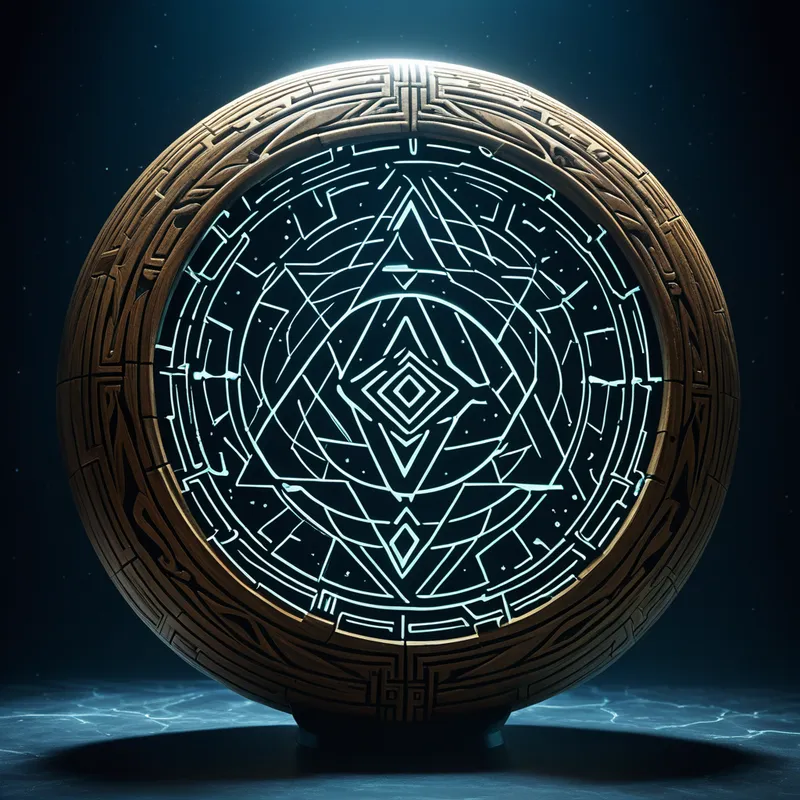
The dreamer is at a precipice where an old identity, a old way of knowing, is dying. The “spear” could be a devastating insight, a betrayal, a failure, or a depression that pierces the core of one’s self-image. The somatic feeling is one of being in process, trapped in the painful, lonely, yet sacred interval between who you were and who you are becoming. The runes, in a modern context, might appear as glowing codes, unsolvable puzzles, or voices speaking an unknown but intuitively understood language—representing a new, emergent truth struggling to be born from the dissolution.
Alchemical Translation
Psychologically, Odin’s ordeal is a perfect map of the individuation process, specifically the stage of mortificatio or nigredo—the blackening, the death of the old king. The conscious ego (Odin the ruler) willingly subjects itself to the torment of the unconscious (the dark roots, the well of fate) to be broken down and reconstituted with greater wholeness.
The goal is not to avoid the wound, but to let it become the aperture through which a larger consciousness enters.
For the modern individual, this translates to those dark nights of the soul where everything you thought you were proves inadequate. It is the burnout of the achiever, the collapse of the caregiver, the silence that follows the artist’s exhausted output. It is the terrifying but necessary surrender where you stop trying to fix yourself from the old playbook and instead hang, exposed, in the mystery of your own suffering. The “runes” you seize on the other side are not magical powers, but integrated truths: a genuine vocation, a hard-won self-knowledge, a creative voice that is authentically your own. The sacrifice is your former innocence, your compact ego. The prize is a wisdom that includes the shadow, a consciousness that has stared into the abyss and brought back a pattern that makes meaning of the chaos. You become, in a sense, your own shaman, having visited the land of the dead and returned with a song for the living.
Associated Symbols
Explore related symbols from the CaleaDream lexicon: