The Round Table of King Arthur Myth Meaning & Symbolism
A fellowship of knights bound by a sacred code, gathered at a table with no head, seeking a holy vessel that promises wholeness and a kingdom's soul.
The Tale of The Round Table of King Arthur
Listen, and hear the tale of the table that was a kingdom’s heart.
In [the mist](/myths/the-mist “Myth from Celtic culture.”/)-shrouded isle of Logres, where the old gods slept beneath the hills, a king was crowned not by blood, but by stone. Arthur Pendragon, son of Uther, raised by secret and sorrow, drew the sword from the anvil and the stone, and a light was kindled in the land’s long twilight. But a sword divides; it cuts [justice](/myths/justice “Myth from Tarot culture.”/) from injustice, friend from foe. A king who rules by the sword alone rules a fractured realm, a body at war with itself.
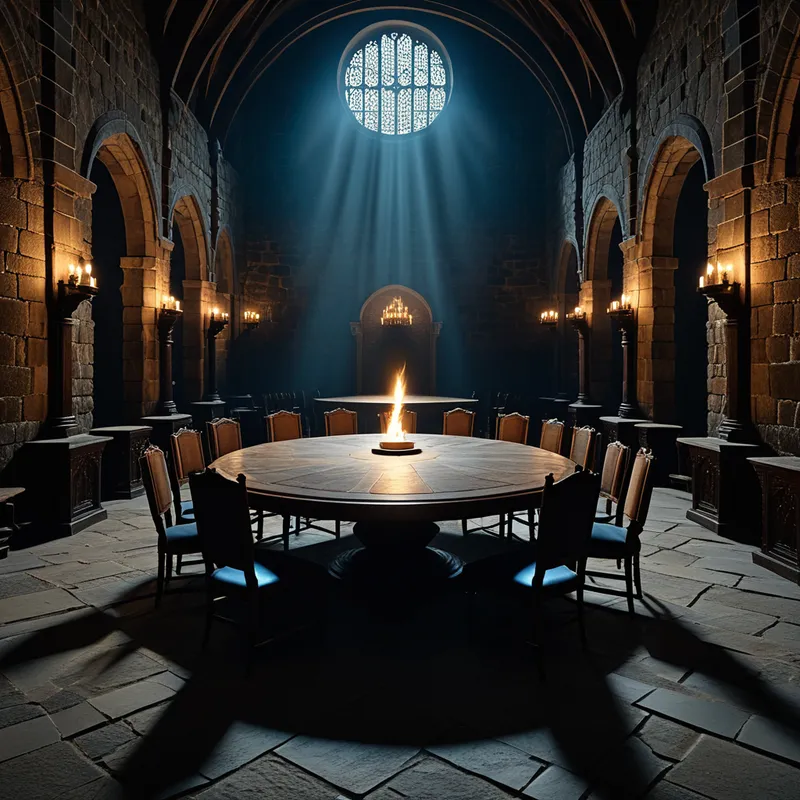
Arthur saw this shadow. In the high hall of Camelot, the great rectangular table of his forebears stood. At its head, the king. Along its sides, the nobles, each position a map of power, of closer and farther, of greater and lesser honor. The very wood whispered of rivalry. Then came a gift, or a vision, from the great enchanter [Merlin](/myths/merlin “Myth from Arthurian culture.”/). A table, vast as a cart-wheel, hewn from a single, sacred oak. A table with no head, for no man could claim precedence. A table that was a circle, perfect and unbroken.
One hundred and fifty seats were carved around its circumference. Here, the mightiest warriors of Christendom gathered: [Lancelot](/myths/lancelot “Myth from Arthurian culture.”/) du Lac, whose heart was his greatest battleground; [Galahad](/myths/galahad “Myth from Arthurian culture.”/), on whose face shone a grace not of this world; Gawain, of the sun’s strength and [the green knight](/myths/the-green-knight “Myth from Arthurian culture.”/)’s challenge; Bedivere, who would bear the king’s sword to destiny’s [water](/myths/water “Myth from Chinese culture.”/). They were not vassals, but peers. They swore an oath not merely to a king, but to the Table itself—a code of courage, justice, mercy, and protection for the weak. The Table was their covenant. Its circle was the boundary of their shared soul.
And in the center of this fellowship, a void, a yearning. One seat remained perilously empty: the [Siege Perilous](/myths/siege-perilous “Myth from Arthurian culture.”/). It waited, a silent judge, for the one pure enough to fill it. This emptiness called forth their greatest quest—not for land or gold, but for the [Holy Grail](/myths/holy-grail “Myth from Arthurian culture.”/). The knights rode out, each taking a separate path into the wild, enchanted forests of [the self](/myths/the-self “Myth from Jungian culture.”/). The Table stood empty behind them, a silent promise of return, of a unity to be regained at a higher level.
Some, like Lancelot, were blinded by their own shadows. Others, like Percival, learned through humility. And one, Galahad, the chosen, achieved the vision, beholding [the Grail](/myths/the-grail “Myth from Arthurian culture.”/)’s blinding mystery. But the vision could not be held; the [Grail](/myths/grail “Myth from Christian culture.”/) withdrew from [the world](/myths/the-world “Myth from Tarot culture.”/). The knights returned, changed, to the Table. The fellowship was mended, yet a fragility now lived in the grain of the wood. The circle held, even as the seeds of its undoing—human love, human jealousy—sprouted within its sacred space. The Table witnessed it all: the glory, the quest, the betrayal, the long, tragic twilight. It was the still point in the turning world of Camelot, the geometric proof of an ideal, shining and fragile as glass, long after the last torch guttered in the hall.
Cultural Origins & Context
The myth of [the Round Table](/myths/the-round-table “Myth from Arthurian culture.”/) is a tapestry woven on a loom of history, threaded with Celtic sovereignty myths, chivalric romance, and political aspiration. Its primary vessels were the 12th and 13th-century writers like Geoffrey of Monmouth, Chrétien de Troyes, and later, Sir [Thomas](/myths/thomas “Myth from Christian culture.”/) Malory. These were not mere recorders, but myth-makers for their age.
The Table served a potent societal function. In the feudal world of strict hierarchy, the image of a [round table](/myths/round-table “Myth from Arthurian culture.”/) where all were equal was a revolutionary ideal. It presented a model of kingship based on counsel and consent, a proto-parliament of the best and bravest. For the knightly class, it codified the ethos of chivalry, transforming the warrior from a brute force into a guardian of spiritual and social order. [The Grail quest](/myths/the-grail-quest “Myth from Arthurian culture.”/), infused with Christian mysticism, elevated this knightly purpose from the earthly to the celestial, offering a spiritual justification for the warrior’s life. The myth was passed down in lavish manuscripts read in courts, becoming a mirror for nobility to see their highest potential—and their tragic flaws—reflected in the polished surface of Arthur’s wooden circle.
Symbolic Architecture
At its core, the Round [Table](/symbols/table “Symbol: Tables in dreams often symbolize stability, social interactions, and a platform for discussions, negotiations, or decisions in our waking life.”/) is a [symbol](/symbols/symbol “Symbol: A symbol can represent an idea, concept, or belief, serving as a powerful tool for communication and understanding.”/) of the Self in its potential wholeness. It is the [mandala](/symbols/mandala “Symbol: A sacred geometric circle representing wholeness, the cosmos, and the journey toward spiritual integration.”/), a sacred circle containing and organizing the diverse, often conflicting, elements of the [personality](/symbols/personality “Symbol: Personality in dreams often symbolizes the traits and characteristics of the dreamer, reflecting how they perceive themselves and how they believe they are perceived by others.”/).
The circle has no beginning and no end; it is the shape of completion. The Round Table is the psyche’s attempt to give perfect, geometric form to the chaos of human community and the inner world.
Each [knight](/symbols/knight “Symbol: The knight symbolizes honor, chivalry, and the pursuit of noble causes, reflecting the ideal of the noble warrior.”/) represents an [archetype](/symbols/archetype “Symbol: A universal, primordial pattern or prototype in the collective unconscious that shapes human experience, behavior, and creative expression.”/) or a facet of the individual’s potential: the [lover](/symbols/lover “Symbol: A lover in dreams often represents intimacy, connection, and the emotional aspects of relationships.”/) (Lancelot), the pure [spirit](/symbols/spirit “Symbol: Spirit symbolizes the essence of life, vitality, and the spiritual journey of the individual.”/) (Galahad), the loyal [warrior](/symbols/warrior “Symbol: A spiritual archetype representing inner strength, discipline, and the struggle for higher purpose or self-mastery.”/) (Gawain), the wise elder (Bedivere). Arthur, as the ego, does not dominate this circle but acts as its first among equals, its conscious center. The Table itself is the [structure](/symbols/structure “Symbol: Structure in dreams often symbolizes stability, organization, and the framework of one’s life, reflecting how one perceives their environment and personal life.”/) that holds these powerful forces in a creative, not destructive, [tension](/symbols/tension “Symbol: A state of mental or emotional strain, often manifesting physically as tightness, pressure, or unease, signaling unresolved conflict or anticipation.”/). The Siege Perilous is the symbol of [destiny](/symbols/destiny “Symbol: A predetermined course of events or ultimate purpose, often linked to spiritual forces or cosmic order, representing life’s inherent direction.”/), the vacant [space](/symbols/space “Symbol: Dreaming of ‘Space’ often symbolizes the vastness of potential, personal freedom, or feelings of isolation and exploration in one’s life.”/) within the self that can only be filled by one’s unique and often terrifying calling. To sit in it unprepared is to be annihilated by the [weight](/symbols/weight “Symbol: Weight symbolizes burdens, responsibilities, and emotional loads one carries in life.”/) of one’s own unreadiness. The [quest](/symbols/quest “Symbol: A quest symbolizes a journey or search for purpose, fulfillment, or knowledge, often representing life’s challenges and adventures.”/) for the [Holy Grail](/symbols/holy-grail “Symbol: A revered object symbolizing the ultimate quest for spiritual fulfillment and enlightenment.”/) is the [journey](/symbols/journey “Symbol: A journey in dreams typically signifies adventure, growth, or a significant life transition.”/) toward that center, the [pursuit](/symbols/pursuit “Symbol: A chase or being chased in dreams often reflects unresolved anxieties, unfulfilled desires, or internal conflicts demanding attention.”/) of the ultimate value that will heal the inner “wasteland” and bring meaning to all the disparate efforts of the knights—the psychic functions.
The Dreamer’s Resonance
To dream of a round table, especially one that is empty, vast, or awaiting your presence, signals a profound moment of psychic reorganization. Somatically, one may feel a centering, a pulling-in of scattered energies, or conversely, an acute awareness of an empty space at one’s core.
Psychologically, this is the dream of integration. You are being called to a council of your inner parts. The empty chairs may represent neglected talents, unvoiced opinions, or shadow aspects demanding recognition. A dream of being unable to find a seat at such a table speaks to feelings of exclusion from one’s own wholeness, or a fear of not measuring up to one’s inner ideal. A table that is broken or shattered reflects a crisis of integrity, a collapse of the personal ethos or moral framework that once held your identity together. The dream is an invitation from the unconscious to convene this inner round table, to hear the voices of your inner knights—the critic, [the child](/myths/the-child “Myth from Alchemy culture.”/), the hero, the lover—and to seek the grail of your own deepest, unifying purpose.

Alchemical Translation
The myth of the Round Table is a blueprint for the alchemical process of individuation. The initial state is the unconscious kingdom (Logres in chaos), ruled by the fragmented will of competing nobles (our conflicting impulses).
The creation of the Table is the opus, the great work. It is the construction of a conscious container—the ego’s commitment to order, ethics, and relationship—strong enough to withstand the heat of transformation.
The knights’ oath is the discipline of introspection and shadow-work. The separate quests for the Grail represent the necessary [separatio](/myths/separatio “Myth from Alchemical culture.”/), the differentiation of psychic functions. Each knight must face his own forest, his own temptations and failures. Lancelot’s failure is as crucial as Galahad’s success, for it illustrates that the transformative power (the Grail) often withdraws when approached through the inflation of the [persona](/myths/persona “Myth from Greek culture.”/) or the unresolved complex.
The ultimate alchemical symbol is the Siege Perilous itself. It is the vas, [the sacred vessel](/myths/the-sacred-vessel “Myth from Various culture.”/) that must remain empty to receive the transcendent. In the individual’s journey, this is the terrifying, necessary act of emptying oneself of preconceived identity, of hubris, of the need for recognition, to become a vessel for what the Self truly intends. The return of the knights, changed, to the Table is the coniunctio—the reunion at a higher level of consciousness. The circle is restored, but now informed by the transcendent experience. The modern individual’s quest is not for a physical cup, but for that which makes life deeply meaningful. We are each called to build our round table, swear our own chivalric code to our inner truth, and embark on the perilous, solitary, and essential quest for the grail that will make us whole.
Associated Symbols
Explore related symbols from the CaleaDream lexicon: