The Round Table Feast Myth Meaning & Symbolism
King Arthur establishes a fellowship of equals at a miraculous table, forging a sacred bond of chivalry and collective purpose in a fractured land.
The Tale of The Round Table Feast
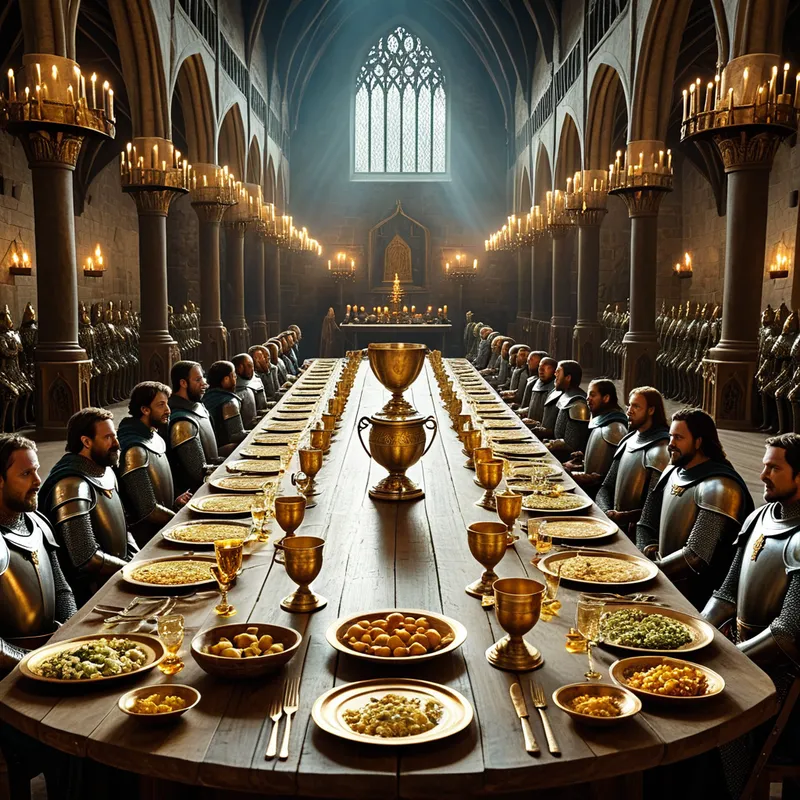
Hear now a tale not of a single hero, but of a fellowship forged in the dying light of Rome and the rising mist of Avalon. In the land of Logres, where shadows clung to the hills and petty kings warred over scraps of a broken empire, a young king dreamed of a different world. His name was Arthur, son of Uther, wielder of the sword Caliburn, drawn from the stone by right and mystery.
But a sword alone cannot rule a heart. A crown cannot command loyalty. Arthur saw that the strength of the land was fractured, its warriors proud and solitary, their honor a brittle thing that broke upon the rocks of envy. He longed for a bond stronger than blood-oath, a company where no man could claim precedence by birth or seat, where counsel would flow freely as mead.
And so, in the high hall of Camelot, built upon the old magic of the land, he unveiled his vision. It was not a throne, but a table. A vast, perfect circle of ancient oak, its surface polished by unknown hands to a deep, resonant sheen like dark water. It had no head, no foot. “Here,” Arthur declared, his voice echoing in the silent hall, “shall sit the finest knights of Christendom. Here, no man is above another. Here, we are bound not by rank, but by purpose.”
One by one, they came. Sir Kay, the stern seneschal. Sir Lancelot, of peerless skill and hidden sorrow. Sir Galahad, with eyes that saw beyond the world. Sir Bors and Sir Gawain, and a company of a hundred and fifty more. Each took his place, the great wooden circle groaning softly as if accepting their weight, their vows.
The feast began. The air grew thick with the scent of roast boar and sweet wine, with the murmur of oaths and the clatter of plate. But as the cups were filled from a common pitcher, a silence descended. A palpable current moved around the table, a circuit of shared intent. In that moment, they were no longer a collection of warriors, but a single entity—the Fellowship of the Round Table. They swore the Pentecostal Oath: to never commit murder or foul treason, to grant mercy to those who asked, to defend the helpless, and to pursue the sacred quests for the good of the realm.
The hall itself seemed to breathe with them. The light from the great hearth flickered across intent faces, gleaming on mail and in earnest eyes. The table was not just furniture; it was an altar to a new covenant. The feast was their first communion, the breaking of bread that sealed a bond meant to hold back the encroaching dark. They ate, they drank, and in doing so, they wove the first threads of a story that would outlast them all—a story of a kingdom built not on force, but on a sacred, circular agreement.
Cultural Origins & Context
The myth of the Round Table Feast is a cornerstone of the larger Arthurian cycle, which coalesced in the fertile ground between post-Roman British history, Celtic mythology, and Norman-French chivalric romance. While the figure of Arthur may have roots in a 5th or 6th-century warlord, the Table itself is a later, literary invention. It first appears in the 12th century in the work of Wace and was spectacularly elaborated by Chrétien de Troyes and later in the Middle English Le Morte d’Arthur by Sir Thomas Malory.
Its societal function was multifaceted. For a medieval audience living under a rigid feudal hierarchy, the Table presented an idealized model of kingship and fellowship. It was a narrative tool for exploring the tension between individual glory (the quest) and collective responsibility (the realm). The feast, as a recurring motif, served as the narrative engine—a gathering point from which adventures launched and to which knights returned to share their tales, thus reinforcing the shared identity and laws of the fellowship. It was a myth told in courts to instruct knights in chivalric virtue and to common folk as a promise of a just and united kingdom, a Logres that could be, if only the right people sat at the right table.
Symbolic Architecture
At its core, the Round Table is an archetypal symbol of wholeness, equality, and cosmic order. Its shape negates hierarchy; there is no “top” or “bottom,” only the circumference. It transforms a collection of individuals—each with their own shadow, pride, and destiny—into a conscious collective.
The circle does not command from above; it contains from within. The king is not the head of the table, but the first among equals, the one who holds the space for the circle to exist.
The table itself becomes a talisman, a physical manifestation of the social contract. The feast is the act of consecration, where consuming food and drink together literalizes the incorporation of shared values into the very bodies of the participants. The empty seat, the Siege Perilous, introduces the element of destiny and potential—a reminder that the circle is not closed, but awaits a higher integration. The table is a mandala for the kingdom, a microcosm of a world in balance, where the sovereign self (Arthur) facilitates the harmony of its constituent parts (the knights).
The Dreamer’s Resonance
To dream of a round table feast is to encounter the psyche’s deep longing for authentic community and integrated self-governance. The dream may manifest in various ways: finding oneself at a vast, empty round table, feeling anxiety about where to sit; or being at a crowded feast where one cannot speak or be heard. Somatic sensations might include a feeling of constriction in the chest (the pressure of collective expectation) or a warm, expansive feeling in the solar plexus (the nourishment of true belonging).
Psychologically, this dream pattern surfaces during life transitions where one’s role within a group—be it family, work, or social circle—is being renegotiated. It asks the dreamer: Where do I truly belong? Am I sitting in my rightful seat, speaking my truth, or am I conforming to an imposed hierarchy? The dream may highlight a “Siege Perilous” in one’s life—a role or responsibility that feels destined but perilous, awaiting the courage to be filled. It is the psyche working to assemble its own internal “knights”—the various archetypal energies and competencies—around a central, ruling principle of the Self.
Alchemical Translation
The myth models the alchemical process of individuation, where the fragmented elements of the personality (the disparate, warring knights of the psyche) are gathered, honored, and organized around a central, unifying principle (King Arthur as the emerging Self).
The first stage is convocation: the conscious ego (Arthur) must recognize the need to call all parts of the self to council. This is the decision to seek wholeness over dominance. The feast is the conjunction, the sacred marriage of opposites within the vessel of the circle: courage with compassion, strength with mercy, ambition with service. The shared oath is the creation of a new, internal law—the superordinate goal of the psyche, which is often the pursuit of the Grail, symbolizing ultimate meaning and integration.
The Round Table is the psyche’s governance system. It is the moment the inner kingdom moves from tyrannical rule by a single complex (like the wounded orphan or the inflated hero) to a constitutional monarchy, where all inner voices have a seat and a vote, presided over by the benevolent sovereignty of the Self.
For the modern individual, the “alchemical translation” is the ongoing work of building this inner round table. It requires identifying our inner “knights”—our skills, drives, and subpersonalities—and inviting them into conscious relationship. It demands we establish our own “Pentecostal Oath,” a personal code that serves something greater than our own pride. The perpetual feast is the act of continually nourishing this inner fellowship through reflection, dialogue, and the commitment to live not as a chaotic bundle of impulses, but as a sovereign, rounded whole.
Associated Symbols
Explore related symbols from the CaleaDream lexicon: