The Rose of Tralee Myth Meaning & Symbolism
A tale of a love so profound it transcends death, transforming a mortal woman into an eternal symbol of beauty, memory, and the soul's immortal essence.
The Tale of The Rose of Tralee
Hear now a story not carved on ancient stone, but carried on the breath of a sigh and the strings of a ballad. It is a tale woven from the mist of County Kerry, from the soft earth where the River Lee meets the sea at Tralee. It begins not with gods, but with a mortal heart, and a beauty that could stop the world.
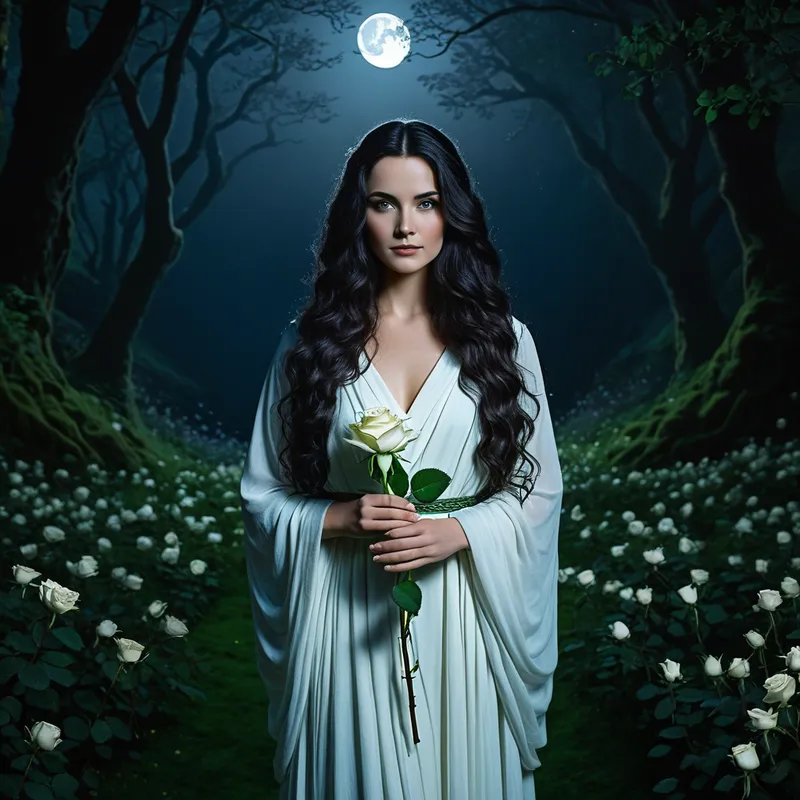
In the green embrace of that land, there lived a maid named Mary. She was not of high birth, nor did she possess lands or gold. Her wealth was of another kind. Her hair was the dark of a raven’s wing under moonlight, her skin the pale cream of hawthorn blossom. But it was her spirit that truly shone—a gentle, steadfast light, as kind and deep as the bog pools that mirror the sky. She worked in the great house, her hands capable and her heart full of song.
And it was there that she was seen by William, the master’s son. He was a man of learning and the world, destined for a life of ease and matched marriage. Yet, when his eyes met Mary’s across a sun-dappled yard, fate’s loom shuddered. He saw not a servant, but a soul. In her quiet dignity, he found a truth absent from grand halls. In the melody of her voice, he heard the old music of the land itself. Their love was a secret flame, nurtured in stolen glances and whispered words by the hawthorn hedge, a love as inevitable and fragile as the first rose of summer.
But the world is a wall of stone against such a flower. His family roared its disapproval. A match with a maid? It was unthinkable, a scandal to shatter their standing. William was pressed, cajoled, and finally commanded to forsake her, to travel abroad and forget. With a heart of lead, he departed, leaving Mary in the perpetual twilight of hope deferred. She waited, her love a quiet, enduring root in the soil of her home, while he wandered distant shores, a ghost of himself.
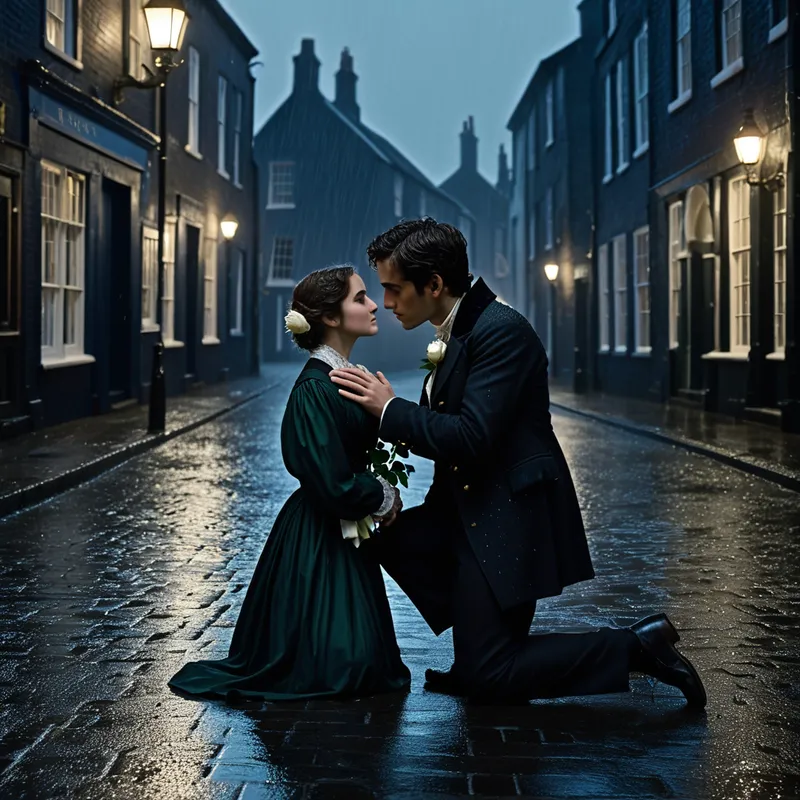
Years passed. The world moved on, but not the heart. William returned to Tralee, a changed man yet unchanged in the one chamber of his soul where her image was enshrined. He sought her immediately, a desperate hope fueling his steps. But he was too late. The story, told in hushed, pitying tones, was a blow to the stomach. Mary, the rose of his life, had faded. A fever had taken her, they said, not long after he had sailed away. She had waited, and she had loved, and she had died of a broken heart, some whispered, though the doctor named a different chill.
That night, under a cold and indifferent moon, William walked the lanes they had dreamed of walking together. The weight of his loss was a physical stone. He saw not the familiar town, but a world drained of color, a canvas from which the only vital hue had been scraped away. In his anguish, a vision came to him—not of her ghost, but of her essence. He saw her not as she was in life, but as she is in truth: eternal, perfect, untouchable by time or death. From the dark soil of his grief, a poem began to grow, line by aching line. He did not write of her death, but of her transformation. He called her “The Rose of Tralee,” and in that naming, he performed an act of magic older than any spell. He did not bury a maid; he gave birth to a symbol. The mortal woman was gone, but the Rose, luminous and everlasting, had just begun to bloom.
Cultural Origins & Context
The story of The Rose of Tralee occupies a unique space in the Celtic narrative tradition. It is not a myth of the Tuatha Dé Danann or a hero from the Ulster Cycle. Its roots are far more recent, springing from the 19th century, yet it has been grafted onto a much older Celtic tree of symbolism. The tale is intimately tied to a specific song, written by William Pembroke Mulchinock, a poet from Tralee, for a woman named Mary O’Connor. This historical kernel was then watered by the collective soul of a people for whom love, loss, and the haunting beauty of the landscape are inseparable.
The myth was passed down not by filidh (the ancient poet-seers) around a chieftain’s fire, but by singers in pubs, at hearthsides, and later through radio waves and festival stages. The Rose of Tralee International Festival itself is a modern ritual that re-enacts the myth’s core theme: the elevation of mortal beauty and character into a celebrated, symbolic ideal. This demonstrates the living, adaptive nature of Celtic storytelling. The societal function shifted from explaining the cosmos to articulating the inner landscape of the human heart—specifically, the Irish romantic heart, which holds a deep cultural template for viewing love as a tragic, beautiful, and ultimately spiritual force that transcends earthly limitations.
Symbolic Architecture
At its core, the myth is an alchemical drama of the soul, using the universal symbol of the rose. Mary is the prima materia—the beautiful, natural, but mortal human soul. William’s love is the agent of observation and valuation, but it is society’s rejection and the subsequent separation that provides the necessary nigredo, the blackening, the descent into darkness and despair.
The most profound beauty is often recognized only through the lens of loss; the soul is crystallized in the brine of tears.
Mary’s physical death is not an end, but the crucial dissolution. Her mortal form is broken down. William’s grief is the ablutio, the painful washing clean. From this dissolution, the poem/song arises as the corpus glorificatum. The “Rose” is no longer a person, but a psychic reality—an archetype of perfect, timeless love and beauty. The white rose specifically symbolizes purity, innocence, and a love that is spiritual rather than merely passionate. The myth teaches that the ego’s possession (the earthly relationship) must fail for the symbolic, eternal value (the archetypal Rose) to be born in the psyche.
The Dreamer’s Resonance
When this mythic pattern stirs in the modern dreamer, it signals a profound process of psychic internalization. To dream of a lost love who transforms into a flower, a light, or an immortal symbol is not necessarily about that person. It is about a part of the dreamer’s own soul that they have projected onto another—an inner quality of beauty, innocence, or ideal love that feels lost or inaccessible.
The somatic experience might be one of deep heartache upon waking, a literal pressure in the chest, echoing William’s grief. Psychologically, the dream is conducting the same alchemy as the myth. It is saying: That which you cherished in the other and believe is gone, is, in truth, a quality within yourself. You must let the outer form die to claim its eternal essence. The dream is a factory of symbolism, working to transmute a personal memory of loss into a permanent, inner resource—a Rose in the garden of the Self.
Alchemical Translation
For the modern individual on the path of individuation, the Rose of Tralee myth models the painful but essential transition from projection to possession. We all, like William, project our inner ideal of beauty, love, or completion onto people, goals, or statuses in the outer world. Culture (the “family” in the myth) often sanctions certain projections (wealth, prestige) and rejects others (authentic, soul-based love).
The journey to the Self requires the death of the idol, so that the god within may be revealed.
The crisis—the loss, the rejection, the failure—is the indispensable fire. William’s forced travel is the soul’s lonely “night sea journey.” In that darkness, the projected image is withdrawn. The mortal beloved (the outer object) “dies.” This feels like the end of the world. But if one can endure the grief without fleeing into numbness or new, shallow projections, a miraculous shift occurs. The libido (psychic energy) that was bound to the outer person is freed and, in a creative act, reforms itself internally. William writes the poem. The modern individual might find a new creativity, a deeper compassion, or a sudden understanding of a timeless truth.
The “Rose” that results is the integrated anima (in a man) or the realized value of the soul (in anyone). It is love and beauty that one carries within, no longer desperately seeking from without. It is the transformation of a personal history of loss into a universal capacity for love. One becomes, in a sense, both the lover and the Rose—the one who perceives eternal beauty and the embodiment of that beauty itself, rooted in the fertile, enduring soil of one’s own lived experience.
Associated Symbols
Explore related symbols from the CaleaDream lexicon: