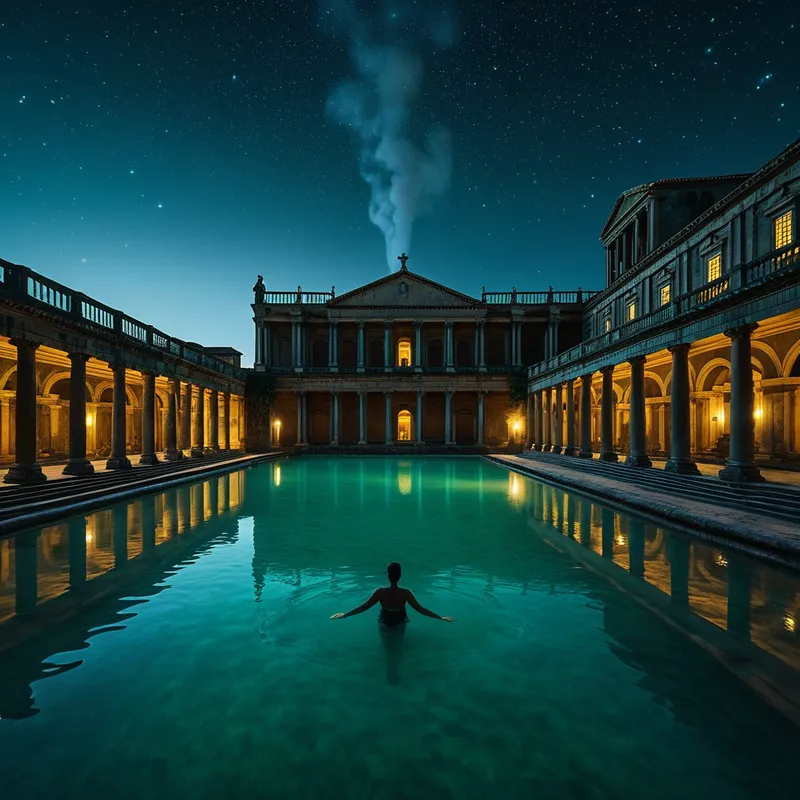
The Roman baths of Aquae Sulis Myth Meaning & Symbolism
A sacred spring where Roman engineering and Celtic divinity merge, creating a liminal space of healing, curse, and profound psychological integration.
The Tale of The Roman baths of Aquae Sulis
Listen. The land remembers. Before the straight roads, before the stone gods with their marble eyes, the earth here spoke in steam and song. From a deep, dreaming crack in the world, the water boiled forth—not with fury, but with a mother’s patient heat. It was a place of threshold, where the veil between worlds was thin as mist. The people of the oaks knew it. They called her Sulis, and she was not a gentle nymph of the shallows. She was an eye. A seer. Her waters did not merely cleanse the limb; they saw into the soul. To bathe here was to be witnessed, to have your secret wounds laid bare in her geothermal light.
Then came the men of the eagle. They marched with measured steps, their minds full of lines and laws. They felt the power—a tangible hum in the humid air, a potency that could not be ignored. They saw not a wild goddess, but a resource. A marvel. And so, with the relentless logic of empire, they began to build. They channeled the steaming flow into great stone pools, laid precise floors of lead, and raised a temple of perfect proportions to their own Minerva. They called the place Aquae Sulis. But the land did not yield its genius so easily.
A strange alchemy occurred. The Roman engineers, in their attempt to harness, found themselves invoking. The name they chose was not a replacement, but a fusion: Sulis Minerva. The temple stood, classical and severe, yet the prayers that rose with the steam were of a different texture. Pilgrims came, their bodies aching, their hearts heavy. They descended the steps into the great green caldarium, the heat seeping into marrow, the mineral-rich water a liquid embrace. Here, in this architectural womb, a silent drama unfolded. Healing was sought, yes. But so was justice.
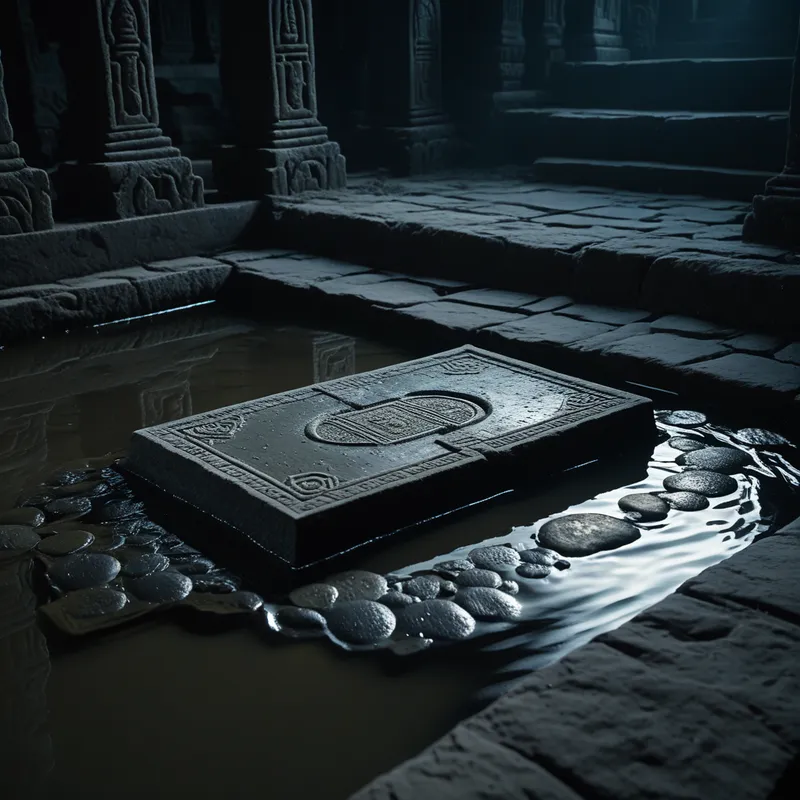
For at the water’s edge, in the soft, receptive silt, another ritual took place. Fingers, trembling with rage or grief, pressed thin sheets of lead into the mud. On these tablets, scratched with curses, were poured out the poison of the human heart: “To Sulis Minerva. I give to your divinity the thief who stole my cloak… let him who stole my coins be drained of his own blood… may he who wronged me be unable to sleep.” The injustice, too petty for a Roman court, was laid before the ancient eye of the spring. The curse was not thrown into the water, but entrusted to it—a secret fed to the consuming, remembering deep. The bathhouse echoed with the sounds of social order—conversation, commerce, the slap of wet feet on stone. But beneath it all, in the sacred dark where the spring welled up, the old magic listened, and held every whispered grievance in its geothermal memory.
Cultural Origins & Context
The mythos of Aquae Sulis is not a single narrative poem but a living, layered reality born at the collision—and collusion—of two worlds. Its “culture” is precisely this liminal, hybrid space: the Romano-Celtic frontier of Britannia in the 1st to 4th centuries CE. The myth was not passed down by bards in a hall, but enacted daily by thousands of bodies and inscribed in lead and stone.
The primary “storytellers” were the pilgrims, soldiers, merchants, and citizens who used the complex. The ritual of bathing was a social and religious act, a performance of Roman civilitas. Yet, the votive offerings—coins, jewelry, and most tellingly, the curse tablets (defixiones)—reveal a persistent, underlying Celtic worldview. These tablets, over 130 of which have been recovered, are raw psychological documents. They show a populace using a Roman framework (writing in Latin, invoking a hybrid deity) to access a profoundly Celtic concept of justice: immanent, poetic, and administered by a chthonic deity intimately connected to place. The societal function was dual: it was a center for civic Roman life and hygiene, and a timeless sanctuary for personal crisis, where the powerless could seek supernatural redress, integrating the individual’s shadow into the community’s sacred space.
Symbolic Architecture
At its core, the myth of Aquae Sulis is a supreme symbol of integration without assimilation. It represents the meeting point of conscious structure and unconscious power.
The Roman bath complex symbolizes the ego and the persona—the constructed self, civilized, ordered, and social. It is logic, engineering, and the public face. The sacred spring of Sulis represents the untamed collective unconscious—the wild, prophetic, healing, and vengeful depths of the psyche that precede and underpin all consciousness. It is the raw, thermal truth of being.
The true temple is built not where the wild is conquered, but where its steam is channeled into pillars of meaning.
The fusion deity, Sulis Minerva, is the archetypal image of the transcendent function. She is wisdom (Minerva) that arises from the deep, thermal springs of instinct and intuition (Sulis). The curse tablets are a stunning symbol of psychic excretion—the process of consciously depositing one’s toxic, unresolved emotions (rage, betrayal, humiliation) into a contained, sacred vessel of the unconscious, rather than letting them fester within or explode destructively in the outer world.
The Dreamer’s Resonance
To dream of the Baths of Aquae Sulis is to dream of a profound somatic and psychological process of heated integration. The dreamer is likely at a point where a long-held, civilized adaptation of the self (the Roman bath) is being challenged or permeated by a rising, thermal truth from the depths (the spring).
The somatic sensation is often one of immersion in uncomfortably warm, mineral-rich water—a feeling of being penetrated, softened, and chemically altered. Architecturally, the dream may feature modern structures (a gym, a spa, a public pool) that suddenly reveal ancient, mossy stonework or a bottomless, green-lit source at their center. This signals the ego’s modern framework being breached by archaic contents.
The critical action in the dream mirrors the myth: the dreamer may be compelled to write something down and hide it in the water, or to speak a secret aloud into the steam. This represents the psyche’s innate drive to confess, to “curse” (i.e., to formally acknowledge) a hidden injustice, wound, or resentment to a higher, witnessing authority within oneself. The process is not about vengeance, but about the visceral relief of being seen in one’s full complexity—both the civilized bather and the cursing supplicant.
Alchemical Translation
The alchemical process modeled here is the solve et coagula—dissolve and coagulate—applied to the psyche. The Roman ego-structure (the coagula, the hardened form) is dissolved in the aqua permanens, the eternal water of Sulis. This is not a destruction, but a necessary return to the primal, chaotic, and healing matrix.
Individuation requires a sacred plumbing: a conscious structure to safely channel the eruptive, transformative powers of the deep.
The modern individual’s “bath complex” is their carefully constructed identity, career, and worldview. The “spring” is the upwelling of forgotten trauma, repressed creativity, or instinctual truth that threatens to crack the neat tiling. The alchemical work is to do as the Romans did: to build a temenos, a sacred precinct (through therapy, art, ritual, or deep reflection) around that erupting source. One must invite the hybrid deity—Sulis Minerva, the integrated self—to preside.
The “curse tablet” ritual is the key operation. It translates to the conscious, embodied act of giving form to one’s shadow material—writing the unsent letter, articulating the old grievance in a journal, or symbolically offering one’s resentment to something greater than the personal ego. This act deposits the leaden, poisonous weight of the complex into the transformative waters of the unconscious. There, over the slow, geothermal time of the psyche, it can be worked upon, not by the ego’s will, but by the soul’s own mysterious processes. What returns is not necessarily the stolen cloak, but something far more valuable: a self that has acknowledged its own depth, and in doing so, has built a more authentic and resilient temple upon it.
Associated Symbols
Explore related symbols from the CaleaDream lexicon: