
The River Styx in Greek mythol Myth Meaning & Symbolism
The sacred river of oaths and the boundary of the Underworld, where gods swear unbreakable vows and souls are ferried into the realm of Hades.
The Tale of The River Styx in Greek mythol
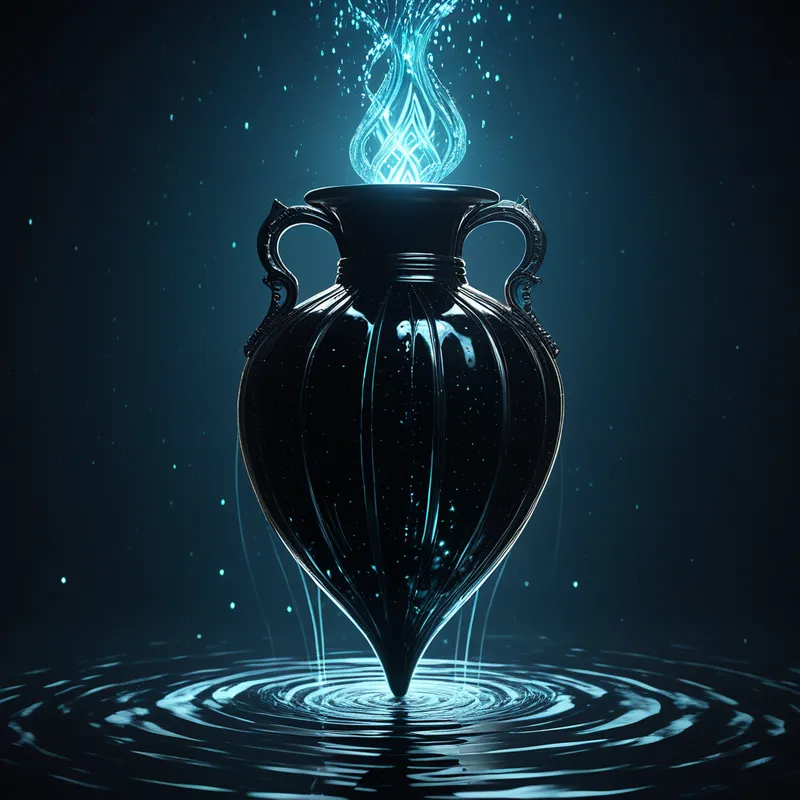
Listen, and hear of the waters that even the deathless ones fear. Not in the sun-drenched world of mortals does it flow, but deep in the belly of the earth, in the realm of Hades. This is the River Styx, the eldest daughter of Oceanus and Tethys. Its course is a coiled serpent of blackness, winding through caverns of eternal twilight, its surface a mirror that shows no reflection, only a profound and chilling void.
The air here is still and heavy, carrying the faint, cold scent of wet stone and forgotten things. This river is the great boundary, the final line between the world of the living and the silent kingdom of the dead. To cross it is to pass beyond all hope of return. And at its banks waits a figure of grim patience: Charon, ancient and hooded, his hand outstretched for the coin placed on the tongues of the deceased. Without it, a soul must wander the desolate shore for a hundred years, a whisper among the reeds.
But the Styx holds a power greater even than its role as the threshold of death. For the gods themselves, in their celestial disputes, descend to its dreadful shore when an oath of ultimate consequence must be sworn. Zeus himself decreed it so. When a god dips a hand into these black waters and speaks a vow, that oath becomes unbreakable, woven into the fabric of fate itself. To break it means a fall from grace so severe the offender must lie breathless and senseless for a great year, exiled from the nectar of the gods and the council of Olympus.
It is said the goddess Styx was the first to side with Zeus in his war against the Titans. In gratitude, he honored her above all, making her waters the instrument of divine law. And in a later age, a desperate mortal mother, the sea-nymph Thetis, sought its power. Seeking to make her son invulnerable, she grasped the infant Achilles by the heel and submerged him in the sacred current. Where the waters touched, his skin became impervious to weaponry, a living armor. But where her fingers held him, at his heel, the mortal flesh remained—a single point of vulnerability in a body forged by the river of oaths, a secret that would echo through history on the plains of Troy.

Cultural Origins & Context
The myth of the Styx originates in the deep, collective imagination of ancient Greece, crystallizing in the epic poetry of Homer and the systematizing works of Hesiod. It was not a single story told around a fire, but a foundational piece of cosmological architecture. Bards and poets wielded it as a narrative tool of immense gravity. To invoke the Styx was to invoke the ultimate stakes, the finality of death, and the most serious possible commitment.
Its societal function was multifaceted. On one level, it provided a vivid, sensory map of the afterlife, giving shape to the abstract terror of death as a tangible journey with a price (Charon’s obol) and a destination. On another, far more crucial level for the living, it served as the bedrock of divine—and by extension, human—ethics. The concept of the unbreakable Stygian oath established a higher order of truth and consequence, a cosmic law that even the gods could not circumvent. It modeled the ultimate price of betrayal and the sacred nature of a promise, reinforcing the cultural imperative of horkos (oath) that bound Greek society, from treaties between city-states to personal vows.
Symbolic Architecture
The River Styx is not merely a location; it is a living symbol of the ultimate threshold. It represents the point of no return, the irreversible transition from one state of being to another. Psychologically, it maps onto every profound transformation that requires the “death” of an old self: the end of innocence, the commitment of marriage, the facing of a deep truth, or the confrontation with one’s own mortality.
The river that divides the worlds is also the mirror that shows no reflection; to cross it is to lose the image of who you were.
Its black, reflective waters symbolize the unconscious itself—deep, unknown, and holding the power to dissolve and reconstitute identity (as with Achilles’ immersion). Charon is the psychopomp, the inner guide or necessary function that facilitates this difficult passage, but only when the ego has paid its due (the coin of acceptance or conscious effort). The unbreakable oath sworn upon it represents the moment a psychological complex or a life decision becomes irrevocably binding, integrated into the core of one’s being, with severe consequences for its violation.
The Dreamer’s Resonance
When the River Styx flows through modern dreams, it rarely appears as a classical mythological tableau. Instead, it manifests as the dreamer’s personal boundary of the unknown. One might dream of standing before a wide, black lake at night, needing to board a ferry but having no ticket. Or of a crucial, dark body of water blocking the path in a familiar landscape. The somatic feeling is often one of cold dread, profound hesitation, and awe.
This dream imagery signals a psyche at a critical juncture. The dreamer is facing an internal or external transition that feels absolute and frightening. It may relate to ending a relationship, changing a career, accepting a painful truth, or grappling with existential questions about life’s purpose or end. The dream is the soul’s way of presenting the threshold in its raw, archetypal form. The struggle is not with the river itself, but with the act of commitment to the crossing—the payment to Charon, which symbolizes the sacrifice of an old attitude, comfort, or self-concept required to move forward.

Alchemical Translation
The alchemical process mirrored in the Styx myth is the nigredo—the blackening, the descent into the prima materia, the essential, dark phase of dissolution that precedes transformation. The journey to the Underworld is the necessary descent of the ego into the unconscious. One does not achieve individuation—the psychic wholeness—by staying in the light of conscious identity alone.
To swear an oath on these waters is to commit the total self to a process, knowing the price of failure is a psychic paralysis, a spiritual coma.
The ritual of the divine oath translates to the modern individuation process as the conscious, solemn commitment to self-knowledge. It is the act of vowing to confront one’s shadow, to integrate the rejected parts of oneself, no matter how dark or difficult. The “invulnerability” granted to Achilles (save for the held heel) symbolizes the resilience and authenticity gained from integrating the transformative power of the unconscious. The held heel, however, is crucial—it is the part of oneself withheld from the process, the blind spot, the complex that remains untouched and therefore becomes the point of fatal vulnerability. The alchemical lesson is that total immersion, total commitment to the crossing, is required. One must be willing to let the old self die in the black waters to be reconstituted, not as an invulnerable hero, but as a more complete, authentic human, capable of navigating both the upper and lower worlds of the psyche.
Associated Symbols
Explore related symbols from the CaleaDream lexicon: